Trenchless Sewer Line Repair in Toronto: Pipe Lining (CIPP) vs Pipe Bursting Compared
By Serhiy Marunchuk, Master Plumber · Licence T95-4969603 · Updated August 17, 2026
Pipe lining (CIPP) cures a resin-saturated liner inside the existing pipe to form a new pipe within the old. Pipe bursting pulls a new HDPE pipe through the old, fracturing the old outward. Both avoid open-cut on the bulk of the run; Toronto pricing $200–$420 per foot installed.
Published February 26, 2026 · Last updated August 17, 2026
On this page
Related services
Get a free estimate
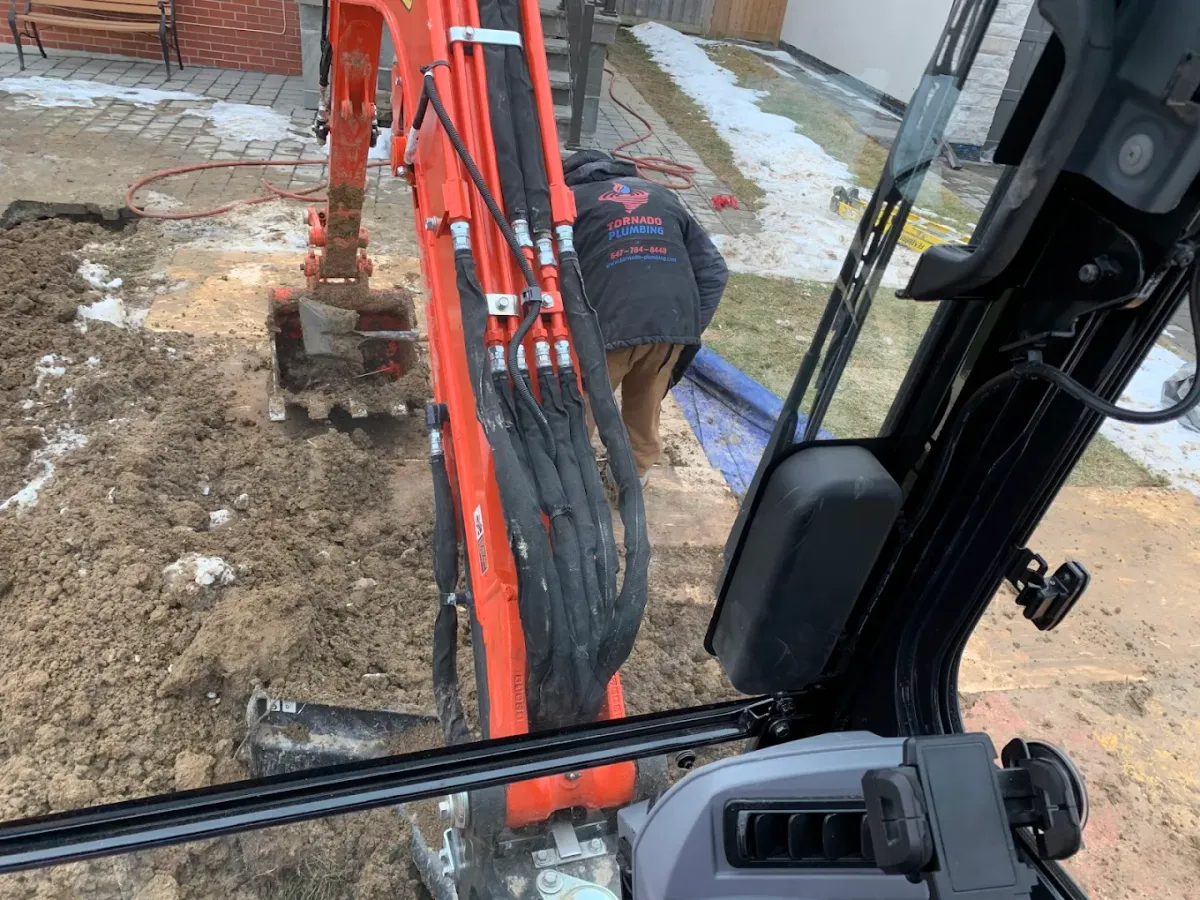
Introduction
Trenchless sewer repair is the technology that lets a Toronto homeowner replace 60 feet of failing clay sewer line under a finished driveway without a backhoe trenching the whole route. Two methods dominate: CIPP (cured-in-place pipe) lining and pipe bursting. Each suits a specific situation. This guide explains how each works, when each is right, what they cost in 2026 Toronto, and the camera inspection that decides between them. If you need the work handled rather than researched, see trenchless sewer line repair Toronto for pricing, process, and booking. Every trenchless quote starts with a drain camera inspection, and where damage is limited to one section, conventional sewer line repair may cost far less.
Related services for this guide
If this article matches what you are dealing with, use one of these links to move into the service or broader category that makes the most sense.
Project photos related to this guide
These real project photos help show what this kind of work looks like in the field, not just on the page.
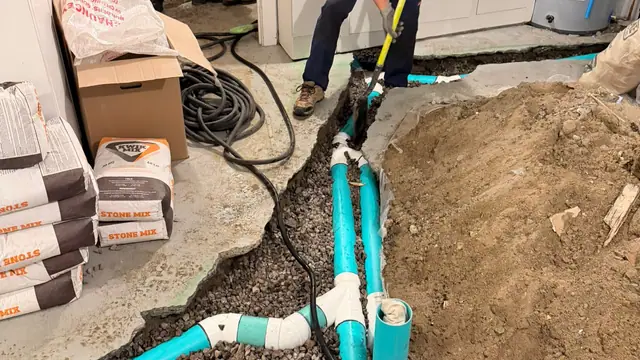
Basement floor opened to replace the under-slab drain lines
Interior drain re-piping, August 2026. The slab was cut along the drain route, the old lines removed, and new PVC drain connections laid on gravel with stub-ups for the fixtures above.
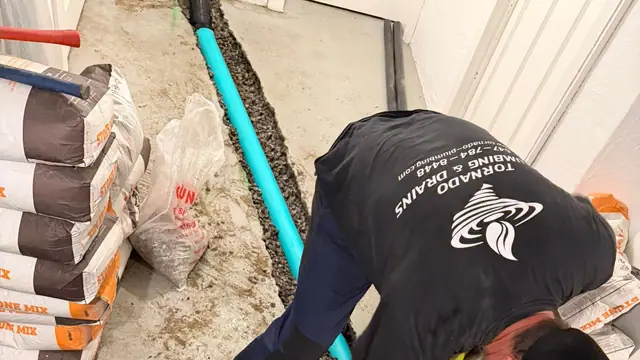
Bedding the new basement drain run in gravel
Same August 2026 basement drain project: each fitting is supported and the run is bedded in clear gravel before restoration, so the slope set during installation does not move.
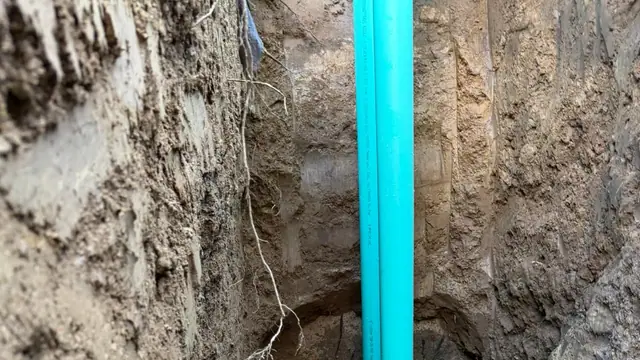
Finished connection: new PVC lateral, shielded couplings and cleanout stub before backfill
Completed connection on the August 2026 lateral replacement: the new pipe meets the existing line on shielded couplings, with a cleanout stub left accessible at grade.
Customer stories related to this topic
These customer stories pair real review quotes with the service pages most closely related to this guide.
Zeu Ming Wong
September 2024“Our house is over a hundred years old and wear and tear was showing on the plumbing. Even though it was a non-urgent situation, the whole process was very quick. We wholeheartedly agree with all the positive reviews for this company. Serhiy assessed the project, provided a reasonable quote and oversaw its completion efficiently. They replaced part of the main stack, lines to the laundry tubs, and the main drain from the basement to the city line in three days. It was a pleasure to watch their teamwork, all of them working hard and competently to complete the job. We think this is a high quality team that we can recommend without any hesitation.”
Most relevant to Drain & Sewer Services in Toronto & the GTA.
Google place photo: Tornado Plumbing & DrainsAndrea Kelly
August 2023“Drain Fix and Clean Out Installation Serghiy is absolutely amazing! When I had a drain backup, he promptly arrived and efficiently fixed the issue with precision and care. His professionalism, expertise, and friendly demeanour were evident throughout the process. Serghiy not only resolved the immediate problem but also provided helpful maintenance tips and installed a clean out to make it easier to access in the future. I highly recommend him for any plumbing needs his top-notch service and commitment to customer satisfaction make him the go-to plumber. Thanks, Serghiy!”
Most relevant to Drain & Sewer Services in Toronto & the GTA.
Google place photo: Tornado Plumbing & DrainsAlex Edelchteine
July 2026“Great service from Serhiy. He came out within a few hours of contacting him. Cleaned tree roots out of the main drainage pipe all the way to the street and showed me on the camera where there were issues. He also gave options for a more permanent fix and went over available rebates. Will definitely use his services in the future.”
Most relevant to Drain & Sewer Services in Toronto & the GTA.
Google place photo: Tornado Plumbing & DrainsRead next in this topic
These related guides help you compare cost, scope, and next steps without starting over.
Best local service areas for this topic
Use one of these city pages when you want the same problem explained through local housing, flood risk, access, and neighbourhood-specific plumbing context.
Licensed, insured, reviewed Toronto plumbers
Serving Toronto & the GTA since 2015 — over 1,200 completed jobs.
Master plumber T95-4969603 · Plumbing contractor T94-4992639 · Drain contractor T87-4722944 · Building renovator T85-4728632 · Plumbing license FI6216638.
4.9-star Google rating from 320+ reviews. 400+ HomeStars reviews (Best of 2019–2025). BBB-accredited.
Same-day and after-hours dispatch across Toronto, Etobicoke, North York, Scarborough, York, Mississauga, and Burlington.
25-year workmanship warranty
Every job Tornado Plumbing & Drains completes in Toronto and the GTA — repair, install, replacement, drain work, sewer work, fixture work — is backed by a 25-year workmanship warranty. The written terms are provided with every quote. If our work fails within 25 years of the install date, we come back and make it right.
Quick answer
Pipe lining (CIPP) installs a resin-saturated felt liner inside the existing sewer line, which cures in place to form a new pipe within the old. Pipe bursting pulls a new HDPE pipe through the old, fracturing the old pipe outward. CIPP is faster (cures in 4–6 hours), preserves diameter, and works in PVC/ABS/cast iron/clay. Bursting needs entry and exit pits, can upsize diameter (e.g., 4″ to 6″), and works in any host material. Toronto pricing 2026: lining ~$200–$330/ft installed, bursting ~$280–$420/ft. Both avoid open-cut on the bulk of the run.
What you should know about each method
Pipe lining (CIPP): cures in 4–6 hours; minimum 4″ host pipe; preserves or slightly reduces diameter; works in PVC, ABS, cast iron, and clay.
Pipe bursting: requires entry and exit pits (~3' x 3' each); upsize diameter possible (e.g., 4″ to 6″); works in any host material.
Both methods avoid open-cut on the run itself, preserving driveway, lawn, and hardscape.
Camera inspection before and after is mandatory — confirms line is suitable, identifies obstacles, documents the result.
NASSCO PACP standard governs trenchless rehabilitation documentation; ask whether the report follows it.
Toronto plumbing permit and inspection are required for any sewer line trenchless repair.
Service life: CIPP liner ~50+ years (cured epoxy is structurally independent of the host pipe); HDPE bursting ~75+ years.
Pipe lining vs pipe bursting head-to-head
| Factor | CIPP Lining | Pipe Bursting |
|---|---|---|
| Surface disturbance | 1–2 access pits at cleanouts | 2 pits (entry + exit), 3' x 3' each |
| Diameter outcome | Preserves or slightly reduces (1/4″ wall) | Same or upsize (4″ to 6″ possible) |
| Host material requirement | Round, intact pipe (4″+ diameter) | Any material — clay, cast iron, ABS, PVC |
| Suitable for severe collapse | No | Sometimes (depends on collapse type) |
| Suitable for upsize | No | Yes |
| Time to complete | 1 day install + 4–6 hr cure | 1–2 days install |
| Cost (Toronto, 2026) | $200–$330 per foot installed | $280–$420 per foot installed |
| Service life | 50+ years | 75+ years |
| Permit required | Yes (Toronto) | Yes (Toronto) |
Picking the right method for your line
CIPP lining is the right call when
Pipe is mostly intact but has cracks, root intrusion, or hairline failures. Diameter is acceptable as-is. You want minimal disturbance and the fastest install. Multiple defects along the run benefit from continuous lining vs spot repairs.
Pipe bursting is the right call when
Pipe is severely deteriorated, partially collapsed, or significantly out-of-round. You want to upsize from 4″ to 6″ for higher capacity (older homes connecting to newer City sewer often benefit). Host pipe material is mixed (clay-cast iron-ABS) and lining wouldn't bond consistently.
What we recommend on the camera
We run the camera inspection, document defects with PACP coding, and quote both methods when both apply. CIPP is the default for most Toronto residential sewers in 2010s-and-later builds; pipe bursting is more common for pre-1955 clay-lateral homes where upsize delivers measurable benefit.
Why Toronto trenchless work has specific City coordination
Toronto plumbing permits are required for any sewer line trenchless repair, with City inspector sign-off before backfill. CIPP lining and pipe bursting are established no-dig methods routinely approved under Toronto plumbing permits. Mature street-tree canopy in older neighbourhoods (Cabbagetown, Riverdale, Roncesvalles, the Beaches) makes trenchless particularly valuable — preserves trees, driveways, and finished hardscape. We coordinate the permit and inspection as part of the install scope; Ontario One Call locate is required before any pit excavation.
Sources cited in this guide
- NASSCO — Trenchless rehabilitation standards(industry)
- City of Toronto — Sewer permits(city)
- Ontario One Call — Locates(regulator)
Where to go next
When the situation in this guide already matches what we cover, Pipe Lining (CIPP) / Sewer Pipe Relining is the page where you book the visit and see the full scope, pricing, and warranty.
Lining and bursting are the right tools for some Toronto sewers, the wrong ones for others. The Drain & Sewer Services category lays out every method — spot repair, full open-cut replacement, rerouting — so you can see the alternatives before you sign.
Ready to book or compare
If the camera footage already shows what's going on with your line, Trenchless Sewer Line Repair is the booking page. If the camera shows damage trenchless can't fix, Sewer Line Replacement is the alternative — we tell you which one fits before you sign.
Common questions
When is trenchless the wrong call and I should book the camera first?
Book the camera first when you don't know if the host pipe is sound. Trenchless lining needs round, intact pipe to bond against; pipe bursting needs a path that the bursting head can follow. If the camera shows a fully collapsed section, severe offset, or a sharp lateral that the rig can't navigate, trenchless stops being an option and open-cut replacement is the honest answer.
Should the camera run again after the trenchless work is done?
Yes — post-install camera footage is what confirms the liner cured to the host pipe with no wrinkles, voids, or service-tap obstructions, or that the new HDPE pulled cleanly with no kinks at lateral joints. Without it you don't know the work succeeded; with it you have a baseline for any future inspection.
Is the work warrantied?
Yes. Every job we complete is backed by a 25-year workmanship warranty. The written terms are provided with the quote. If our work fails within 25 years of the install date, we come back and make it right.
Are you licensed in Toronto?
Yes — Master plumber T95-4969603, Plumbing contractor T94-4992639, Drain contractor T87-4722944, Building renovator T85-4728632, Plumbing license FI6216638. Tornado has been serving Toronto and the GTA since 2015 with over 1,200 completed jobs.
Explore more