Sewer Line Repair Guide for Toronto Homes: Warning Signs, Repair Methods, and Real Cost Factors
By Serhiy Marunchuk, Master Plumber · Licence T95-4969603 · Updated August 17, 2026
The earliest warning signs of Toronto sewer line failure are recurring backups, gurgling drains, slow drainage at multiple fixtures, sewage smell, and lush patches of grass over the sewer route. Repair options range from spot repair ($2,500–$5,500) to trenchless lining ($6,000–$14,000) to full replacement ($8,000–$25,000+).
Published February 26, 2026 · Last updated August 17, 2026
On this page
Related services
Get a free estimate
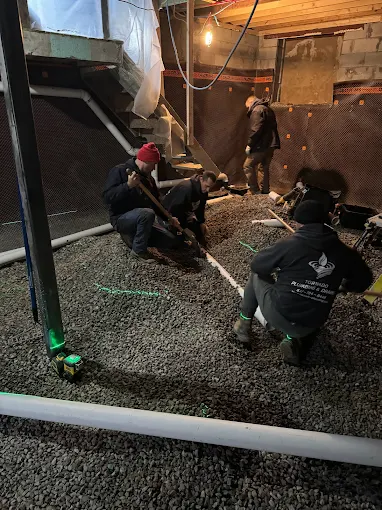
Introduction
Toronto sewer mains were installed in clay (pre-1970), cast iron (1950s–80s), or ABS (1980+), and each fails in characteristic ways. Clay laterals are vulnerable to root intrusion through joints; cast iron rots from the bottom; ABS pulls at joints when soil settles. This guide explains the warning signs, what each material's failure pattern looks like on camera, and the real 2026 Toronto pricing for spot repair, trenchless lining, and full replacement. If you need the work handled rather than researched, see sewer line repair Toronto for pricing, process, and booking. Diagnosis starts with a drain camera inspection, and where the line qualifies, trenchless sewer line repair avoids digging up the yard entirely.
Related services for this guide
If this article matches what you are dealing with, use one of these links to move into the service or broader category that makes the most sense.
Project photos related to this guide
These real project photos help show what this kind of work looks like in the field, not just on the page.
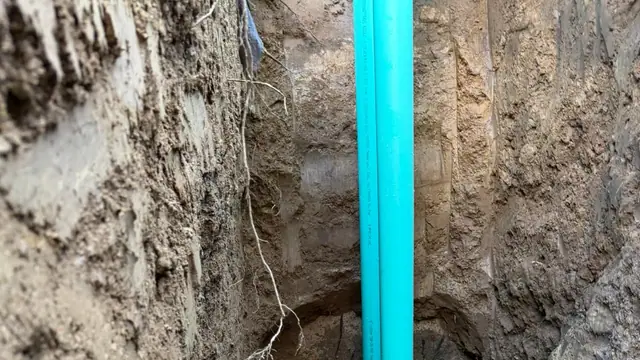
Finished connection: new PVC lateral, shielded couplings and cleanout stub before backfill
Completed connection on the August 2026 lateral replacement: the new pipe meets the existing line on shielded couplings, with a cleanout stub left accessible at grade.
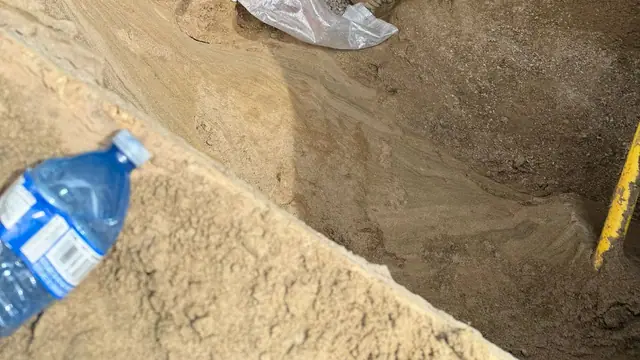
New sewer lateral bedded in gravel at the bottom of the excavation
Open-cut sewer lateral replacement, August 2026. The old line was removed and the new run was laid on gravel bedding and tied to a green PVC riser that becomes the accessible cleanout for future camera and cleaning work.
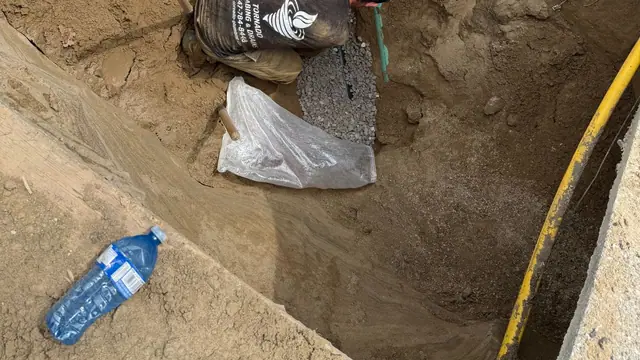
Tying the new lateral into the cleanout riser inside the excavation
Same August 2026 lateral replacement: the cleanout riser is connected to the new pipe before backfill so the line can be inspected without digging again.
Customer stories related to this topic
These customer stories pair real review quotes with the service pages most closely related to this guide.
Andrea Kelly
August 2023“Drain Fix and Clean Out Installation Serghiy is absolutely amazing! When I had a drain backup, he promptly arrived and efficiently fixed the issue with precision and care. His professionalism, expertise, and friendly demeanour were evident throughout the process. Serghiy not only resolved the immediate problem but also provided helpful maintenance tips and installed a clean out to make it easier to access in the future. I highly recommend him for any plumbing needs his top-notch service and commitment to customer satisfaction make him the go-to plumber. Thanks, Serghiy!”
Most relevant to Drain & Sewer Services in Toronto & the GTA.
Google place photo: Tornado Plumbing & DrainsDawn Stocks
May 2021“Peter was great. He kept me updated on time of arrival, pointed out the problems with my main drain and gave me a quote on the spot. No pressure to do more work and he was inexpensive.”
Most relevant to Drain & Sewer Services in Toronto & the GTA.
Google place photo: Tornado Plumbing & DrainsDale Howey
September 2020“Tornado was very quick to get back to me after I called to get a quote on a drain issue and arranged to come on-site the next day. Troy was very careful to contain any mess and describe the work done in detail. I wouldn't hesitate to use them again.”
Most relevant to Drain & Sewer Services in Toronto & the GTA.
Google place photo: Tornado Plumbing & DrainsRead next in this topic
These related guides help you compare cost, scope, and next steps without starting over.
Best local service areas for this topic
Use one of these city pages when you want the same problem explained through local housing, flood risk, access, and neighbourhood-specific plumbing context.
Licensed, insured, reviewed Toronto plumbers
Serving Toronto & the GTA since 2015 — over 1,200 completed jobs.
Master plumber T95-4969603 · Plumbing contractor T94-4992639 · Drain contractor T87-4722944 · Building renovator T85-4728632 · Plumbing license FI6216638.
4.9-star Google rating from 320+ reviews. 400+ HomeStars reviews (Best of 2019–2025). BBB-accredited.
Same-day and after-hours dispatch across Toronto, Etobicoke, North York, Scarborough, York, Mississauga, and Burlington.
25-year workmanship warranty
Every job Tornado Plumbing & Drains completes in Toronto and the GTA — repair, install, replacement, drain work, sewer work, fixture work — is backed by a 25-year workmanship warranty. The written terms are provided with every quote. If our work fails within 25 years of the install date, we come back and make it right.
Quick answer
The earliest warning signs of sewer line failure in Toronto: recurring backups, gurgling drains, slow drainage at multiple fixtures, sewage smell in the basement, lush patches of grass over the sewer route. Repair options: spot repair ($2,500–$5,500), trenchless lining/CIPP ($6,000–$14,000), full replacement ($8,000–$25,000+). Camera inspection ($350–$650) is the diagnostic that decides which. Toronto plumbing permit required for any repair beyond a spot point repair.
How much does sewer line repair cost in Toronto (2026)?
Sewer line repair in Toronto costs $2,500-$5,500 for a spot repair, $6,000-$14,000 for trenchless lining (CIPP), or $8,000-$25,000+ for full replacement. A camera inspection ($350-$650) is the diagnostic that decides which method you need, and a Toronto permit ($190-$850) is required for anything beyond a spot repair.
Toronto sewer material failure modes
Clay laterals (pre-1970): vulnerable to root intrusion through joints, separated joints, and crack development.
Cast iron (1950s–80s): vulnerable to bottom-channel rot (waste flow at the bottom corrodes the iron from inside), tubercular scale, and structural collapse at the failure point.
ABS (1980 forward): generally durable; pull-out at joints is the failure mode, often from soil settlement.
Recurring backups within 6–12 months of a cleaning almost always mean a structural issue (root intrusion, belly, crack), not a clog.
Camera inspection (~$350–$650) is the only objective way to confirm what's wrong and choose the correct repair.
Toronto plumbing permit required for any sewer line repair beyond a spot point repair. Permit fees: $190–$850.
Mature street-tree canopy over Toronto sewer routes is why root intrusion is so common in this city — much more than newer suburban GTA.
Warning signs and what they usually mean
| Sign | Most likely cause | Right next step |
|---|---|---|
| Recurring backups (>1 in 12 months) | Structural issue, not just clog | Camera inspection → repair scope |
| Gurgling drains during normal use | Vent or partial blockage | Diagnostic, snake or jet |
| Slow drainage at multiple fixtures simultaneously | Main line partial blockage or sag (belly) | Camera + jet |
| Sewage smell in basement | Vent issue, dry trap, or cracked line | Vent inspection + camera |
| Lush patches of grass over sewer route | Active leak fertilizing the lawn | Camera + locate, then repair |
| Toilet bubbles when laundry runs | Main line near-blocked | Camera + clean, possible repair |
| Pavement settling over sewer route | Pipe collapse or large leak | Camera + repair (often replacement) |
Spot repair vs trenchless vs replacement
Spot repair when
Camera shows a single isolated defect (one cracked section, one root mass, one offset joint). The rest of the line is in good condition. Repair section is accessible without major surface restoration.
Trenchless lining when
Multiple defects along the run, but pipe is mostly intact and round. You want to preserve the surface above (driveway, mature lawn, hardscape). Want a long-term fix that doesn't disturb landscaping.
Full replacement when
Camera shows continuous deterioration, multiple breaks, severe collapse, or the line has reached end-of-service. Open-cut required for shallow service or under load-bearing structures. Pipe bursting (trenchless replacement) preserves the surface and can upsize.
Why Toronto sewer repairs follow specific patterns
Toronto's older neighbourhoods (pre-1970 builds — Cabbagetown, Riverdale, the Beaches, Roncesvalles, the Annex) have clay sewer laterals that are at the upper end of their service life. Combined with mature street trees that target the smallest joint they can find, root intrusion is the #1 sewer-repair driver in this city. Mid-century homes (1950s–80s) often have cast iron at the property line transitioning to clay or to the City sewer — the cast iron is in similar end-of-life territory. Newer suburban GTA (1980+) is mostly ABS and PVC and rarely needs structural repair. We see the failure patterns clearly in our 1,200+ Toronto sewer inspections; what looks like 'just another clog' to the homeowner is often a structural failure that camera footage immediately confirms.
Sources cited in this guide
- City of Toronto — Sewer permits(city)
- NASSCO — Pipeline Assessment Certification Program(industry)
- Ontario One Call — Locates(regulator)
Where to go next
When the situation in this guide already matches what we cover, Sewer Line Repair is the page where you book the visit and see the full scope, pricing, and warranty.
Repair, replacement, lining, bursting, and rerouting are five different answers to a sewer problem. The Drain & Sewer Services category shows them side by side with what each one is suited for — and what it's not.
Turn the diagnosis into a real route
If the warning signs in this guide match what you're seeing on your property, Sewer Line Repair is the booking page. If the camera ends up showing damage in multiple sections, Sewer Line Replacement becomes the honest answer — we don't repair what's beyond repair.
Common questions
When does a sewer-line problem stop being a 'maybe later' decision?
When you have any of these: a backup that returns within weeks of cleaning, slow drainage in multiple fixtures, gurgling at a basement floor drain when an upstairs toilet flushes, a wet patch over the sewer route, or a camera showing 25%+ diameter loss, an offset, or a belly holding water. Those are calls to make this month, not next year.
Should I camera the line after the repair to confirm it held?
Yes — post-repair camera footage is the only way to confirm the new section is properly seated, sloped, and bonded. It also gives you a baseline so when slow drainage shows up in 5 years you can see if it's the repaired section or something further down the line.
Is the work warrantied?
Yes. Every job we complete is backed by a 25-year workmanship warranty. The written terms are provided with the quote. If our work fails within 25 years of the install date, we come back and make it right.
Are you licensed in Toronto?
Yes — Master plumber T95-4969603, Plumbing contractor T94-4992639, Drain contractor T87-4722944, Building renovator T85-4728632, Plumbing license FI6216638. Tornado has been serving Toronto and the GTA since 2015 with over 1,200 completed jobs.
Explore more