AC Condensate Drain Line Clog in Toronto: Signs, Causes, and How to Clear It Safely
By Serhiy Marunchuk, Master Plumber · Licence T95-4969603 · Updated August 17, 2026
What actually clogs a Toronto AC condensate drain line — algae and biofilm in a small, always-wet PVC line — and how to tell a clogged condensate line apart from a backed-up floor drain or a real plumbing leak before you call.
Published June 15, 2026 · Last updated August 17, 2026
On this page
Related services
Get a free estimate
Introduction
When your air conditioner stops cooling on a humid Toronto afternoon and there's water pooling around the furnace, the cause is often the part nobody thinks about: the AC condensate drain line. As the evaporator coil pulls moisture out of the air, that water has to go somewhere — usually a small 3/4" PVC line that drips to a floor drain or condensate pump. Because that line carries standing water in a dark, warm space, algae and biofilm grow inside it and eventually block it. This guide explains how to tell a clogged condensate line apart from a backed-up floor drain or a real plumbing leak, what the safety float switch is doing when the AC won't run, and when the problem crosses from a quick clear into drain and sewer work. If the floor drain itself turns out to be the blockage, professional drain cleaning — with a camera inspection for repeat clogs — sorts it out quickly.
Related services for this guide
If this article matches what you are dealing with, use one of these links to move into the service or broader category that makes the most sense.
Project photos related to this guide
These real project photos help show what this kind of work looks like in the field, not just on the page.
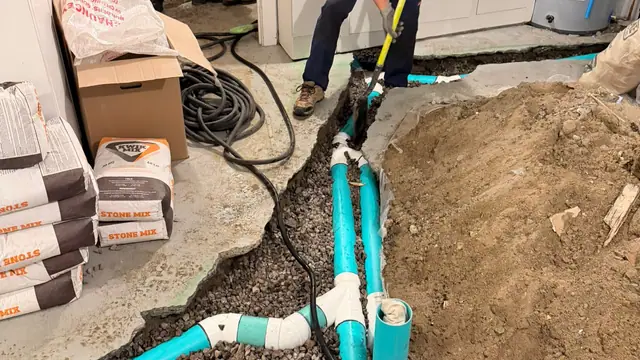
Basement floor opened to replace the under-slab drain lines
Interior drain re-piping, August 2026. The slab was cut along the drain route, the old lines removed, and new PVC drain connections laid on gravel with stub-ups for the fixtures above.
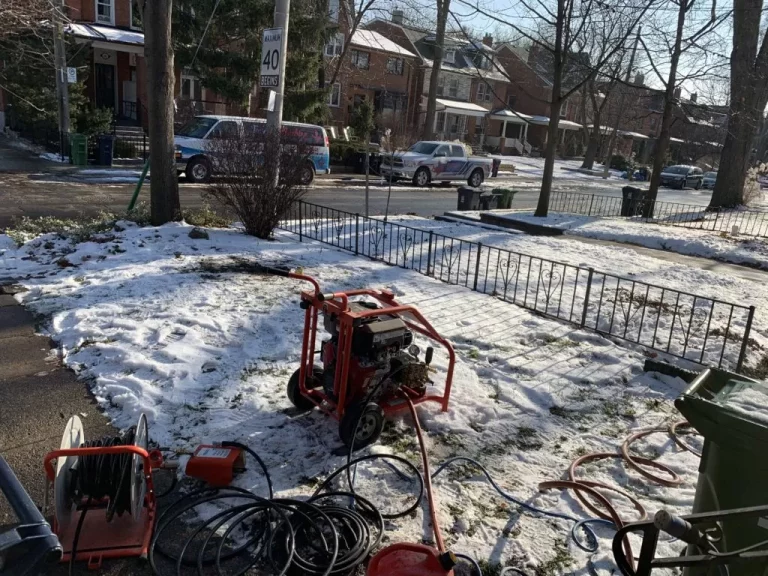
Drain-cleaning equipment set up before line clearing
This image shows the equipment-prep stage of a drain-clearing job, where the line condition still needs to be confirmed before it is obvious whether cleaning alone will solve it.

Close-up of drain access and service equipment
This photo focuses on the actual drain access point and the equipment staged to inspect and clear the affected line.
Customer stories related to this topic
These customer stories pair real review quotes with the service pages most closely related to this guide.
kevin
May 2024“I had a cast iron stack in my bsmt with a huge crack that was just about to give out. After obtaining a few quotes I decided to hire Tornado given the positive reviews, fair pricing, and there fast response time. The crew were here within an hour, very professional, worked quickly, and left the space immaculate. I recommend them without hesitation. Thank you Serhiy and crew!”
Most relevant to Sewer Line Repair in Toronto & the GTA.
Google place photo: Tornado Plumbing & Drains
“Highly recommend Tornado Plumbing. Serhiy is professional, punctual, and incredibly efficient. We had to get are main line corrected along with properly venting are current plumbing and a drain floor drain added for are laundry room. Serhiy and his team looked over the job, advised on some better recommendations to insure we proper flow. Work was completed, fully cleaned up. I’ll never recommend another plumber, one of the best in the city. Truly appreciate the honesty and quality work.”
Most relevant to Drain & Sewer Services in Toronto & the GTA.
Google place photo: Tornado Plumbing & DrainsBabar T. Karamat
August 2021“Peter from Tornado came well prepared for the job. We got power wash done. He did the work professionally and ensured through camera inspection that the line is fully cleaned and cleared after the wash was done. Would highly recommend Tornado to anyone needing a professional service at a reasonable price.”
Most relevant to Drain Camera Inspection in Toronto & the GTA.
Google place photo: Tornado Plumbing & DrainsRead next in this topic
These related guides help you compare cost, scope, and next steps without starting over.
Best local service areas for this topic
Use one of these city pages when you want the same problem explained through local housing, flood risk, access, and neighbourhood-specific plumbing context.
Licensed, insured, reviewed Toronto plumbers
Serving Toronto & the GTA since 2015 — over 1,200 completed jobs.
Master plumber T95-4969603 · Plumbing contractor T94-4992639 · Drain contractor T87-4722944 · Building renovator T85-4728632 · Plumbing license FI6216638.
4.9-star Google rating from 320+ reviews. 400+ HomeStars reviews (Best of 2019–2025). BBB-accredited.
Same-day and after-hours dispatch across Toronto, Etobicoke, North York, Scarborough, York, Mississauga, and Burlington.
25-year workmanship warranty
Every job Tornado Plumbing & Drains completes in Toronto and the GTA — repair, install, replacement, drain work, sewer work, fixture work — is backed by a 25-year workmanship warranty. The written terms are provided with every quote. If our work fails within 25 years of the install date, we come back and make it right.
Quick answer
An AC condensate drain line clog happens when algae and biofilm build up inside the small PVC line that carries water away from the evaporator coil. The first sign is usually the AC shutting off (a safety float switch cut the system to prevent overflow), water around the furnace or air handler, or a musty smell. A clear line drips steadily; a clogged one backs up into the pan. The fix is to clear the line and clean the pan — and to confirm where the line actually drains, because if it ties into a slow floor drain, the floor drain is the real problem.
Why did my AC shut off and now there's water near the furnace?
Your AC condensate drain line is clogged. Algae and biofilm block the small 3/4-inch PVC line, water backs up into the drain pan, and a safety float switch shuts the AC off to prevent overflow. The fix is to clear the line, clean the pan, and confirm the floor drain it empties into isn't itself slow.
How a Toronto condensate line clogs — and what it tells you
The condensate line is a small (commonly 3/4") PVC pipe that drains water the evaporator coil pulls out of humid air. It is almost always wet, dark, and warm — ideal conditions for algae and biofilm.
Algae and biofilm are the most common cause of a clog. Dust, drywall debris from a renovation, and rust flakes from an older pan can add to it.
Most modern systems have a safety float switch on the primary line or in the secondary pan. When water backs up, the float trips and shuts the AC off — so a system that won't cool is often a clog, not a broken compressor.
Two drainage setups are common in Toronto basements: a gravity line that drips to a nearby floor drain, and a condensate pump that lifts the water up to a drain. Each fails differently.
A clogged line overflows the drain pan. That overflow can stain or damage finished basement ceilings, drywall, and flooring before anyone notices.
If the line drains to a floor drain that is itself slow, clearing the condensate line alone won't hold — the floor drain has to be cleared too.
Condensate clog vs the things people mistake it for
| What you see | Likely cause | How to tell | What it usually needs |
|---|---|---|---|
| AC stops cooling, no obvious water | Float switch tripped by a backed-up condensate line | Reset clears it briefly, then it trips again; line is wet but not dripping at the outlet | Clear the condensate line and clean the pan |
| Water pooling around the furnace or air handler | Condensate pan overflowing past a clogged line | Water is at the indoor unit, not at a fixture or wall | Clear the line; check the pan and float for damage |
| Water at the floor drain when the AC runs | Condensate line drains to a slow or partly clogged floor drain | Floor drain is wet/standing whenever the AC cycles | Floor drain cleaning, then verify the condensate flow |
| Condensate pump runs constantly or overflows | Failed pump, stuck float, or a clogged pump discharge line | You hear the pump cycling but water level stays high | Pump service or replacement plus discharge-line clear |
| Wet wall, ceiling, or floor away from the unit | A real supply or drain leak, not condensate | Wetness is not near the AC unit or its drain path | Leak detection and plumbing repair |
| Sewer smell with the backup, not just musty | Backup is on the drain/sewer side, not the condensate line | Odour is sewer-like and other drains are slow too | Drain or sewer diagnosis with a camera |
When to clear it yourself and when to call
A homeowner can often handle
Power down the system at the thermostat and the disconnect first. If you can reach the condensate line's cleanout tee or the pan, you can vacuum the line from the outdoor or drain end with a wet/dry vacuum, flush the pan, and reset the float switch. Replacing a clogged in-line filter or pouring an approved condensate treatment tablet into the pan is also within reach for most people.
Call a professional when
The line clogs again within days of clearing it, the float switch keeps tripping, the condensate pump has failed, water has reached finished ceilings or drywall, the line ties into a floor drain that is itself slow, or you can't find or safely reach the line. Repeated clogs usually mean the drainage setup needs correcting, not just another flush.
What Tornado does on the visit
We confirm where the line actually drains, clear the line and clean the pan, test the float switch and (if present) the condensate pump, and check the floor drain or discharge point the line relies on. If the real bottleneck is the floor drain, we clear that too, so the fix actually holds through the cooling season rather than backing up again the next humid week.
Why this shows up so often in Toronto basements
Toronto summers are humid, so air conditioners and high-efficiency furnaces in cooling mode pull a lot of moisture out of the air — which means a lot of condensate moving through that small line all season. In many older Toronto homes the furnace and air handler sit in a finished or partly finished basement, and the condensate either drips to a basement floor drain or gets lifted by a small pump. Both setups share the same weak point: a narrow, always-wet line that algae loves. When that line blocks during a heat wave, the float switch stops the AC right when you need it, and any overflow lands on finished basement space. The reliable fix is not just clearing the line once — it's confirming the line's drainage point is healthy, since a condensate line is only ever as good as the drain it empties into.
Where to go next
When the condensate line drains to a basement floor drain that backs up, Floor Drain Cleaning is the page where you book the visit and see the full scope, pricing, and warranty for clearing the drain the line depends on.
If the backup isn't just the condensate line — slow drains elsewhere, sewer odour, or a problem deeper in the system — the Drain & Sewer Services category lists every diagnostic and repair option so the next step matches the real cause.
Stop the repeat backups, not just today's clog
If your AC keeps shutting off on a tripped float switch, the condensate line is telling you the drainage path is choked. Book Floor Drain Cleaning and we clear the line, the pan, and the floor drain it empties into — then verify the flow so it holds through the cooling season. If the trouble runs deeper than the condensate line, Drain & Sewer Services covers the diagnosis and the repair.
Common questions
Why does my AC turn off and then water shows up near the furnace?
That's the classic clogged-condensate-line pattern. As the line blocks, water backs up into the drain pan. A safety float switch senses the rising water and shuts the AC off to stop the pan from overflowing — but if the switch is missing or stuck, the pan overflows and you see water around the furnace or air handler. Clearing the line and cleaning the pan usually restores cooling; if it trips again quickly, the line's drainage point needs attention too.
Can I clear the condensate line myself?
Often, yes. Power the system down first, then use a wet/dry vacuum at the line's outdoor or drain-side end to pull the clog out, flush the pan, and reset the float. Approved condensate tablets in the pan help slow algae regrowth. Call a professional if it re-clogs within days, the float keeps tripping, a condensate pump has failed, water has reached finished surfaces, or the line empties into a slow floor drain — that usually means the setup needs correcting, not just another flush.
How do I know it's the condensate line and not a real plumbing leak?
Look at where the water is. Condensate problems show up at the AC unit, its drain pan, the floor drain it empties into, or the condensate pump — and they track with the AC running. A supply or drain leak shows up away from the unit, on walls, ceilings, or floors, and often regardless of whether the AC is on. If the wetness isn't on the condensate path, treat it as a leak and have it found and repaired rather than just clearing the line.
Is the work warrantied?
Yes. Every job we complete is backed by a 25-year workmanship warranty. The written terms are provided with the quote. If our work fails within 25 years of the install date, we come back and make it right.
Are you licensed in Toronto?
Yes — Master plumber T95-4969603, Plumbing contractor T94-4992639, Drain contractor T87-4722944, Building renovator T85-4728632, Plumbing license FI6216638. Tornado has been serving Toronto and the GTA since 2015 with over 1,200 completed jobs.
Explore more