Why Toronto Sewers Back Up During Heavy Rain — and What Actually Stops It
By Serhiy Marunchuk, Master Plumber · Licence T95-4969603 · Updated September 15, 2026
About 25% of Toronto is on combined sewer (sanitary + storm in one pipe), and that's the structural reason basements flood during intense storms. Property-level prevention works; the City pays up to $6,650 toward it.
Published March 28, 2026 · Last updated September 15, 2026
Introduction
Most Toronto homeowners discover the combined-sewer system the hard way — basement floor drain back-flowing during the worst storm of the summer, sewage on the basement floor, and a panicked search for what just happened. The actual answer is decades of municipal infrastructure history: Toronto's older neighbourhoods were built with combined sewers (one pipe carries both household waste and rainwater), and modern climate trends (heavier, more concentrated storms) overwhelm the system's design capacity. This guide explains the system, why it backs up, and what works at the property level to stop it. If sewage is coming up right now, call our emergency plumbing service; for long-term protection during outages, add a battery backup sump pump.
Related services for this guide
If this article matches what you are dealing with, use one of these links to move into the service or broader category that makes the most sense.
Project photos related to this guide
These real project photos help show what this kind of work looks like in the field, not just on the page.
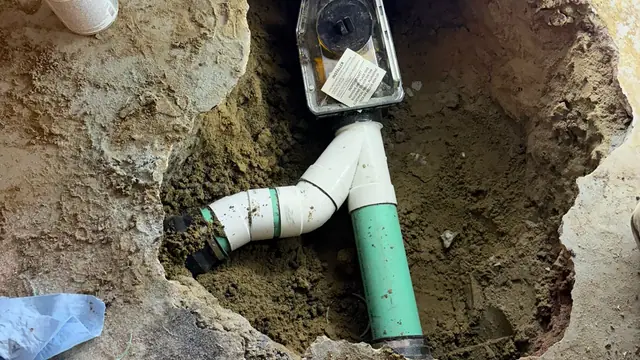
Mainline backwater valve set below the basement floor
Backwater valve installation, August 2026. The building drain was cut below the slab, the mainline valve set with its clear inspection lid facing up, and a cleanout branch added so the line can be serviced without disturbing the valve.
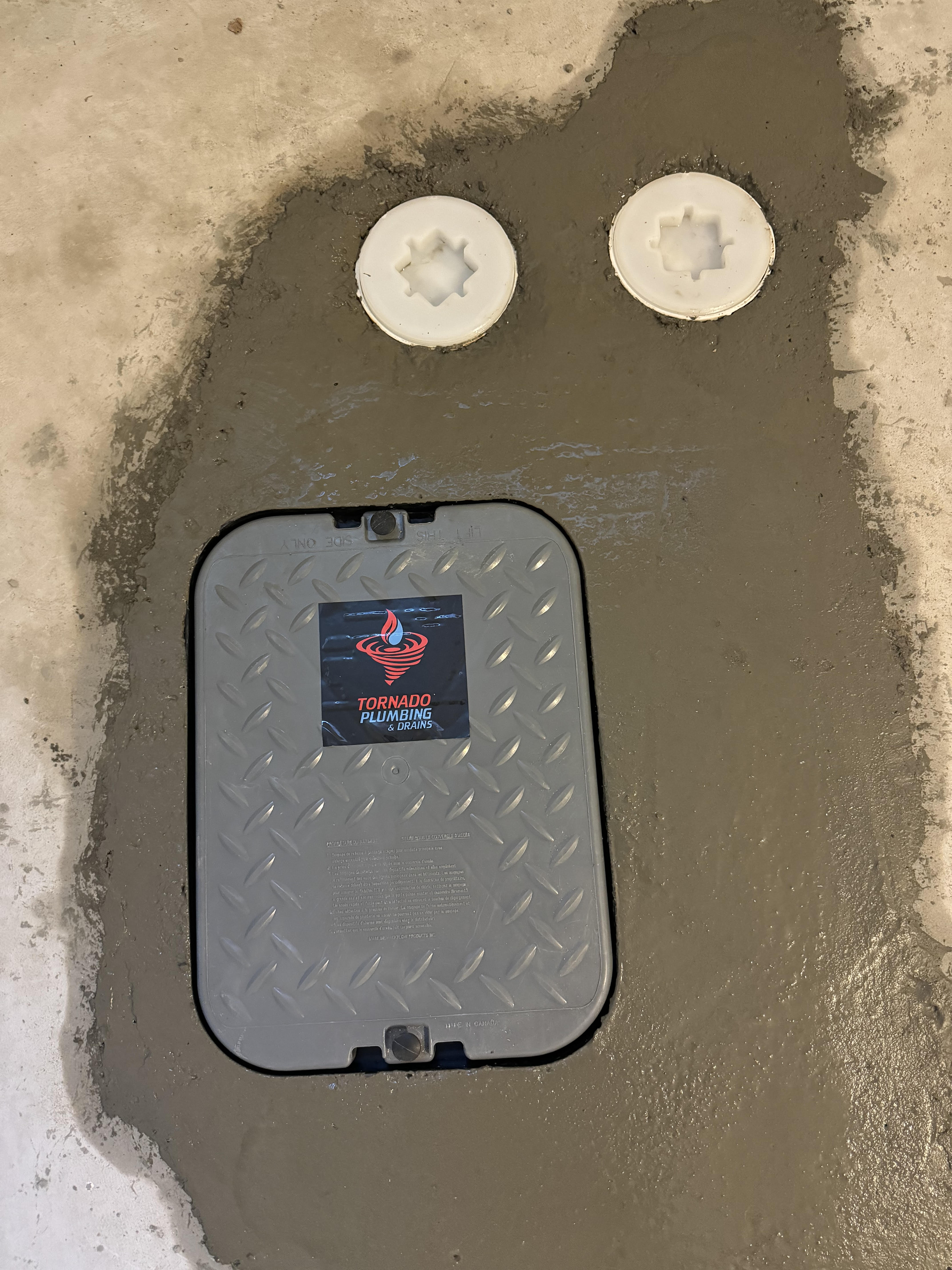
Backwater-valve access finished after concrete patch
This result photo shows the finished access point after basement flood-protection plumbing was installed and the floor was restored.
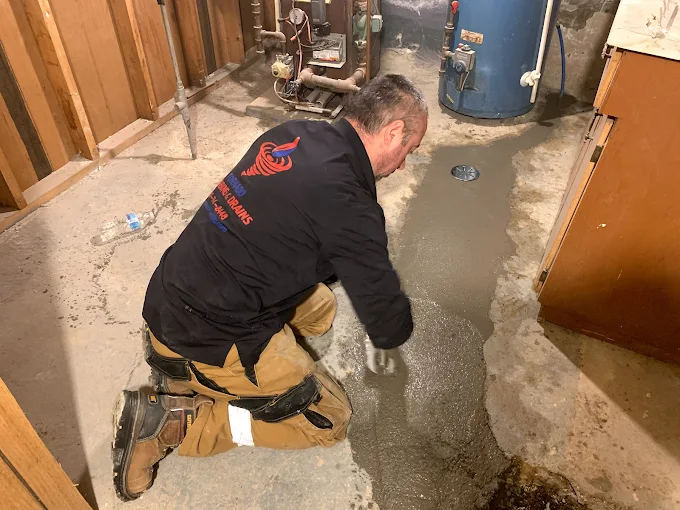
Basement floor patched back after flood-prevention plumbing work
Finished concrete patch after below-floor flood-prevention work, showing the restored surface homeowners see after the plumbing is installed.
Customer stories related to this topic
These customer stories pair real review quotes with the service pages most closely related to this guide.
Paul Milgram
June 2024“I was very happy with Tornado Plumbing's services. Every step of the procedure was executed professionally, very neatly, and exceptionally promptly. They were also very flexible with regards to accommodating our availability. Although, as with most customers presumably, I am not particularly well educated on the finer points of water supplies, drains, backwater valves, and the like, Tornado Plumbing's work appears to be have been performed very skillfully. I am not able to provide any valuable insight about how Tornado's prices compare with other companies' prices, since I simply relied on the recommendation of friends when I contracted with Tornado. I can say, however, that there was no "hard selling" and no "hidden costs" in our project; the final price was exactly as quoted initially by Serhiy. In addition to the above, I shall add that Serhiy was very friendly, and also willing to answer (very patiently) any questions that arose during our project. Conclusion: I am happy to recommend Tornado Plumbing.”
Most relevant to Backwater Valve Installation in Toronto & the GTA.
Google place photo: Tornado Plumbing & DrainsSharyn Flood
December 2020“Sergey and the team at Tornado Plumbing are exceptional. Their professionalism is second to none. On a scale of 1 to 10 I rate them 11! I highly recommend them! They installed a sump pump for me two years ago and recently repaired foundation wall cracks. Very reliable, experienced, hard working and left the job site clean. I am a very happy customer!”
Most relevant to Sump Pump Installation in Toronto & the GTA.
Google place photo: Tornado Plumbing & Drainsthea barber
September 2024“Serhiy has been to our house several times for various issues (sump pump, dishwasher, mystery drip etc.). He works quickly to figure out the problem and give the best solution. I'm always really impressed with his work.”
Most relevant to Sump Pump Installation in Toronto & the GTA.
Google place photo: Tornado Plumbing & DrainsRead next in this topic
These related guides help you compare cost, scope, and next steps without starting over.
Best local service areas for this topic
Use one of these city pages when you want the same problem explained through local housing, flood risk, access, and neighbourhood-specific plumbing context.
Licensed, insured, reviewed Toronto plumbers
Serving Toronto & the GTA since 2015 — over 1,200 completed jobs.
Master plumber T95-4969603 · Plumbing contractor T94-4992639 · Drain contractor T87-4722944 · Building renovator T85-4728632 · Plumbing license FI6216638.
4.9-star Google rating from 320+ reviews. 400+ HomeStars reviews (Best of 2019–2025). BBB-accredited.
Same-day and after-hours dispatch across Toronto, Etobicoke, North York, Scarborough, York, Mississauga, and Burlington.
25-year workmanship warranty
Every job Tornado Plumbing & Drains completes in Toronto and the GTA — repair, install, replacement, drain work, sewer work, fixture work — is backed by a 25-year workmanship warranty. The written terms are provided with every quote. If our work fails within 25 years of the install date, we come back and make it right.
Quick answer
About 25% of Toronto's sewer system — concentrated in the older central, east, and west neighbourhoods built before the 1960s — is combined: sanitary waste and stormwater share the same pipe. During intense rain, the combined system surcharges (fills past capacity) and the higher pressure pushes back through the path of least resistance, which is almost always your basement floor drain. Climate trends have made qualifying storms ~15% more frequent in southern Ontario since 2000. Property-level prevention (backwater valve + sump pump + weeping-tile disconnect) stops the back-flow at your property line; the City of Toronto pays up to $6,650 toward this work.
Why do Toronto sewers back up during heavy rain?
About 25% of Toronto's sewer system is combined, carrying waste and stormwater in one pipe. Heavy rain surcharges it past capacity, and the pressure pushes back through your basement floor drain. Property-level prevention (backwater valve, sump pump, weeping-tile disconnect) stops it, with up to $6,650 in City subsidy.
The numbers behind Toronto sewer backups
About 25% of Toronto's sewer system is combined sanitary-and-storm (City of Toronto data).
Combined sewers were built between the 1880s and 1940s, primarily in central, east, and west neighbourhoods.
Modern intense-rain frequency in southern Ontario is up ~15% since 2000 (Environment and Climate Change Canada).
August 2005 storm caused over $500M in basement-flood losses across Toronto — the event that triggered the current subsidy program.
Toronto Basement Flooding Protection Subsidy: up to $6,650 per property, expanded May 1, 2026.
Backwater valve installation prevents approximately 95% of sanitary back-flow events in our service data.
Average Toronto basement-flood claim in 2024: approximately $43,000 (Insurance Bureau of Canada).
How the combined-sewer system actually works (and fails)
Normal operation: a combined sewer carries household waste from toilets, sinks, showers, and laundry, plus stormwater that drains into street catch basins. During dry weather, the pipe handles ~5–10% of its capacity — fine. During light rain, capacity climbs but stays below the surcharge threshold — still fine.
Storm event: heavy rain dumps water into street catch basins faster than the system can drain to the treatment plant. The pipe fills, then surcharges (pressurizes above atmospheric), then pushes back through any path of least resistance. In a connected basement, that path is your floor drain, basement toilet, or laundry standpipe — whichever is lowest. The result is sewage-laced stormwater on your basement floor.
Why it can't be solved at the City level (fast): separating Toronto's combined sewers into sanitary and storm requires decades of infrastructure work and tens of billions of dollars. The City is doing this incrementally. Until then, property-level prevention is what works.
Where combined sewers are concentrated in Toronto
| Area | Sewer type | Risk level |
|---|---|---|
| Cabbagetown, Riverdale, Leslieville, Beaches, Riverside | Combined | High |
| The Annex, Forest Hill, Casa Loma, Yorkville | Mostly combined | High |
| Roncesvalles, Junction, Bloor West, High Park | Combined | High |
| Davenport, Dufferin Grove, Christie Pits | Combined | High |
| Old East York, Pape Village | Mostly combined | Medium-High |
| Don Valley West, Leaside (newer sections) | Mostly separated | Medium |
| Etobicoke (post-1960 builds) | Separated | Low |
| North York (post-1960 builds) | Separated | Low |
| Scarborough (post-1960 builds) | Separated | Low |
| Newer suburban GTA (Mississauga, Vaughan, Markham) | Separated | Very low |
What actually stops the back-flow at your property
Backwater valve ($2,800–$4,800 install, $1,600 City rebate): a normally-open one-way valve on your sanitary lateral that closes when flow reverses. Stops sewer back-flow before it reaches your basement. Single most effective property-level defence.
Sump pump system ($1,400–$6,500 depending on scope, $2,250 City rebate): handles groundwater that enters from outside the foundation, including weeping-tile output. Battery backup is essential because power outages and major storms correlate.
Weeping-tile disconnect ($5,500–$15,000, $400 City rebate for the severance/capping plus the $2,250 sump-pump item): for homes (mostly pre-1955) where the foundation drain is tied to the sanitary sewer. Severs that connection and re-routes weeping-tile output to a sump pit. Eliminates the most common path for groundwater into the basement.
Combined scope: most homeowners doing comprehensive flood protection do all three for the full $6,650 maximum subsidy. The combined gross is typically $9,500–$25,000; net out-of-pocket $2,850–$18,350 depending on scope and complexity.
What works for which problem
Backwater valve solves
Sanitary back-flow during sewer surcharge — water/sewage coming up through floor drains, basement toilets, and laundry standpipes during heavy rain. The single most cost-effective fix.
Backwater valve does NOT solve
Groundwater entering the basement from outside the foundation (cracks, walls, window wells). For that, you need waterproofing scope and sump pump capacity. The valve closes the sanitary lateral; it does nothing for water entering elsewhere.
What the comprehensive scope looks like
For complete flood protection in a high-risk Toronto neighbourhood: backwater valve (sanitary back-flow) + sump pump with battery backup (groundwater + power outage) + weeping-tile disconnect where applicable (foundation drain off the sanitary). City subsidy applies to all three independently up to the $6,650 cap.
Why this is uniquely a Toronto problem within the GTA
Toronto is the only major GTA municipality with a significant combined-sewer footprint. Mississauga, Brampton, Vaughan, Markham, and Burlington were predominantly built post-1960 with separated sanitary and storm sewers, which is why rain-correlated basement floods are much rarer there. The structural difference is also why the City of Toronto's Basement Flooding Protection Subsidy is the most generous municipal program in Canada — the City has both the most exposure to the problem and the strongest financial incentive to incentivize property-level prevention while infrastructure separation continues. If you're in Toronto's older central, east, or west neighbourhoods, this isn't theoretical — it's the predictable outcome of every major storm. The fix is the prevention scope, not waiting.
Where to go next
The primary fix for combined-sewer back-flow. $1,600 City rebate.
For groundwater that enters from outside the foundation. $2,250 separate rebate.
The full category — including weeping-tile disconnect ($400 severance/capping component plus the sump-pump item).
If you have an existing valve that needs inspection or service.
The diagnostic-side article paired with this system explainer.
Full $6,650 subsidy walkthrough with eligibility and application steps.
Sources cited in this guide
Stop the next backup
Book the install scope at Backwater Valve Installation, Sump Pump Installation, or the full Basement Waterproofing & Flood Prevention. Calls go through 647-784-8448 with same-day and after-hours dispatch. The City's $6,650 subsidy applies on every eligible install.
Common questions about Toronto sewer backup during rain
How do I know if my home is on combined sewer?
Check your address with the City of Toronto Sewers map (the Open Data portal has it) or call 311. As a rule of thumb: pre-1960 homes in central, east, and west Toronto are usually combined; post-1960 homes and most suburban GTA are separated.
If 25% of Toronto is combined, why does only my basement flood?
Two reasons. First, combined-sewer surcharge is local — only the homes downstream of the surcharging pipe section see back-flow. Second, the path of least resistance varies — some homes have functional backwater valves already, some have sealed floor drains, some are at higher elevation in the system. Yours flooding doesn't mean every neighbour did.
Why doesn't the City just separate the sewers?
Cost and time. Toronto has been doing incremental separation for decades; full separation would cost tens of billions and take 50+ years at current pace. The Basement Flooding Protection Subsidy is the City's mechanism to incentivize property-level prevention faster than infrastructure separation can be completed.
Is climate change making this worse?
Yes. Environment and Climate Change Canada data shows ~15% increase in heavy-rain frequency in southern Ontario since 2000. The combined-sewer system was designed for 1940s-era rainfall intensity; modern storms exceed that capacity more often. The trend is expected to continue.
Will my insurance pay for the install or just the cleanup?
Insurance generally doesn't pay for prevention installs (only damage repair after a covered loss). However, most insurers reduce the water-damage portion of the premium when prevention equipment is documented, and many require a backwater valve or sump pump for the sewer-backup endorsement to apply. The combined effect of the City rebate plus insurance discount typically pays back the homeowner net cost within 5–8 years.
How urgent is this if I haven't flooded yet?
If your home is on combined sewer in a high-risk neighbourhood, statistically you will eventually. The cost of one flood event ($43,000 average claim) exceeds the cost of comprehensive prevention ($9,500–$25,000 gross, $2,850–$18,350 net after subsidy). Most homeowners we install for are either coming out of a flood or proactively flood-proofing because they know the next storm is coming.
Explore more