Drain Cleaning Cost in Toronto (2026): Honest Prices by Method
By Serhiy Marunchuk, Master Plumber · Licence T95-4969603 · Updated July 3, 2026
Toronto drain cleaning runs $189–$350 for a single fixture, $350–$650 for a main snake, $400–$1,400 for hydro jetting, and $250 more if you want camera-after-clean to confirm the line is actually clear.
Published March 28, 2026 · Last updated July 3, 2026
On this page
Related services
Get a free estimate
Introduction
Drain cleaning is one of the few plumbing services where the right answer often costs less than the wrong one — provided you know what you're paying for. A $189 fixture snake fixes a fresh kitchen-sink clog as well as a $700 jetting job, but neither will fix a recurring main-line backup that's actually root intrusion through a clay joint. This guide gives you the real 2026 Toronto numbers by method, when each is the right call, and how to spot the up-sell when it isn't. If you need the work handled rather than researched, see drain cleaning Toronto for pricing, process, and booking. When cleaning keeps failing because the pipe itself is damaged, the real fix is drain repair or trenchless sewer line repair rather than another snake.
Related services for this guide
If this article matches what you are dealing with, use one of these links to move into the service or broader category that makes the most sense.
Project photos related to this guide
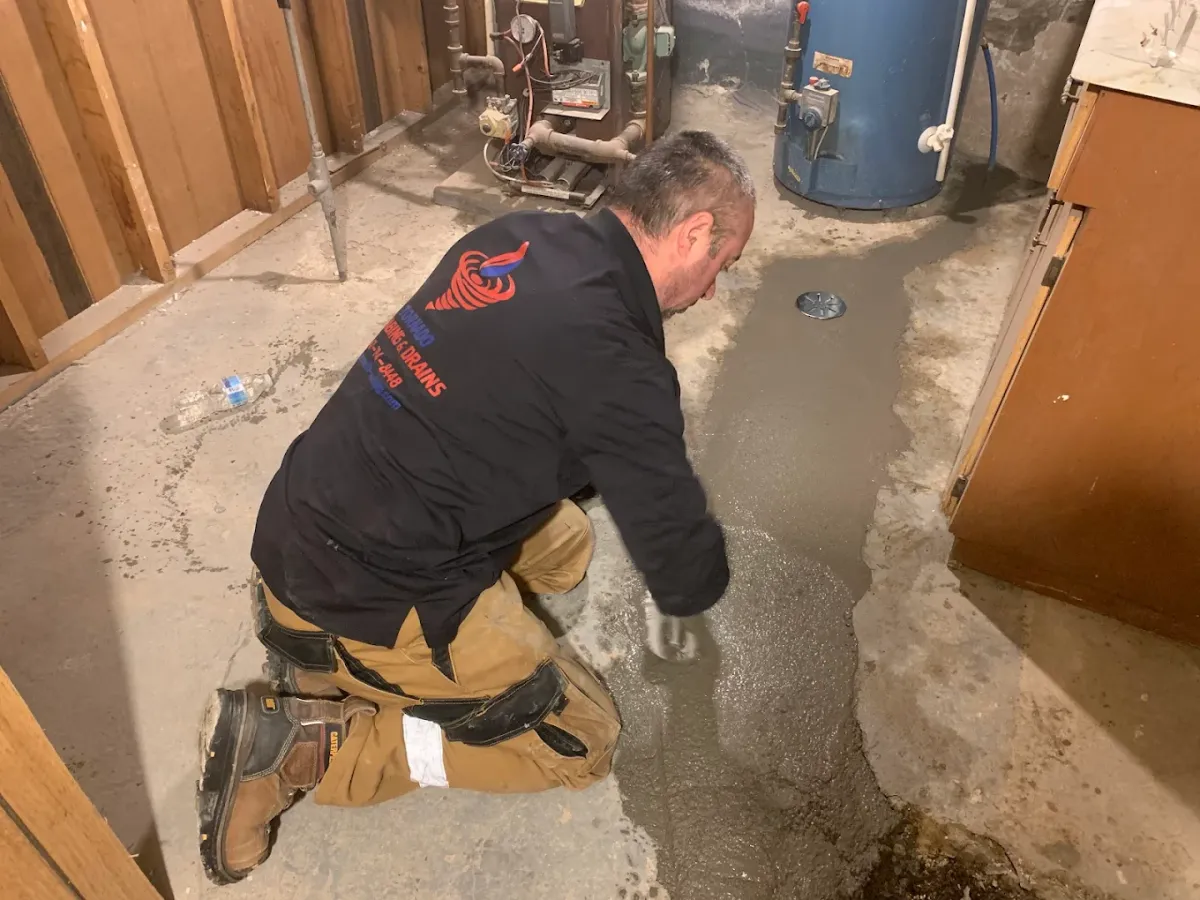
These real project photos help show what this kind of work looks like in the field, not just on the page.
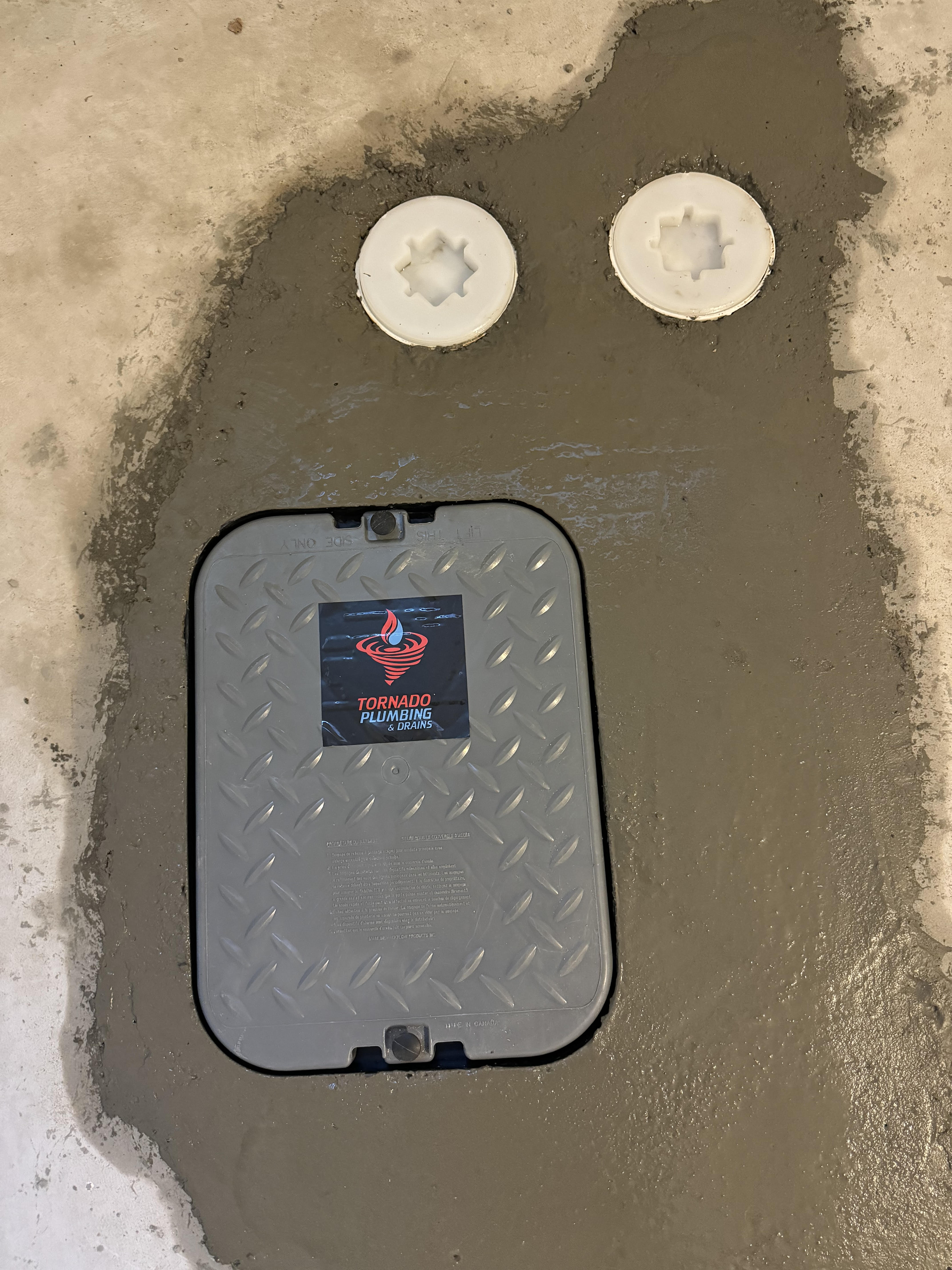
Backwater-valve access finished after concrete patch
This result photo shows the finished access point after basement flood-protection plumbing was installed and the floor was restored.
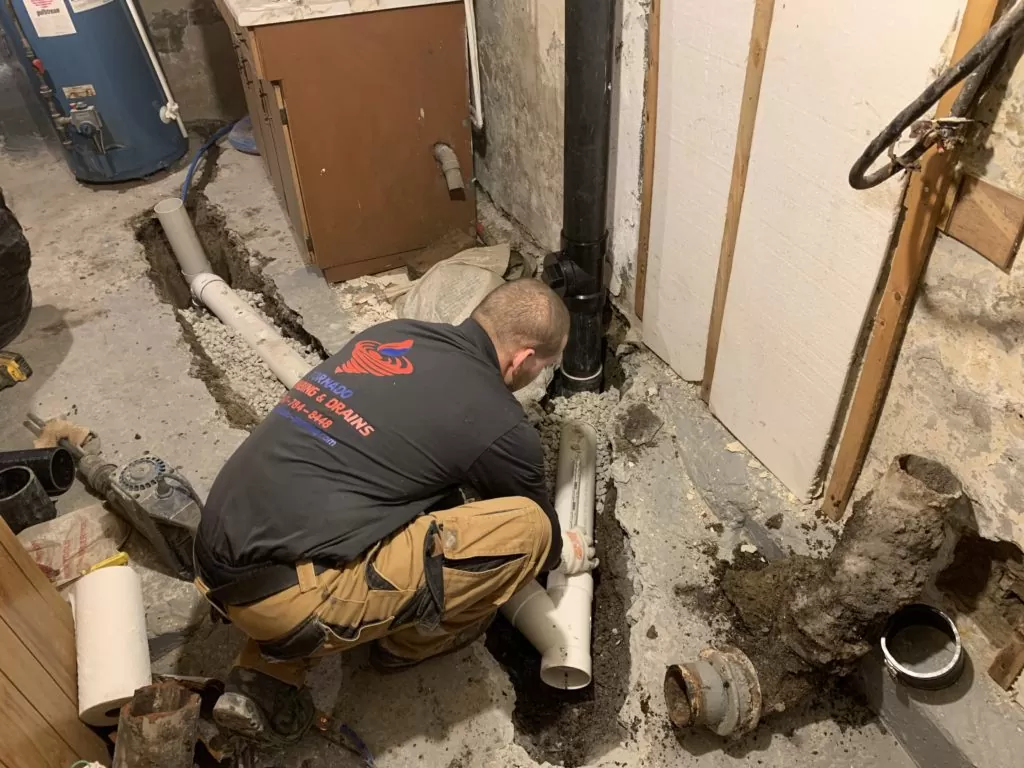
Basement drain tie-in in progress
This project photo shows the below-floor drain installation phase, where route changes, tie-ins, and access all affect the actual scope of the work.
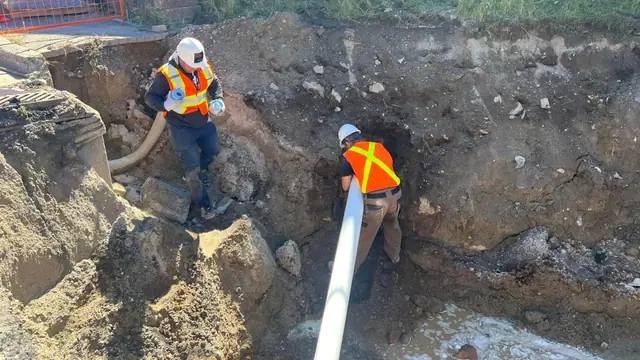
Large-diameter line installation in open excavation
This image captures the moment where the new pipe section is being positioned and checked before the excavation is closed back up.
Read next in this topic
These related guides help you compare cost, scope, and next steps without starting over.
Best local service areas for this topic
Use one of these city pages when you want the same problem explained through local housing, flood risk, access, and neighbourhood-specific plumbing context.
Licensed, insured, reviewed Toronto plumbers
Serving Toronto & the GTA since 2016 — over 1,200 completed jobs.
Master plumber T95-4969603 · Plumbing contractor T94-4992639 · Drain contractor T87-4722944 · Building renovator T85-4728632 · Plumbing license FI6216638.
180+ five-star Google reviews. 400+ HomeStars reviews (Best of 2019–2025). BBB-accredited.
Same-day and after-hours dispatch across Toronto, Etobicoke, North York, Scarborough, York, Mississauga, and Burlington.
25-year workmanship warranty
Every job Tornado Plumbing & Drains completes in Toronto and the GTA — repair, install, replacement, drain work, sewer work, fixture work — is backed by a 25-year workmanship warranty. The written terms are provided with every quote. If our work fails within 25 years of the install date, we come back and make it right.
Quick answer
Drain cleaning in Toronto in 2026 typically runs $189–$350 for a single fixture snake (kitchen, bath, laundry), $350–$650 for a main-line snake through an accessible cleanout, $400–$750 for hydro jetting a 3″ branch, and $650–$1,400 for jetting a 4″ main. Camera-after-clean adds about $250 and is worth it on any recurring or unfamiliar line. Avoid 'free drain inspection' offers — they usually involve a 30-second look meant to upsell additional cleaning.
How much does drain cleaning cost in Toronto in 2026?
Drain cleaning in Toronto in 2026 costs $189-$350 for a single-fixture snake, $350-$650 for a main-line snake through a cleanout, $400-$750 to hydro jet a 3-inch branch, and $650-$1,400 for a 4-inch main. Camera-after-clean adds about $250 and is worth it on any recurring line.
What you should know before booking
An accessible cleanout cuts visit time roughly in half compared to pulling a toilet or running a snake through a roof vent.
Snaking is fine for soft clogs (paper, hair, light grease film); jetting is required for set grease, root mats, and mineral scale.
Camera-after-clean adds about $250 — but it's the only objective way to know whether the line is clear or just opened a path.
Recurring slowdowns at the same fixture within 6–12 months almost always mean the underlying line condition (not the clog) is the real issue.
Toronto's combined-sewer system surcharges during heavy rain — recurring backups during storms point to a backwater valve recommendation, not just cleaning.
Chemical drain cleaners (lye, sulfuric acid) can crack older ABS, score cast iron, and rarely clear set grease — we don't recommend them on any age of pipe.
Real Toronto drain cleaning prices (2026)
Kitchen sink, bathroom sink, tub/shower, or laundry — accessible from the fixture. 30–60 minutes typical. Most one-time clogs land here.
Single-fixture snake
$189 – $350
Kitchen sink, bathroom sink, tub/shower, or laundry — accessible from the fixture. 30–60 minutes typical. Most one-time clogs land here.
Toilet snake / auger
$220 – $380
Toilet-specific auger to clear the trap and immediate downstream branch. Wax ring replacement included if the toilet has to be pulled.
Main-line snake (cleanout)
$350 – $650
Sewer main from the basement cleanout to the property line, typical 60–90 ft. Best when the symptom is multi-fixture slow drainage.
Hydro jet (3″ branch)
$400 – $750
High-pressure scrubbing of a kitchen, laundry, or bath-group branch. Right call when snaking has been done multiple times without lasting results.
Hydro jet (4″ main)
$650 – $1,400
Full sewer main jetting. Removes set grease, mineral scale, root mats. 2–3 hours on site.
Cast-iron descaling
$900 – $2,400
Specialized chain-knocker or milling head for hard mineral scale. Slow, careful work to avoid thinning corroded pipe walls past repair.
Camera-after-clean (add-on)
+$250 – $400
Recorded video inspection of the cleaned line, with PACP-style condition notes. The objective proof the line is actually clear and the baseline for future inspections.
Pulled-toilet / roof-vent access
+$150 – $300
When there's no accessible cleanout. Includes wax ring, reset, and mess control.
Picking the right method (so you don't pay twice)
Snake first when
It's a fresh, single-fixture clog. The line history is unknown. The pipe condition is unknown (start lighter, escalate if needed). The customer wants the cheapest first-pass option to see if it holds.
Jet first when
Snaking has been done within the past 12 months and the slowdown returned. The symptom is set grease in a kitchen line or restaurant. The camera shows mineral scale or root mats. Multiple fixtures are slowing simultaneously (points to the main, not a single fixture).
Always pair with a camera when
The line is older than 30 years, the pipe material is unknown, the slowdown is recurring, the customer is buying or selling, or an insurance claim is involved. The recorded footage pays for itself the first time it answers a question.
Safe DIY first steps before you pay for a visit
| Where it's clogged | Most likely cause | Safe DIY first step | When to call |
|---|---|---|---|
| Kitchen sink | Grease build-up | Hot water + dish soap; plunger if water sits | Slow returns within 1–2 months |
| Bathroom sink | Hair + soap scum | Manual zip-it tool, P-trap clean | Multiple sinks slow simultaneously |
| Shower / tub | Hair + body grease | Drain snake, hair-grabber tool | Standing water in tub > 30 min |
| Toilet | Paper, wipes, foreign objects | Plunger; auger if no movement | Recurring backup, water at low fixtures |
| Floor drain (basement) | Grease film, sediment | Hot-water flush | Backup during heavy rain (combined sewer) |
| Multiple fixtures slow simultaneously | Main line near-blocked | Stop using water; call | Always call — main-line failure |
| Toilet bubbles when laundry runs | Main line partial block | Stop using water; call | Always call — pre-backup signal |
DIY vs call the pro
DIY is fine for
Single-fixture fresh clog with visible cause (hair in shower, paper in toilet). First-time slowdown that responds to hot water or plunger. P-trap clean on a bathroom sink (with a bucket and basic tools).
Call when
Multiple fixtures slow simultaneously (main-line problem). Recurring at the same fixture within months (line-condition issue). Toilet bubbles when laundry runs (pre-backup signal). Backup during heavy rain (combined-sewer surcharge → backwater valve scope). Anyone has poured chemicals into the drain (tech-safety issue).
What we do on the call
Diagnose, run camera if pipe condition is in question, choose the right cleaning method (snake / jet / descale), confirm result with post-clean camera, and document. If structural issues surface (root intrusion, belly, crack), we quote the appropriate repair scope rather than just cleaning around the problem.
Three Toronto drain calls from the past 90 days
Scarborough, kitchen-sink slow drain — Standard fixture-level clog, single visit. Snake at $239, in-and-out in 45 minutes. Customer added a $25 strainer recommendation. No return call in the 4 months since.
The Annex, recurring main-line backup — Customer had been snaked twice in 14 months by another company. Camera at $410 showed continuous root mat across 22 ft of clay lateral. Quoted trenchless lining at $11,400 instead of repeated cleaning. The total cost of the previous two snake visits ($1,200) was effectively wasted; the camera visit told the truth.
Etobicoke, kitchen restaurant drain — Set grease across 35 ft of horizontal main. Jet + camera bundle $1,090 (after-hours premium $150). Restaurant subsequently signed a quarterly contract at $390/visit. No emergency calls in the 6 months since.
What to have ready when you call
These six answers determine the truck, the access plan, and the right method — and tighten the on-site quote to within 10–15% of the dispatch number.
Which fixture — kitchen, bath, laundry, toilet, or main-line backup at the lowest drain?
Is it the first time, or has this happened before? When was the last visit?
Is there an accessible cleanout, or do we need to pull a toilet or use the roof vent?
Is more than one fixture affected at the same time?
Property age — pre-1955 (likely clay/cast iron), 1955–80 (likely cast iron), 1980+ (likely ABS/PVC)?
Have you tried any chemical drain cleaner recently? (We need to know for tech safety.)
Why Toronto drain pricing differs from suburban GTA
Three structural reasons Toronto drain cleaning is its own market within the GTA. (1) Pipe material — older central, east, and west neighbourhoods have clay laterals (root-prone), cast iron (scale-prone), and lead in the supply (rare in drains but tied to the same vintage). Newer 905 suburbs are mostly ABS and PVC, which clean faster and hold cleaner longer. (2) Tree canopy — Toronto's mature street-tree program puts large root systems over the lateral run on most older streets, meaning recurring root intrusion is a different problem class than in newer subdivisions. (3) Combined sewer — about 25% of Toronto is on combined sanitary-and-storm sewers, which surcharge during heavy rain. A floor-drain backup during a Toronto summer storm is often the City system, not your line — the only way to know is camera footage. The Sewer Use Bylaw (Ch. 681) caps grease/oil discharge at 150 mg/L, which is the practical reason restaurants schedule cleanings rather than wait for emergencies.
Where to go next
Service page with full scope, method-by-method pricing, and the warranty terms. Where you book the visit.
When the cause is roots through a joint — root cutting plus the recommendation for what to do about the joint long-term.
When grease, scale, or recurring biofilm is the problem and snaking won't hold.
When pipe condition is unknown, this is the diagnostic that decides the right cleaning method.
Side-by-side comparison if you're still deciding which method.
Sources cited in this guide
Ready to book
If your symptoms match what's described above, Drain Cleaning is the booking page. For root-driven recurring backups, see Drain Snaking / Rootering. For grease and scale, Hydro Jetting Services. If pipe condition is unknown, start with Drain Camera Inspection. Calls go through 647-784-8448 with same-day and after-hours dispatch across Toronto and the GTA.
Common questions about Toronto drain cleaning cost
How much does drain cleaning cost in Toronto in 2026?
Single-fixture snake: $189–$350. Main-line snake: $350–$650. Hydro jetting branch: $400–$750. Hydro jetting main: $650–$1,400. Camera-after-clean adds about $250. Pulled-toilet or roof-vent access adds $150–$300 if no cleanout is accessible.
Is hydro jetting worth the extra cost over a snake?
For soft, isolated clogs (paper, hair, food), no — snaking is faster and cheaper. For grease, mineral scale, or roots, yes — snaking just punches a hole through the build-up; jetting scrubs the pipe wall clean. The tell is recurrence: if you've snaked the same line in the past 12 months and it's slow again, jetting is what actually fixes it.
Why do prices range so wide — $189 to $1,400?
Three drivers: line size (3″ branch is fast, 6″ commercial main is a half-day), method (snake vs jet vs descale), and access (cleanout vs pulled toilet vs roof vent). The dispatch call narrows the range. We give a firm on-site quote before any work starts.
Should I try chemical drain cleaner first?
Generally no. Lye and sulfuric-acid cleaners can crack older ABS, score cast-iron walls, and produce dangerous fumes. They rarely clear set grease or roots. They also create a tech-safety problem when we arrive — we have to neutralize the line before working. Hot water and dish soap is fine for early kitchen-grease films; beyond that, call.
Do you offer free inspections?
We offer free phone consultations and free written estimates, but we don't run the camera for free. A 'free' inspection is usually a 30-second look gated behind a service you didn't ask for. A standalone, paid inspection is a structured deliverable with recorded footage and a written report — the kind that supports an insurance claim or a property purchase.
What if the cleaning doesn't work?
We tell you on the visit, before you pay, what we found and what's actually needed. If the symptom is structural (root intrusion, belly, crack), no amount of cleaning will hold and we recommend the right repair scope instead. If we did the cleaning, post-clean camera shows the line is clear, and the slowdown returns within 90 days from the same cause we documented as cleared, we re-run the cleaning at no charge. That's our 25-year workmanship warranty applied to drain work.
Are you actually licensed for drain work?
Yes — Drain contractor T87-4722944 (the specific license required for drain and sewer work in Toronto), plus Master plumber T95-4969603 and Plumbing contractor T94-4992639. Drain cleaning is performed by drain-contractor-certified technicians under master-plumber supervision.
Explore more