Commercial Drain Maintenance: Preventing Downtime in Toronto Restaurants, Retail, and Multi-Tenant Buildings
By Serhiy Marunchuk, Master Plumber · Licence T95-4969603 · Updated September 5, 2026
The math on Toronto restaurant drain maintenance: one prevented Friday-night closure pays for an entire year of contract service. Here's how to schedule it right and what the City actually requires you to document.
Published February 26, 2026 · Last updated September 5, 2026
On this page
Related services
Get a free estimate
Introduction
Toronto commercial drain failures are predictable: grease accumulates along the same horizontal runs every ~3 months, mineral scale builds in cast iron, and root intrusion in older laterals shows up after every major storm. Predictable means preventable — but only if you're on a maintenance schedule that catches build-up before it becomes a Friday-night kitchen closure. This guide walks through what scheduled maintenance actually does, how it pays back through prevented downtime, and what the City's Sewer Use Bylaw documentation requirements look like in practice. If you need the work handled rather than researched, see commercial drain cleaning Toronto for pricing, process, and booking. When a backup does hit mid-service, our emergency plumbing service covers after-hours dispatch across the GTA.
Related services for this guide
If this article matches what you are dealing with, use one of these links to move into the service or broader category that makes the most sense.
Project photos related to this guide
These real project photos help show what this kind of work looks like in the field, not just on the page.
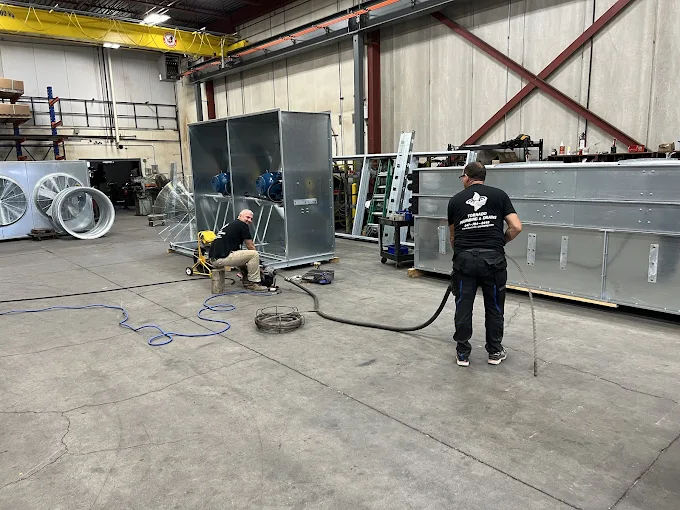
Commercial plumbing crew working inside an industrial facility
Commercial crew on site inside an industrial facility, showing the kind of access, equipment, and coordination commercial plumbing work can involve.
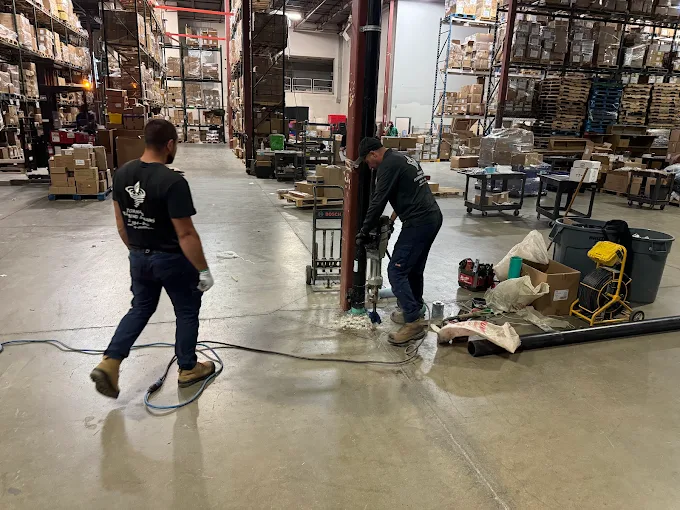
Commercial service crew working inside an industrial facility
This facility photo gives the commercial service pages a broader proof image for inspection, cleaning, and hydro-jetting related work in larger buildings.
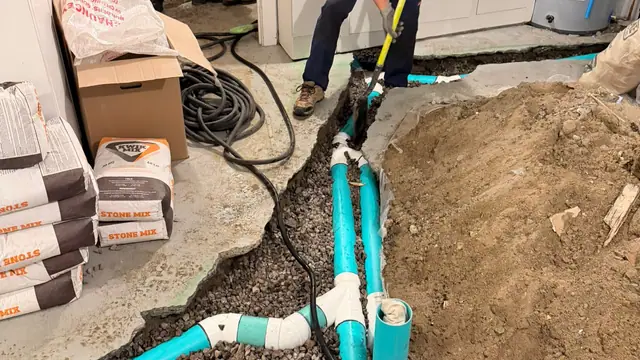
Basement floor opened to replace the under-slab drain lines
Interior drain re-piping, August 2026. The slab was cut along the drain route, the old lines removed, and new PVC drain connections laid on gravel with stub-ups for the fixtures above.
Customer stories related to this topic
These customer stories pair real review quotes with the service pages most closely related to this guide.
Nastaran Razavi
April 2026“Very impressed with Tornado Plumbing & Drains! They installed our grease trap quickly and professionally, without any delays. The team was respectful, organized, and made sure everything was up to code. They also gave us useful tips on maintenance, which was a big plus. Highly recommended!”
Most relevant to Commercial Plumbing in Toronto & the GTA.
Google place photo: Tornado Plumbing & DrainsBennet Chan
December 2025“We had a plumbing blockage that needed urgent attention, and Serhiy handled it expertly. He quickly identified the problem, cleared the blockage thoroughly, and made sure everything was fine before leaving. He was professional, courteous, and efficient throughout the visit. Very satisfied with the service.”
Claudia Taylor
April 2019“Excellent work and great attention to detail. Very pleased with Serhiy and his team. Highly recommend their services. We had a 2-piece basement washroom that we wanted roughed-in to a 3-piece, plus some additional work in the laundry room. We are very pleased with the results and at the competitive price.”
Read next in this topic
These related guides help you compare cost, scope, and next steps without starting over.
Best local service areas for this topic
Use one of these city pages when you want the same problem explained through local housing, flood risk, access, and neighbourhood-specific plumbing context.
Licensed, insured, reviewed Toronto plumbers
Serving Toronto & the GTA since 2015 — over 1,200 completed jobs.
Master plumber T95-4969603 · Plumbing contractor T94-4992639 · Drain contractor T87-4722944 · Building renovator T85-4728632 · Plumbing license FI6216638.
4.9-star Google rating from 320+ reviews. 400+ HomeStars reviews (Best of 2019–2025). BBB-accredited.
Same-day and after-hours dispatch across Toronto, Etobicoke, North York, Scarborough, York, Mississauga, and Burlington.
25-year workmanship warranty
Every job Tornado Plumbing & Drains completes in Toronto and the GTA — repair, install, replacement, drain work, sewer work, fixture work — is backed by a 25-year workmanship warranty. The written terms are provided with every quote. If our work fails within 25 years of the install date, we come back and make it right.
Quick answer
Commercial drain maintenance for Toronto restaurants and retail prevents downtime through scheduled jetting (quarterly for high-volume kitchens, semi-annual for moderate), annual camera inspection, grease-trap pump-out at City-mandated intervals, and after-hours scheduling that doesn't disrupt operations. Maintenance contracts pay back through fewer emergency calls (one prevented Friday-night closure pays for the year), zero City compliance issues, and 20–35% lower per-visit cost than ad-hoc emergency calls.
Why scheduled maintenance pays back
Quarterly jetting contracts reduce per-visit cost by 20–35% vs ad-hoc emergency calls.
Most kitchen drain failures are predictable: grease accumulation along the same horizontal runs every ~3 months without intervention.
Toronto Sewer Use Bylaw caps grease/oil discharge at 150 mg/L — scheduled maintenance is the way restaurants stay compliant.
Documentation (date, scope, technician license, hauler manifest) is required for both insurance and City compliance.
Off-hours dispatch (10 PM–6 AM) is standard practice; surcharge offset by zero lost service revenue.
Average Toronto restaurant lost revenue from a single Friday-night drain failure: $1,500–$5,000 plus customer impact. Annual contract $3,000–$5,500 covers itself with one prevention.
From our Toronto restaurant data: properties on quarterly contracts have ~85% fewer emergency drain calls than ad-hoc-only properties.
What scheduled maintenance prevents
| Scheduled service | What it prevents | Cost impact of skipping |
|---|---|---|
| Quarterly main-line jet | Grease coating buildup on horizontal runs | Emergency call ($600+) plus closure ($1,500–$5,000) |
| Monthly grease-trap pump | Trap overflow into sanitary, City fine, sewer surcharge | Fines + emergency pump + remediation ($1,500–$5,000+) |
| Annual camera inspection | Undetected root intrusion, line collapse | Backup → emergency repair → restoration ($3,000–$15,000) |
| Annual backflow test | Failed device discovered during inspection only | City compliance notice → fines → potential service interruption |
| Semi-annual fixture inspection | Failed shut-offs, leaking valves discovered during failure | Property damage + insurance claim disputes |
Three Toronto commercial accounts
King West, full-service restaurant, monthly maintenance contract — 200 covers/day, full kitchen + bar. Monthly jet + grease pump + quarterly camera. $4,800/yr total contract. In 18 months: zero emergency calls, City inspector spot-check passed first try, manager reports 'we forgot drains existed.'
Etobicoke, retail strip mall (3 tenants), quarterly contract through landlord — Single contract covers all 3 tenant lines plus shared exterior interceptor. $3,200/yr split among tenants. Eliminated the monthly arguments about whose drain was clogged.
Yonge corridor, ad-hoc only, the regret math — 60-seat cafe chose ad-hoc. 5 emergency calls in 18 months ($3,400 total) plus one Saturday closure ($1,800 lost revenue). Total $5,200 vs $2,400 contract equivalent. Switched to contract after the third emergency.
Picking the right contract interval
Monthly contract for
High-volume kitchens (150+ covers/day, deep-fry, heavy grease menu). Multi-tenant buildings with shared sanitary main. Restaurants with prior compliance history.
Quarterly is enough for
Moderate-volume restaurants (50–150 covers/day, average grease load). Single-tenant retail. Cafes with light food prep.
What we recommend on first walk-through
Free assessment that includes camera inspection of the main, walk-through of the kitchen lines, and review of any prior maintenance records. We then quote both monthly and quarterly options for direct comparison. The right interval is whatever stays ahead of your specific grease and volume profile.
Why Toronto's commercial drain environment is uniquely strict
Toronto's Sewer Use Bylaw (Ch. 681) is one of the more actively enforced municipal sewer bylaws in Canada. The City inspects commercial properties — particularly restaurants and food-service tenants — for grease/oil discharge compliance, and fines are real. Combined with Toronto's combined-sewer system in older neighbourhoods (which surcharges during heavy rain and complicates restaurant drainage), the case for scheduled maintenance is structural. Most commercial leases also explicitly require documented drain maintenance — landlords flag missing records as a lease violation. We provide records the City inspector and the landlord both accept.
Where to go next
Service page for ad-hoc and contract maintenance. Free walk-through and contract assessment.
When grease build-up needs jetting rather than snaking — the workhorse of commercial maintenance.
Trap install, replacement, and scheduled pump-out.
Full commercial scope including backflow testing, fixture work, emergency dispatch.
The pricing detail for ad-hoc vs contract scheduling.
Sources cited in this guide
Get a free walk-through
Book a free commercial walk-through at Commercial Drain Cleaning — we'll quote both ad-hoc and contract pricing for direct comparison. Calls go through 647-784-8448.
Common questions about Toronto commercial drain maintenance
How often should we have our drains cleaned?
High-volume kitchens (150+ covers/day, deep-fry, heavy grease): monthly. Moderate-volume (50–150 covers/day): quarterly. Light-volume cafes: semi-annually. Grease trap pump-out frequency is set by the City based on trap size and volume — typically every 30–90 days.
Why is contract pricing lower than ad-hoc?
Three reasons: scheduled work doesn't carry the after-hours emergency premium; routes are pre-planned with multiple stops which reduces per-visit overhead; predictable maintenance prevents the larger emergency scope ($2,000+ jetting + grease pump together vs scheduled $400 cleaning). The contract is essentially insurance against your own grease build-up.
What documentation is included with each visit?
Dated service record (date, time, scope, technician name and license), photos before and after, hauler manifest for grease pump-out, written notes on any conditions observed, recommendations for next service. Filed under your property address and emailed to the manager same day.
Can you handle multi-tenant retail buildings?
Yes. Common arrangement: single contract through the landlord covers the shared sanitary main; individual tenants book their own kitchen-line maintenance separately. We handle both arrangements and coordinate scheduling to minimize disruption to all tenants.
Explore more