Floor Drain Backing Up During Rain in Toronto: Causes, Fixes, and the Permanent Solution
By Serhiy Marunchuk, Master Plumber · Licence T95-4969603 · Updated September 15, 2026
Floor drain backups during heavy rain in Toronto are almost always combined-sewer surcharge or a missing backwater valve — not your line. Here's how to prove it and fix it under the City's $6,650 subsidy.
Published March 28, 2026 · Last updated September 15, 2026
Introduction
If your basement floor drain backs up only during heavy rain — not during dry weather, not during normal use — the cause is almost certainly system-level, not a clog in your line. Most homeowners get this exact situation cleaned three or four times before someone explains the actual problem: Toronto's combined-sewer system surcharges during heavy rain and pushes back through the path of least resistance, which is your basement floor drain. The cleaning works for the first few hours; the next storm fills it up again. The fix isn't more cleaning — it's a backwater valve, and the City pays up to $1,600 toward installing one. If you need the work handled rather than researched, see basement floor drain backup service for pricing, process, and booking. If you still need the line cleared today, book drain cleaning — then look at basement waterproofing and flood prevention so the next storm doesn't repeat it.
Related services for this guide
If this article matches what you are dealing with, use one of these links to move into the service or broader category that makes the most sense.
Project photos related to this guide
These real project photos help show what this kind of work looks like in the field, not just on the page.
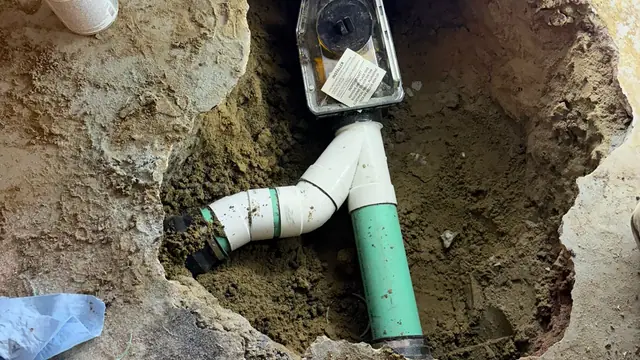
Mainline backwater valve set below the basement floor
Backwater valve installation, August 2026. The building drain was cut below the slab, the mainline valve set with its clear inspection lid facing up, and a cleanout branch added so the line can be serviced without disturbing the valve.
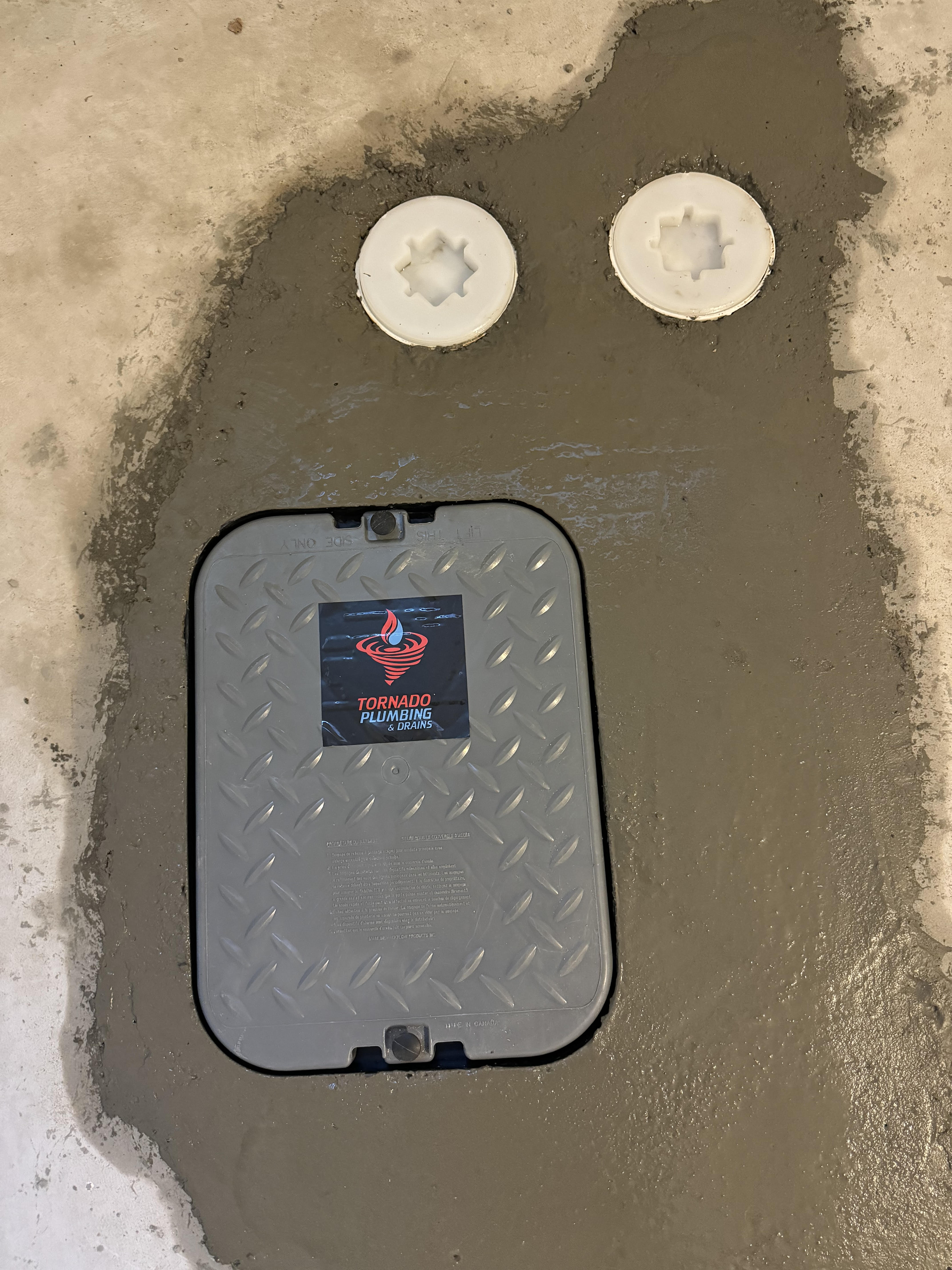
Backwater-valve access finished after concrete patch
This result photo shows the finished access point after basement flood-protection plumbing was installed and the floor was restored.
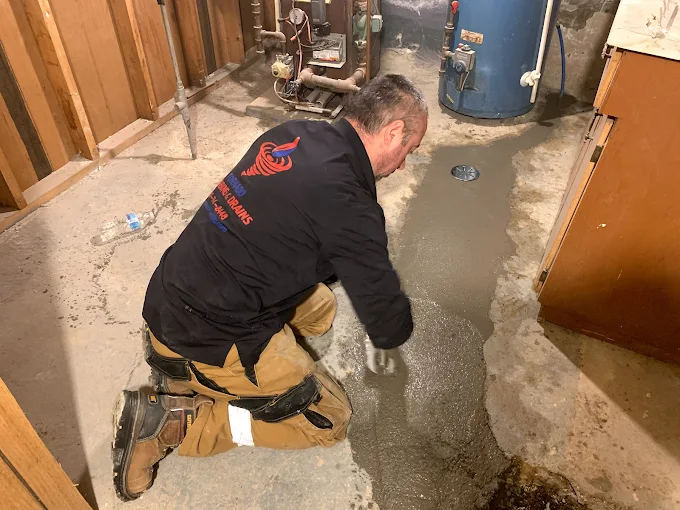
Basement floor patched back after flood-prevention plumbing work
Finished concrete patch after below-floor flood-prevention work, showing the restored surface homeowners see after the plumbing is installed.
Customer stories related to this topic
These customer stories pair real review quotes with the service pages most closely related to this guide.
Benjamin Forsey
August 2024“I found Tornado Plumbing & Drain's which is run by Sergey and his team after having multiple problems of poor quality works for my drainage and weeping tiles from another company. Let me start by saying Sergey's customer service is flawless he is a gentleman and so polite and caring to explain the works and process that you feel like you have known him for years. We agreed a price and date and Tornado Plumbing & Drain delivered. All of his team are really nice whenever I came to the house they were happy to show me progress and they never took a short cut with the works despite having to make good some defective works. I passed my revised drainage inspections first time with Tornado Plumbing & Drain and he also supported me getting my rebates. Sergey also has his own equipment which is rare usually other companies sub contract this out or use additional labor which costs you (the client) more money and time is construction schedule. Sergey has his own digger and a high quality drain camera so he can use his camera to find issues and defective works. He paid a lot of money for this equipment but it helps him work effectively and this in turn helps the client as he can pinpoint the defects to save the client money as he knows the issue and location ASAP. I will leave with saying this, just call Sergey for underpinning, waterproofing and plumbing and drainage works and if you are lucky enough to meet him I think the way he conducts himself you will see that my review is a genuine reflection of this honest hard working man! Finally, mesage me on here if you would like to speak to me directly as a previous client of Sergey's and if you want to come see his work I am happy to show you it at my house. I would do this for Sergey in return of his high quality work and conduct he gave me. Ben F.”
Most relevant to Basement Waterproofing & Flood Prevention in Toronto & the GTA.
Google place photo: Tornado Plumbing & DrainsMR Verxcy
April 2019“We were happy with Tornado plumbing from start and finish. Sergey came on the time to give us a quotation,he found the cracks in our foundation wall also our sump pump didn't work also. We are 100% satisfied with the crew ,they keep job site clean even weather wasn't great, the power flash the driveway and my basement is dry we are so happy!!! Highly recommend”
Most relevant to Sump Pump Installation in Toronto & the GTA.
Google place photo: Tornado Plumbing & DrainsMichael Slapsys
May 2024“Fast, competent, reliable, clean and reasonably priced. Can’t say enough good things about our experience with Serhiy and his team. We had our entire waste water lines, from stack to city hook-up replaced, and some plumbing redone (basement toilet was given a much needed vent and backwater valve was installed). They spent three nine hour days (non-stop) and got the job done with minimal disruption (start at 7:30 am end at 4:30 pm each and every day). Serhiy took care of permits and coordinated inspection of waste water valve by Toronto inspectors, and the City rebate cheque for waste water valve came in a week (City of TO says processing may take ten weeks). I completed the online application in ten minutes. Highly recommend Tornado Plumbing. I’ve dealt with at least two other plumbing and drain contractors (we have several properties to manage (big family)) they’re the only ones we’ll call in the future when and if the need arises. I wish them good health and much success!”
Most relevant to Backwater Valve Installation in Toronto & the GTA.
Google place photo: Tornado Plumbing & DrainsRead next in this topic
These related guides help you compare cost, scope, and next steps without starting over.
Best local service areas for this topic
Use one of these city pages when you want the same problem explained through local housing, flood risk, access, and neighbourhood-specific plumbing context.
Licensed, insured, reviewed Toronto plumbers
Serving Toronto & the GTA since 2015 — over 1,200 completed jobs.
Master plumber T95-4969603 · Plumbing contractor T94-4992639 · Drain contractor T87-4722944 · Building renovator T85-4728632 · Plumbing license FI6216638.
4.9-star Google rating from 320+ reviews. 400+ HomeStars reviews (Best of 2019–2025). BBB-accredited.
Same-day and after-hours dispatch across Toronto, Etobicoke, North York, Scarborough, York, Mississauga, and Burlington.
25-year workmanship warranty
Every job Tornado Plumbing & Drains completes in Toronto and the GTA — repair, install, replacement, drain work, sewer work, fixture work — is backed by a 25-year workmanship warranty. The written terms are provided with every quote. If our work fails within 25 years of the install date, we come back and make it right.
Quick answer
A floor drain that backs up only during heavy rain in Toronto almost always points to a combined-sewer surcharge issue, root intrusion in the lateral, or a missing/failed backwater valve — not a routine clog. Cleaning the line gives you maybe 2–6 hours of relief during the storm; the permanent fix is a normally-open mainline backwater valve ($2,800–$4,800 install, $1,600 City rebate) plus a sump pump where applicable. About 25% of Toronto is on combined sewer, which is the structural cause.
What's actually happening underground
About 25% of Toronto's sewer system is combined — sanitary waste and stormwater share the same pipe (concentrated in older central, east, and west neighbourhoods).
During intense rain, the combined system surcharges (fills past capacity) and pushes back through the path of least resistance — almost always your basement floor drain.
Floor drain backups during dry weather usually mean a clog in your line; backups only during heavy rain mean a system-level issue.
City of Toronto subsidy covers up to $6,650 for backwater valve, sump pump, and weeping-tile disconnect — directly addressing this exact problem.
A normally-open mainline backwater valve seals during back-flow events and prevents approximately 95% of sanitary back-flow into the basement.
Climate trend data shows ~15% increase in heavy-rain frequency in southern Ontario since 2000 (Environment and Climate Change Canada) — meaning storms that surcharge are becoming more common.
Average Toronto basement-flood claim is approximately $43,000 (Insurance Bureau of Canada). Prevention installation pays back through one avoided claim plus reduced annual premium.
Diagnose what's actually causing your floor drain backup
| Pattern | Most likely cause | Right next step |
|---|---|---|
| Backs up only during heavy rain | Combined-sewer surcharge | Backwater valve install ($1,600 City rebate) |
| Backs up during normal use, gets worse in rain | Root intrusion in lateral + surcharge stress | Camera inspection → root cutting + lining + backwater valve |
| Backs up after using laundry / shower upstairs | Lateral clog or partial obstruction | Drain cleaning + camera inspection |
| Backs up with sewage smell at all times | Trap dry, vent issue, or active leak | Plumbing diagnostic — likely fixable on first visit |
| Backs up during dry weather only | Clogged or damaged lateral | Drain cleaning → camera if recurs |
| Slow drainage but no back-flow | Partial blockage or sag (belly) | Camera inspection |
When cleaning is the right answer — and when it isn't
Drain cleaning is enough when
The backup happens during normal use (not rain-correlated). It's the first occurrence. The line history is unknown and a snake hasn't been tried. There's a clear single-source clog (e.g., laundry just ran).
Cleaning is not enough when
The backup correlates with heavy rain. You've been cleaned more than once for the same symptom. Camera inspection shows roots, breaks, or system-level issues. Multiple drains in the basement back up simultaneously during rain.
What to install instead
Backwater valve on the sanitary lateral is the primary fix for rain-correlated backups. Sump pump for groundwater that comes through the foundation. Weeping-tile disconnect if your foundation drain is tied to the sanitary sewer (common in pre-1955 Toronto homes). All three are eligible under the City's $6,650 subsidy.
Three Toronto floor-drain situations from the past 90 days
Cabbagetown, century home, repeating storm-day backup — Customer cleaned 3 times in 18 months, every cleaning held until the next storm. Camera revealed clean lateral, no clogs — pure surcharge from the combined sewer. Backwater valve installed at $3,400, $1,600 rebate. Net $1,800. Three storm events in the 8 months since: zero backups.
Riverdale, semi-detached, intermittent — Backup only during the heaviest 10% of rain events. Combined-sewer surcharge confirmed by camera + storm log. Customer combined backwater valve + sump pump for a $3,850 rebate ($1,600 valve + $2,250 sump). Net combined cost $3,350 for comprehensive protection.
The Beaches, post-flood — Major flood event, $34,000 insurance payout. Pre-existing weeping tile tied to sanitary sewer (common in century homes). Full disconnect + backwater valve + sump pump combo, $14,400 install, $4,750 rebate ($1,600 valve + $2,250 sump + $400 severance/capping + $500 assessment). Net $9,650 after the City rebate. Insurer added a 12% water-damage discount on next renewal.
Why Toronto is the GTA's combined-sewer capital
Toronto's combined-sewer system was built between the 1880s and 1940s and serves the older central, east, and west neighbourhoods — Cabbagetown, Riverdale, Leslieville, the Beaches, the Annex, Forest Hill, Cabbagetown, Roncesvalles, Bloor West Village. About 25% of the city's sewer mileage is combined. Suburban GTA municipalities (Mississauga, Vaughan, Markham, Brampton) were almost entirely built post-1960 with separated sanitary and storm sewers, which is why the rain-day floor-drain backup is much rarer in those areas. The combined system worked fine for the rainfall intensity it was designed for; modern climate trends (heavier, more concentrated storms) overwhelm it routinely. The City's Basement Flooding Protection Subsidy exists precisely because retrofitting the entire combined system would cost tens of billions, while incentivizing property-level prevention is fast and effective.
Where to go next
The primary fix for rain-correlated floor-drain backup. $1,600 City rebate applies.
Service page for active floor-drain backup — diagnostic, cleaning if appropriate, install recommendation.
For groundwater that enters the basement from outside the foundation. $2,250 separate rebate.
When pipe condition matters to the diagnosis — roots, cracks, bellies, or just confirming the line is fine.
The system-level explanation of combined sewers and how they surcharge.
$6,650 subsidy walkthrough — eligibility, application, documentation.
Sources cited in this guide
Stop the next backup before the next storm
Book the diagnostic with Basement Floor Drain Backup Service, or go directly to install with Backwater Valve Installation if you've already had cleanings that didn't hold. The City's $6,650 rebate program is at Toronto Basement Flooding Subsidy guide. Calls go through 647-784-8448 with same-day and after-hours dispatch.
Common questions about Toronto floor-drain backup during rain
Why does my floor drain only back up when it rains hard?
Almost certainly because your home is on Toronto's combined-sewer system and the City sewer is surcharging during the storm. The combined system carries both sanitary and stormwater; intense rain fills it past capacity and pushes back through the path of least resistance — your basement floor drain. It's a system-level problem, not your line.
Is this a problem with my plumbing or the City's?
The City's, structurally. But the responsibility for protecting your home is yours — and the property-level fix (backwater valve) is what stops the back-flow at your property line. The City offsets the install cost through the $1,600 rebate precisely because it's the right structural answer.
How do I prove it's the City's sewer and not my line?
Camera inspection of your lateral, plus a storm log. If the camera shows a clean lateral and the backup correlates with City-recorded storm events, the cause is surcharge, not your line. We document this as part of the diagnostic and provide it for any insurance dispute.
Will my insurance pay for the cleanup?
Only if you carry the sewer-backup endorsement on your policy. Most Ontario insurers now require an installed backwater valve and/or sump pump for the endorsement to apply — meaning the same install that prevents the backup is also what makes the claim payable. The City rebate covers a meaningful portion of the install cost.
Can I just cap the floor drain and stop using it?
Capping the floor drain doesn't stop the back-flow — pressure forces water through the next-lowest path, often a basement toilet or laundry standpipe. The backwater valve closes the lateral at the property line, which actually solves the problem. Capping is a temporary measure during an active backup, not a permanent fix.
How long does the install take?
Typically a one-day install for a mainline backwater valve in a finished basement. Inspection happens within 2–7 days. Subsidy reimbursement arrives 6–12 weeks after a complete application. We provide the documentation package as part of every install.
Is the work warrantied?
Yes — Tornado's 25-year workmanship warranty applies to the install. The valve mechanism carries the manufacturer's warranty (typically 5–10 years on Mainline, Liberty, and other major brands). Annual inspection and cleaning of the valve flapper is recommended to keep it free-swinging.
Explore more