Basement Bathroom Rough-In Plumbing Cost in Toronto (2026): What You Pay With and Without Existing Stubs
By Serhiy Marunchuk, Master Plumber · Licence T95-4969603 · Updated August 17, 2026
$3,500–$6,500 if your builder left rough-in stubs in the slab. $6,500–$9,500 for a gravity slab break-in. $8,500–$13,500 with a new ejector pit and pump, including drains, vent, supply, and code-compliant rough.
Published March 25, 2026 · Last updated August 17, 2026
Introduction
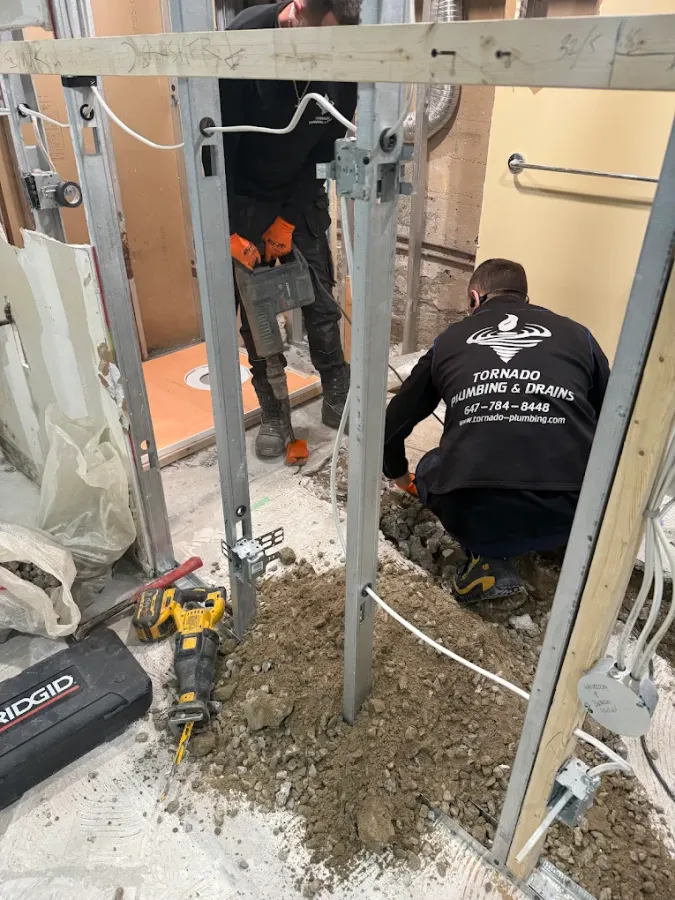
A basement bathroom rough-in is the project where the price difference between 'lucky' and 'unlucky' is bigger than almost any other plumbing job. Lucky: the builder left rough-in stubs in the slab when the home was constructed, and your bathroom slots in for $4,000–$6,000. Unlucky: there's no stub, the gravity-to-main-stack route doesn't work, and you need an ejector basin and pump plus full slab break-in for $9,000–$14,000. This guide explains how to tell which case you're in, what the Toronto plumbing permit and OBC venting requirements actually involve, and the real 2026 pricing for each scope. Before breaking the slab, a drain camera inspection confirms the lateral's condition, and many basement projects add a backwater valve while the floor is already open.
Related services for this guide
If this article matches what you are dealing with, use one of these links to move into the service or broader category that makes the most sense.
Project photos related to this guide
These real project photos help show what this kind of work looks like in the field, not just on the page.
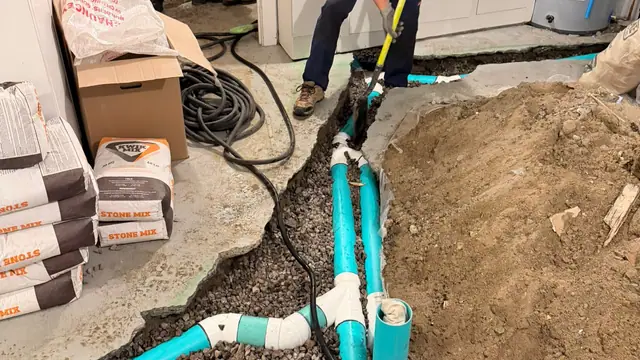
Basement floor opened to replace the under-slab drain lines
Interior drain re-piping, August 2026. The slab was cut along the drain route, the old lines removed, and new PVC drain connections laid on gravel with stub-ups for the fixtures above.
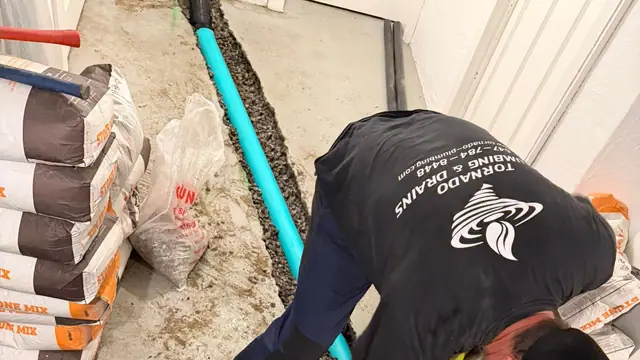
Bedding the new basement drain run in gravel
Same August 2026 basement drain project: each fitting is supported and the run is bedded in clear gravel before restoration, so the slope set during installation does not move.
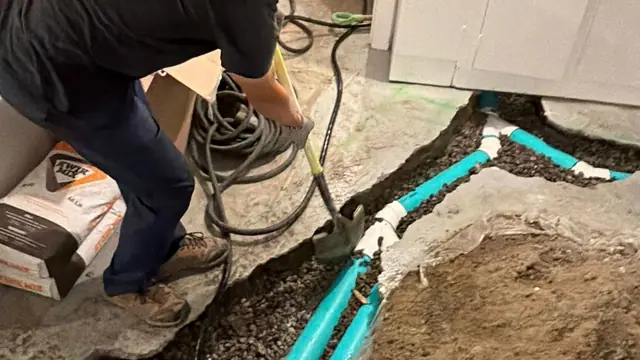
Running the new drain line along the basement wall
Same August 2026 basement drain project: the replacement run follows the original route where slope allowed, with new stub-ups placed for the fixtures being reconnected.
Customer stories related to this topic
These customer stories pair real review quotes with the service pages most closely related to this guide.
Mimi Lam
June 2020“I can’t recommend Tornado plumbing enough. Sergei and his team are literally the best. Sergei always provides the best recommendations and gives you his honest opinion. He doesn’t over sell and gives you the best advice. I had to have my main valve change which was something we had discussed a while ago from another service I had hired him for. The shut off valve was old and had lead component. I knew from past experience that anytime I needed to turn it on or off, it would start leaking. There was also a lead pipe leading underground. I made the decision to change all the lead pipe as opposed to just changing the shut off valve because it would eventually need to be changed regardless. Sergei dug from the front of my house to the water valve in my basement with minimal interruptions to my tenants, and minimal mess. This speaks to his attention to detail. He goes over and beyond my expectations. Thank you Sergei and Tornado Plumbing.”
Most relevant to Plumbing Repairs & Installations in Toronto & the GTA.
Google place photo: Tornado Plumbing & DrainsSharon Muszynski
May 2025“I highly recommend Serhiy. I have used him several times, and he always does quality work. He recently replaced a toilet, faucet, and house shut-off valve, all of which had leaks and were faulty. He knows what he is doing - He is licensed, experienced, efficient, and pays attention to details. His pricing is very fair, and unlike some others, the price doesn't go up based on the area you live in. All this is hard to find in professionals. Someone honest (he won't fix things that don't need repair to create work) and who takes pride in a job well done. I will definitely call him again for future plumbing needs.”
Most relevant to Plumbing Repairs & Installations in Toronto & the GTA.
Google place photo: Tornado Plumbing & DrainsLiza Gan
March 2021“As usual, Tornado Plumbing came to the rescue on time and did their job efficiently and professionally. Thdy fixed the problem quickly and without mess. I am a repeat customer and highly recommend them to anyone who is looking for honest and reliable plumbers.”
Read next in this topic
These related guides help you compare cost, scope, and next steps without starting over.
Best local service areas for this topic
Use one of these city pages when you want the same problem explained through local housing, flood risk, access, and neighbourhood-specific plumbing context.
Licensed, insured, reviewed Toronto plumbers
Serving Toronto & the GTA since 2015 — over 1,200 completed jobs.
Master plumber T95-4969603 · Plumbing contractor T94-4992639 · Drain contractor T87-4722944 · Building renovator T85-4728632 · Plumbing license FI6216638.
4.9-star Google rating from 320+ reviews. 400+ HomeStars reviews (Best of 2019–2025). BBB-accredited.
Same-day and after-hours dispatch across Toronto, Etobicoke, North York, Scarborough, York, Mississauga, and Burlington.
25-year workmanship warranty
Every job Tornado Plumbing & Drains completes in Toronto and the GTA — repair, install, replacement, drain work, sewer work, fixture work — is backed by a 25-year workmanship warranty. The written terms are provided with every quote. If our work fails within 25 years of the install date, we come back and make it right.
Quick answer
Basement bathroom rough-in plumbing in Toronto in 2026 typically runs $3,500–$6,500 if the builder already left rough-in stubs in the slab (toilet flange, drain pit, vent stack), $6,500–$9,500 for a gravity slab break-in (no existing stubs), and $8,500–$13,500 if a new sewage ejector basin and pump are required (no gravity to the main stack) including drains, vent, supply for a 3-piece bath. Toronto plumbing permit is mandatory ($400–$800 in fees and inspection time).
How much does a basement bathroom rough-in cost in Toronto (2026)?
A basement bathroom rough-in in Toronto costs $3,500-$6,500 when builder stubs already exist in the slab, $6,500-$9,500 for a gravity slab break-in, and $8,500-$13,500 when a sewage ejector basin and pump are required. A mandatory City plumbing permit adds $400-$800.
What you should know before booking
Toronto plumbing permit is mandatory for basement bathroom rough-in. Permit + inspection: $400–$800. Plan 2–4 weeks calendar time.
Standard 3-piece rough-in: 3″ toilet drain, 1.5″ lavatory drain, 2″ tub/shower drain, all vented per Ontario Building Code (Part 7).
Ejector basin and pump (when gravity to main stack isn't possible): adds $1,800–$3,500 to the rough-in cost.
Concrete saw-cut and patch is typically 30–40% of the labour budget on a slab break-in.
Air-admittance valves (AAVs) are allowed in Ontario in specified situations — useful for retrofits but not a universal substitute for vent stacks.
Future-proofing (curbless shower, double vanity, barrier-free) adds little cost during rough-in but prevents costly re-work later.
The rough-in itself is permitted and inspected separately from the finishing scope (drywall, tile, fixtures) — the homeowner schedules each phase.
Real Toronto basement bathroom rough-in prices (2026)
Best case. Toilet flange, drain pit, and vent stack already in the slab from original construction. Mostly connection work plus permit/inspection.
Tie into existing builder stubs
$3,500 – $6,500
Best case. Toilet flange, drain pit, and vent stack already in the slab from original construction. Mostly connection work plus permit/inspection.
Slab break-in, gravity to main stack
$6,500 – $9,500
No existing stubs but the bathroom can drain by gravity to the existing main stack. Saw-cut concrete, set drains, run vent, supply rough-in, restore slab.
Ejector basin + pump (no gravity)
$8,500 – $13,500
Gravity to main stack not possible (basement deeper than stack tie-in). Adds basin, pump, vent, and discharge plumbing. Most common scope on older Toronto homes with main stacks at first-floor level.
Full 3-piece slab break-in
$10,500 – $14,000
Full scope: saw-cut for all three drains, set toilet flange, run lav and tub branches, vent through ceiling to existing stack or AAV, supply rough-in for hot/cold.
Permit + inspection
$400 – $800
Toronto plumbing permit fee plus inspection coordination. Tornado pulls the permit on your behalf.
Add for floor drain
+$300 – $700
Optional but strongly recommended in basement bathrooms — protects from future overflow events.
What a complete basement bathroom rough-in actually includes
DWV (drain, waste, vent): 3″ toilet drain with closet flange set in the slab; 1.5″ lavatory drain; 2″ tub/shower drain; full venting through to existing stack (or AAV where allowed by OBC).
Supply rough: 1/2″ hot and cold lines stubbed for lavatory, tub/shower, and toilet supply. Pressure-tested before slab close.
If ejector required: sealed ejector basin set in the slab, 1/2 HP grinder pump, vent line, 2″ discharge plumbed to gravity-flow point above. Sized to match fixture-unit load.
Permit + inspection: pulled by the licensed contractor (us), scheduled with the City inspector, signed-off before slab close.
Not included (separate scopes/contractors): drywall, tile, fixture install (toilet, vanity, shower base), painting, electrical for the bathroom. The rough-in is the plumbing skeleton; finishing is a separate phase usually done after rough-in inspection passes.
Knowing what scope you're actually facing
You're in the cheap zone when
Your home has builder rough-in stubs visible in the basement slab (small concrete patches usually marked, or a capped pipe). The basement floor is below the main stack tie-in, so gravity drainage works. The basement is unfinished, giving easy access for venting.
You're in the expensive zone when
No existing stubs. The basement floor is above where the main stack ties to the lateral (ejector required). The basement is finished, requiring drywall opens for vent routing. The bathroom layout is complex (multiple fixtures, custom shower, etc.).
What we do on the diagnostic visit
Site walk to confirm stub presence, measure floor-to-stack-tie-in elevation, identify vent routing path, and quote both 'stub tie-in' and 'full break-in' scopes if which applies isn't clear. Camera inspection of any existing stubs to confirm they're usable.
Three Toronto basement bathroom rough-ins from the past 90 days
North York, 2008 build, builder stubs present — Toilet flange and 2″ drain pit visible in unfinished slab. Tie-in for full 3-piece, supply rough, vent to existing stack. Total: $4,800. Permit + inspection passed first try. Customer's renovation contractor handled finishing for a separate $9,200 (drywall, tile, fixtures).
Riverdale, 1928 century home, ejector required — Main stack tie-in at first-floor level, basement floor 4 ft below. Required ejector basin + pump, full slab break-in. Total: $11,400 plumbing. Customer combined with backwater valve install ($2,800, $1,600 rebate) since the slab was already open.
Etobicoke, 1972 build, gravity worked — No stubs but basement floor below main stack. Full slab break-in for 3-piece, AAV vent (no through-roof access available). Total: $8,200. Inspection took 2 visits to pass — vent height adjustment required.
Why Toronto basement bathrooms are different
Older central-Toronto homes often have main sewer stacks tied to the lateral at the basement-floor level or above, which means a true gravity rough-in is rare without an ejector. Newer suburban builds (1980s onward) commonly include builder stubs in the slab specifically because basement bathrooms are a known future renovation. Permits and inspections are taken seriously by City inspectors — undocumented basement bathrooms are a known resale issue and an insurance dispute trigger when something fails. The Ontario Building Code Part 7 venting requirements are particular about basement fixtures; we work to OBC and document everything for the inspection sign-off.
What to have ready before you call for a rough-in quote
Send these by text or email before the visit and we can usually confirm gravity-vs-ejector and the right price bracket on the diagnostic instead of guessing on the phone.
Photos of the unfinished basement slab where the bathroom will go — especially any capped pipes, concrete patches, or a visible drain pit that could be builder stubs.
Original builder/sale documents if you have them — many post-2000 builds note 'rough-in for future bath,' which changes the scope and price bracket.
The approximate distance (in feet) from the planned basement floor down to where your main stack ties into the sewer lateral — this is what decides gravity drainage vs. an ejector basin and pump.
Which fixtures you want: 2-piece (toilet + sink) or full 3-piece (adds tub/shower), plus any future-proofing like a curbless shower, double vanity, or barrier-free layout.
Whether there is a clear path through the ceiling/joists to the existing vent stack, or if a through-roof vent is blocked (this affects whether an AAV is needed).
A photo of your main stack and any nearby cleanout, plus the home's approximate build year — older central-Toronto homes often need an ejector that newer suburban builds do not.
Whether you also want a floor drain or backwater valve done while the slab is open, since combining work while concrete is cut saves a second saw-and-patch.
Where to go next
Service page with full scope, ejector vs gravity options, permit handling.
Category overview if you also need fixture install (toilet, vanity, shower valve) post-rough-in.
If ejector is required — the specific service page with pump options.
Detailed walkthrough of the scope, OBC venting, and permit process.
Sources cited in this guide
Ready to book the diagnostic
Book at Rough-In Plumbing for the diagnostic and quote, Sewage Ejector Pump Installation if you already know an ejector is needed. Calls go through 647-784-8448.
Common questions about basement bathroom rough-in
How do I know if my home already has rough-in stubs?
Look for capped pipes or small concrete patches in the basement slab where a future bathroom would logically go. Also check builder documents from the original sale — many post-2000 builds explicitly note 'rough-in for future bath.' If unclear, a 30-minute diagnostic visit confirms presence and condition. Builder stubs that exist but are damaged or improperly sized still need replacement, just at a lower scope than full break-in.
Do I really need an ejector pump?
Only if the basement floor is below where the main stack ties into the lateral. Gravity drainage to the lateral is always preferred when possible. Ejector pumps are reliable but add $1,800–$3,500 to the cost and need periodic maintenance and replacement (typically 8–12 years). Confirmed via measurement on the diagnostic visit.
Can I do the rough-in without a permit to save money?
No. Toronto requires permits for basement bathroom rough-in, and an unpermitted basement bath is a future resale problem (inspectors flag it on home inspections, lawyers flag it on title) and an insurance dispute trigger when something fails. Permit is part of the scope, not an extra cost-cutting target. Tornado pulls the permit; the homeowner doesn't deal with the City directly.
How long does the rough-in take from start to inspection?
Typical residential rough-in: 2–4 days of work plus 1–2 weeks of inspection scheduling. Full project (rough-in to finished bathroom) usually takes 4–8 weeks calendar time including the rough-in inspection wait, then the finishing scope, then the final inspection.
Explore more