Drain Inspection & Cleaning Guide for Toronto Homes: The Workflow That Prevents Surprises
By Serhiy Marunchuk, Master Plumber · Licence T95-4969603 · Updated August 17, 2026
Inspect first, clean second. Camera ($250–$650) reveals pipe condition, then snake/jet/descale is matched to what's actually there. Pays back through fewer repeat calls and earlier catches on root intrusion.
Published February 26, 2026 · Last updated August 17, 2026
Introduction
The most common Toronto drain mistake we see is reaching for the snake before knowing what's in the line. A snake on a clay lateral with severe root intrusion gives you a few weeks before the next backup. A jet on fragile cast iron can fail the pipe entirely. Inspect first, clean to match — this guide explains the workflow, when annual inspection makes sense, and what 'pipe-condition-aware' drain service actually delivers in dollars and avoided emergencies. If you need the work handled rather than researched, see drain inspection & cleaning Toronto for pricing, process, and booking. When the camera shows buildup, drain cleaning matched to pipe condition clears it; when it shows damage, drain repair is the honest recommendation.
Related services for this guide
If this article matches what you are dealing with, use one of these links to move into the service or broader category that makes the most sense.
Project photos related to this guide
These real project photos help show what this kind of work looks like in the field, not just on the page.
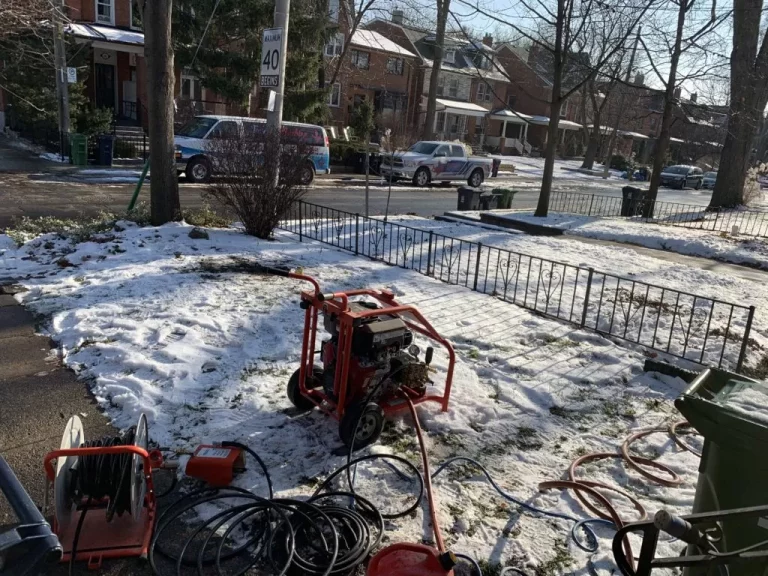
Drain-cleaning equipment set up before line clearing
This image shows the equipment-prep stage of a drain-clearing job, where the line condition still needs to be confirmed before it is obvious whether cleaning alone will solve it.

Close-up of drain access and service equipment
This photo focuses on the actual drain access point and the equipment staged to inspect and clear the affected line.

Drain service setup on a stone terrace
This wider view shows the real access conditions and equipment footprint during an exterior drain inspection and clearing visit.
Customer stories related to this topic
These customer stories pair real review quotes with the service pages most closely related to this guide.
kevin
May 2024“I had a cast iron stack in my bsmt with a huge crack that was just about to give out. After obtaining a few quotes I decided to hire Tornado given the positive reviews, fair pricing, and there fast response time. The crew were here within an hour, very professional, worked quickly, and left the space immaculate. I recommend them without hesitation. Thank you Serhiy and crew!”
Most relevant to Sewer Line Repair in Toronto & the GTA.
Google place photo: Tornado Plumbing & Drains
“Highly recommend Tornado Plumbing. Serhiy is professional, punctual, and incredibly efficient. We had to get are main line corrected along with properly venting are current plumbing and a drain floor drain added for are laundry room. Serhiy and his team looked over the job, advised on some better recommendations to insure we proper flow. Work was completed, fully cleaned up. I’ll never recommend another plumber, one of the best in the city. Truly appreciate the honesty and quality work.”
Most relevant to Drain & Sewer Services in Toronto & the GTA.
Google place photo: Tornado Plumbing & DrainsLuis Escobar
May 2021“I asked Tornado to come and inspect my main drain as it was constantly backing up and causing the house to smell like sewage. They came quickly and helped me identify the problem: roots inside the old clay pipe. Since the problem was really bad, they schedule the repair the very next day and finish the job without any issues in less than 2 days. During the job excavation, they identified the water supply line being lead (really bad for you) and recommended to do the replacement to 3/4" cooper. They offered me a generous discount since the excavation was already completed, so I took them up on the offer to replace both pipes at once. They completed the job without any issues and within the time previously agreed (less than 2 days), and all while having very little disturbances to our water and drain usage during the work. Overall great job!”
Most relevant to Drain & Sewer Services in Toronto & the GTA.
Google place photo: Tornado Plumbing & DrainsRead next in this topic
These related guides help you compare cost, scope, and next steps without starting over.
Best local service areas for this topic
Use one of these city pages when you want the same problem explained through local housing, flood risk, access, and neighbourhood-specific plumbing context.
Licensed, insured, reviewed Toronto plumbers
Serving Toronto & the GTA since 2015 — over 1,200 completed jobs.
Master plumber T95-4969603 · Plumbing contractor T94-4992639 · Drain contractor T87-4722944 · Building renovator T85-4728632 · Plumbing license FI6216638.
4.9-star Google rating from 320+ reviews. 400+ HomeStars reviews (Best of 2019–2025). BBB-accredited.
Same-day and after-hours dispatch across Toronto, Etobicoke, North York, Scarborough, York, Mississauga, and Burlington.
25-year workmanship warranty
Every job Tornado Plumbing & Drains completes in Toronto and the GTA — repair, install, replacement, drain work, sewer work, fixture work — is backed by a 25-year workmanship warranty. The written terms are provided with every quote. If our work fails within 25 years of the install date, we come back and make it right.
Quick answer
Drain inspection and cleaning in Toronto starts with a camera inspection ($250–$650) to identify the actual condition of the line, followed by the right cleaning method (snake for soft clogs, jet for grease/scale/roots, descaling for cast iron) — then a post-clean camera to confirm the result. Total workflow $400–$900 for a residential service line. Inspection-first prevents the wrong tool being used on fragile pipe and pays back through fewer repeat calls.
Why inspect-first changes the math
Inspection-first prevents the wrong tool being used on fragile pipe — high-pressure jetting on rotted cast iron can fail the line.
Snake handles paper, hair, and grease film; jet handles set grease, mineral scale, and roots; cast-iron descaling is its own specialty.
Post-clean camera footage is the proof that the line is actually clear — and the baseline for future inspections.
Annual camera inspection on the sewer main catches root intrusion before it causes a backup; cheapest preventive maintenance in plumbing.
Common Toronto findings (Tornado data): root intrusion ~38%, cracked clay laterals ~22%, bellies/sags ~14%, grease coating ~11%.
PACP (NASSCO) coding standardizes the report so insurers, lawyers, and future plumbers can read it consistently.
Inspect-first workflow turns most surprise emergency calls into scheduled repair scope — meaningfully cheaper and less disruptive.
The inspect-first drain workflow
| Step | What we do | Why it matters |
|---|---|---|
| 1. Camera inspection | Run camera through the line, document with PACP-style report | Identifies pipe material, condition, and the actual cause of the slowdown |
| 2. Match cleaning method | Snake / jet / descale — chosen for the actual conditions | Wrong tool on fragile pipe = failed pipe; right tool = lasting clean |
| 3. Run the cleaning | Operate within safe pressure for the pipe condition | Tornado's drain-contractor-certified technicians handle this |
| 4. Post-clean camera | Re-run camera after cleaning, confirm pipe wall is clear | Proves the line is actually clean, not just opened |
| 5. Recommend next-step (if any) | Scope follow-up repair if the camera shows structural issues | Catches the long-term issue while you're already engaged |
| 6. Provide footage and report | Email recorded video and written report | Your record for insurance, resale, and next plumber |
When inspection-first is mandatory vs optional
Always inspect first when
Pipe is older than 30 years (most central-Toronto homes). Backup has happened more than once in 12 months. Pipe material is unknown. Customer is buying or selling. Insurance claim is involved. Pipe condition might rule out high-pressure jetting.
Inspection optional when
Single fresh fixture clog (kitchen sink, bath tub) on a known-modern line. First-time slowdown on a property with no prior issues. The clog is clearly local (you can see what's in there).
Annual inspection contract
For Toronto homes with pre-1970 sewer laterals, annual or biannual camera inspection on the sewer main is the cheapest preventive maintenance available. Catches root intrusion 1–3 years before backup, gives time to plan the spot repair or trenchless lining instead of emergency response.
Why Toronto's pipe stock makes inspect-first non-optional
Toronto's older neighbourhoods have clay sewer laterals (pre-1970) and cast-iron in-house drains (1950s–80s) that fail in distinct ways the camera reveals. Reaching for a high-pressure jet without seeing pipe condition first is how cast iron gets blown through and how recurring backups become structural failures. The City's permit system reinforces this — any sewer line repair beyond a basic snake requires plumbing permit and inspection. Inspect-first is the workflow we run on every Toronto sewer-main job. We've completed 1,200+ inspections; the data informs the recommendation we make.
Matching the cleaning method to the pipe: snake vs jet vs descale
| Method | Clears best | Safe on | Limit / risk to know |
|---|---|---|---|
| Drain snake / rooter | Paper, hair, soft grease film, a single soft clog | Most pipe in fair condition; the gentlest first option | Punches a hole through the blockage but leaves wall coating — roots regrow in weeks on a clay lateral |
| Hydro-jetting | Set grease, mineral scale, and fine roots — scours the full pipe wall | Sound PVC, ABS, and healthy clay where the camera confirms structure | High pressure can blow through rotted cast iron or a cracked clay lateral — never run blind |
| Cast-iron descaling | Hardened tuberculation and rust scale inside aging cast-iron in-house drains | Cast iron specifically — chain/cutter heads sized to the wall | Wrong head or pressure on thin-walled iron causes failure; a specialty, not a default snake |
| Camera inspection first | Nothing — it diagnoses pipe material, condition, and the actual cause | Every line, every time before the first cleaning pass | Adds the camera fee up front, but it's what tells you which of the three methods above is safe |
Sources cited in this guide
Where to go next
When the situation in this guide already matches what we cover, Drain Camera Inspection is the page where you book the visit and see the full scope, pricing, and warranty.
Inspection and cleaning are the front end of every drain decision. The Drain & Sewer Services category shows what comes next — the repair, replacement, or trenchless options — when the camera shows the line needs more than a clean.
Turn the diagnosis into a real route
If you want camera-then-clean-then-camera in one visit, Drain Inspection & Cleaning is the booking page. We confirm the line is actually clean before we leave, not just that the snake came back.
Common questions
When does inspection-then-clean beat clean-only?
Anytime you've cleaned the same line in the past 12 months, anytime multiple fixtures share the slow drainage, and anytime the home is pre-1970 with original clay or cast-iron sewer. Camera-first costs the camera fee but stops you from cleaning a line that needs repair, or repairing a line that just needed cleaning.
Why does the camera run before AND after the clean?
Before: to see what we're cleaning into, so we don't push pressure or a cable through compromised pipe. After: to confirm the line is actually clear and that nothing was missed. The footage stays with you and becomes the baseline for the next time slow drainage shows up.
Is the work warrantied?
Yes. Every job we complete is backed by a 25-year workmanship warranty. The written terms are provided with the quote. If our work fails within 25 years of the install date, we come back and make it right.
Are you licensed in Toronto?
Yes — Master plumber T95-4969603, Plumbing contractor T94-4992639, Drain contractor T87-4722944, Building renovator T85-4728632, Plumbing license FI6216638. Tornado has been serving Toronto and the GTA since 2015 with over 1,200 completed jobs.
Explore more