Pressure Reducing Valve (PRV) Installation in Toronto & the GTA
Toronto & the GTA • Call 647-784-8448
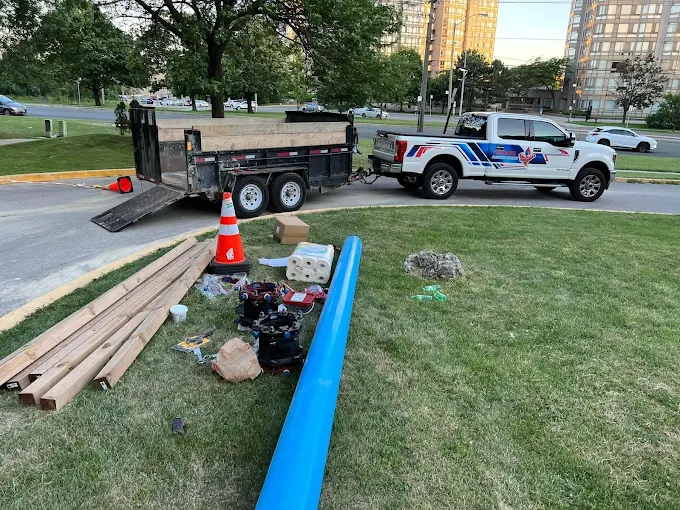
If incoming city pressure is too high, fixtures wear out faster, fittings leak more often, and water heaters and dishwashers fail prematurely. A pressure reducing valve (PRV) drops the pressure to a safe range — usually 50 to 60 psi. Tornado Plumbing & Drains installs and replaces PRVs across Toronto and the GTA where pressure tests show the supply is over the recommended range.
Last updated September 5, 2026
When this service makes sense
Part of Water Lines & Service Upgrades in Toronto & the GTA
Book this service when
Book this when a hose-bib gauge reads above 80 psi, the house has no PRV, an old valve no longer holds its setpoint, or a new heater or dishwasher warranty requires pressure in spec.
Common signs
- A gauge on the hose bib reads above 80 psi, the code limit for residential supply.
- The house has no PRV at all and sits low on a hill or near a pumping station with high street pressure.
- An existing PRV is 15+ years old and no longer holds its setpoint — pressure creeps back up after it's adjusted.
- A new water heater, tankless unit, or dishwasher install requires pressure brought into spec to protect the warranty.
If you're not sure, compare these too
- Water Service Upgrade - when the complaint is low flow, not high pressure
- Shut-Off Valve Replacement & Installation - when the main shutoff next to the PRV also needs replacing
On this page
Quick guide and key details
What changes price and scope
- New install versus replacement of an existing PRV.
- Whether an expansion tank is required.
- How accessible the supply line is at the install point.
How a professional visit usually unfolds
1. Pressure test
Confirm incoming pressure with a gauge. PRV only makes sense when pressure is actually high.
2. Locate install point
Usually right after the main shutoff. Protects the entire home.
3. Install PRV
Cut into the line, install valve and required gauge. Permanent installation.
4. Set target pressure
Adjust output to 50 to 60 psi. Right pressure for fixtures.
5. Add expansion tank if needed
When closed system, an expansion tank prevents thermal pressure spikes. Required by code in many cases.
Recent Pressure Reducing Valve (PRV) Installation work
These real project photos show the kind of work this service involves, so you can see examples before you book.
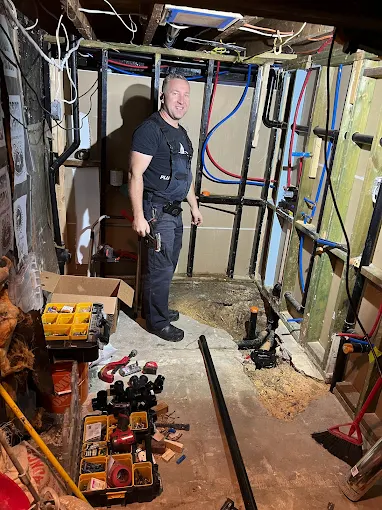
Interior renovation rough-in plumbing in progress
This renovation-stage photo gives rough-in, repiping, and interior plumbing pages a stronger proof image than generic stock-style service graphics.
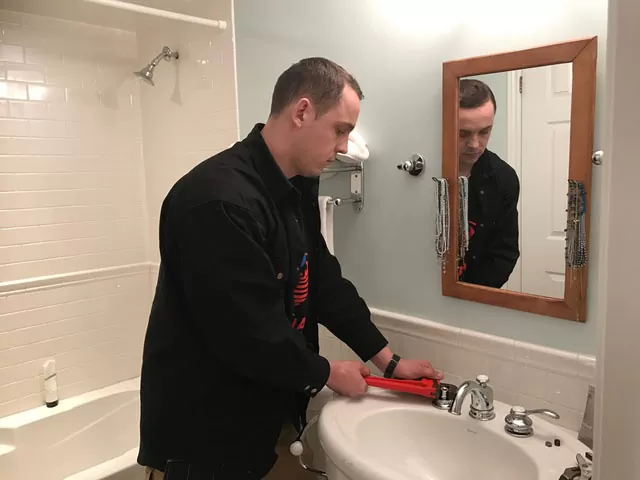
Technician handling a residential interior plumbing service call
This is a useful general indoor-service photo for interior plumbing pages where homeowners want to see a real technician on site instead of generic brand graphics.
PRV installation pricing (Toronto 2026)
| Scope | Starting from | Typical range |
|---|---|---|
| PRV replacement (existing) | $450 | $450 to $900 |
| New PRV installation | $650 | $650 to $1,400 |
| PRV + expansion tank | $850 | $850 to $1,800 |
Ranges are for planning and triage. Final pricing depends on access, urgency, materials, and whether the visit stays isolated once the area is opened.
Cities Where This Service Is a Strong Fit
Related Services
- Main Water Line Repair & Replacement
Main water line repair & replacement in Toronto & GTA: buried service-line leaks, low pressure & water main repairs. Spot repair from $1,800. Book or call.
- Trenchless Water Line Replacement
No-dig trenchless water line replacement in Toronto & GTA: new copper or HDPE pulled through small pits, no driveway dig. From $6,500. Call 647-784-8448.
- Lead Water Service Replacement
Lead pipe replacement in Toronto: remove the private-side lead water service line and coordinate the City public-side swap. From $5,500. Call 647-784-8448.
- Water Service Upgrade
Water service upgrade in Toronto from $6,000: upsize a 1/2 or 5/8 inch line to 3/4 or 1 inch for more pressure and flow. Call 647-784-8448; 25-yr warranty.
- Outdoor Faucet & Frost-Free Hose Bib
Outdoor faucet repair and frost-free hose bib installation in Toronto: replace standard hose bibs with frost-free models, fix leaks, and prevent freeze damage.
- Shut-Off Valve Replacement & Installation
Shut-off valve replacement and installation in Toronto & GTA: main shutoffs that won't close, leaking fixture stops, and adding shutoffs where none exist.
- Water Line Locating
Water line locating in Toronto & GTA: tracing the buried service line, finding leak locations, and marking the route on the surface before excavation.
Related Guides
- Water Pressure & PRV Installation Cost in Toronto (2026): What a Pressure Reducing Valve Really Costs
Pressure reducing valve installation in Toronto costs $450–$1,800 in 2026 depending on whether it's a replacement, a new install, or a PRV plus expansion tank.
- Main Shut-Off Valve Replacement (Toronto): Why It Matters and What It Actually Costs
An aged main shut-off valve fails exactly when you need it most. Gate valves seize in 15–25 years; a quarter-turn ball valve swap takes 1–2 hours, $280–$750.
- Water Service Line Replacement Cost in Toronto (2026): Trenchless vs Open-Cut, Lead vs Copper
Water service line replacement in Toronto: $4,500 to $8,500 trenchless, $6,000 to $14,000 open-cut. What lies under your lawn decides the method and the price.
- Water Service Upgrade in Toronto (2026): When to Replace or Upsize Your Water Main
When to upgrade your Toronto water service: undersized for the home, aged galvanized or copper, lead, or a pool or addition on the way. Sizing to 1-inch HDPE.
- Lead Water Service Replacement (Toronto): Health Risk, Free Testing, and the Free City-Side Replacement Program
Pre-1955 Toronto homes may still have a lead service line. Free City testing, how the shared replacement program splits the cost, and what to do next.
Licensed, insured, reviewed Toronto plumbers
- Serving Toronto & the GTA since 2015 — over 1,200 completed jobs.
- Master plumber T95-4969603 · Plumbing contractor T94-4992639 · Drain contractor T87-4722944 · Building renovator T85-4728632 · Plumbing license FI6216638.
- 4.9-star Google rating from 320+ reviews. 400+ HomeStars reviews (Best of 2019–2025). BBB-accredited.
- Same-day and after-hours dispatch across Toronto, Etobicoke, North York, Scarborough, York, Mississauga, and Burlington.
25-year workmanship warranty
Every job Tornado Plumbing & Drains completes in Toronto and the GTA — repair, install, replacement, drain work, sewer work, fixture work — is backed by a 25-year workmanship warranty. The written terms are provided with every quote. If our work fails within 25 years of the install date, we come back and make it right.
Why a PRV is the fix for chronic high pressure
A pressure reducing valve is a spring-loaded brass valve that sits on the main line just past your shutoff and holds downstream pressure at a fixed setpoint no matter how high the city side climbs. The spring tension is set against a diaphragm, so once we dial in the outlet, the valve throttles incoming flow to keep the house at a tested 50 to 60 psi even as street pressure swings overnight. Because a PRV closes the system off from the street, code requires a thermal expansion tank so water-heater heat-up has somewhere to go instead of spiking pressure back into the danger zone. If your symptoms point to a single bad fixture rather than whole-house pressure, see Faucet Repair & Replacement before committing to a PRV.
When homeowners book a PRV install
- A gauge on the hose bib reads above 80 psi, the code limit for residential supply.
- The house has no PRV at all and sits low on a hill or near a pumping station with high street pressure.
- An existing PRV is 15+ years old and no longer holds its setpoint — pressure creeps back up after it's adjusted.
- A new water heater, tankless unit, or dishwasher install requires pressure brought into spec to protect the warranty.
- An expansion tank or relief valve keeps having to be replaced because nothing upstream is capping the incoming pressure.
- A home inspection or insurance review flagged the supply pressure as out of range before a sale.
What's included
- Gauge test of static and, where relevant, peak incoming pressure to confirm a PRV is the right fix.
- Supply of the correctly sized PRV in brass, plus any required test gauge or pressure gauge on the outlet.
- Shut down and drain of the main, cut-in at the install point just past the shutoff, and soldered or pressed connections.
- Adjustment and lock of the outlet pressure to a tested 50 to 60 psi target, verified at multiple fixtures.
- Thermal expansion tank added when the system is closed, as required by code, to absorb water-heater pressure spikes.
- Cleanup of the work area, removal of the old valve, and a written 25-year workmanship warranty on the install.
Signs of high water pressure:
- Banging or hammering pipes when valves close.
- Repeat fixture leaks (faucet cartridges, toilet fill valves).
- Toilet fill valve hisses or runs constantly.
- Water heater T&P relief valve drips.
- Appliances (dishwasher, washing machine) failing prematurely.
- Spitting at faucets when first opened.
PRV installation cost
Pricing depends on whether the work is new install or replacement, whether an expansion tank is required, and how accessible the supply line is at the install point. Replacement of an existing PRV is the lowest range. New installation with expansion tank is higher.
What to share when you call
- Pressure symptoms.
- Whether a PRV already exists.
- Approximate age of the existing PRV if there is one.
- Photos of the main shutoff area.
- Any expansion tank already installed.
- Recent water heater issues.
Toronto context
Toronto street pressure can swing 60-100 psi depending on neighborhood and elevation. A PRV protects the home's plumbing from the high end — preventing premature failure on dishwasher hoses, toilet fill valves, and aged solder joints. We size the PRV to the home's flow demand, not just the line size.
When this is not enough
A new PRV protects the plumbing going forward. It does not undo damage from years of high pressure. If high pressure has already failed valves, weakened supply lines, or cracked fixtures, the right next step is a repipe or supply-line repair scope alongside the PRV install — not just the valve.
What to confirm before approving PRV work
- Pressure should be tested before recommending a PRV.
- Expansion tank requirements should be addressed for closed systems.
- Output pressure should be set to the right range and verified at fixtures.
Useful info on the call: pressure symptoms, existing PRV status, and water heater behaviour.
Frequently asked questions
What is the right water pressure for a home?
Generally 50 to 60 psi. Above 80 psi is too high for most fixtures and appliances. Below 40 psi feels weak.
How long do PRVs last?
Typical residential PRVs last 10 to 15 years. Failed PRVs often cause sudden high pressure, leaks at fixtures, and water heater issues.
Do I need an expansion tank with a PRV?
Often yes. A PRV creates a closed system, which means thermal expansion from a water heater has nowhere to go. An expansion tank handles that pressure spike. Code requires it in many situations.
Will a PRV fix low pressure?
No — a PRV only reduces pressure. Low pressure usually points to the buried service line, the city tap, or interior pipe restriction. Different fix.
Related services
Pressure Reducing Valve (PRV) Installation: real customer reviews
Recent Google reviews from Tornado customers across Toronto and the GTA, in their own words.
Kevin
October 2019“I called a couple of plumbers to help investigate a water leak in our main water line. Sergey at Tornado Plumbing was the most attentive and the only contractor that actually came to our place to look at the issue. All other contractors simply recommended replacing the water main and provided a quote using Google Maps and did not show up at the house at all. Sergey provided me with the option to fix the leak which was located just below the slab in the basement, but his recommendation was to replace our side of the water main as it was old lead pipe. Once our side was completed I could notify the city and they would schedule a time to replace the city side using a city contractor. We had some water damage in our basement because of the leak so Sergey scheduled a team to arrive within 24 hours after signing the project estimate. The team that arrived were excellent. They needed to do a little discovery to find the main water line in our front property as the location marking wasn't exact. They didn't get discouraged and found the old lead pipe and completed the work by torpedoing a new ¾" copper line from inside the house. The leak had created a lot of water under the basement slab which made the work a little difficult but the team worked in to the evening to make sure everything was complete, holes filled back in, new concrete poured, and to be sure the water in the house was working as expected. Everything was cleaned up perfectly and Sergey followed up on the work within a couple of days when he was back in the area to provide another estimate. Overall the experience with Tornado Plumbing was excellent. We need to install a sump pump (Sergey's recommendation) and replace our basement slab in the future – I'll definitely be calling Sergey at Tornado Plumbing.”
Most relevant to Main Water Line Repair & Replacement in Toronto & the GTA.
Google place photo: Tornado Plumbing & DrainsGreg Tsarev
May 2022“Professional service and fair price. Definitely recommend and will use again if needed.”
Jason Wang
December 2018“Great service, clean kitchen sink very well, highly recommend.”
Authoritative sources for this service
Public references — City of Toronto programs, federal guidelines, and standards bodies — used for the rules and figures cited on this page.
- City of Toronto — Priority Lead Water Service Replacement Program(city)
- CSA B125.3 — Plumbing fittings(standard)
- Toronto Public Health — Free residential lead-in-water testing(city)
- Health Canada — Drinking Water Quality: Lead (MAC 0.005 mg/L)(federal)
- Ontario Building Code — Part 7: Plumbing Services(regulator)
- Ontario One Call — locate before you dig(regulator)
Other services homeowners often compare with this one
If your situation could fit one of these adjacent services instead, open the page that matches more closely before you book.
Fast answers before you call
What is the right water pressure for a home?
Generally 50 to 60 psi. Above 80 psi is too high for most fixtures and appliances. Below 40 psi feels weak.
How long do PRVs last?
Typical residential PRVs last 10 to 15 years. Failed PRVs often cause sudden high pressure, leaks at fixtures, and water heater issues.
Do I need an expansion tank with a PRV?
Often yes. A PRV creates a closed system, which means thermal expansion from a water heater has nowhere to go. An expansion tank handles that pressure spike. Code requires it...
Will a PRV fix low pressure?
No — a PRV only reduces pressure. Low pressure usually points to the buried service line, the city tap, or interior pipe restriction. Different fix.
Book Pressure Reducing Valve (PRV) Installation today.
Tornado Plumbing & Drains handles Pressure Reducing Valve (PRV) Installation across Toronto and the GTA. Call 647-784-8448 or book online for a clean diagnosis, written scope, and the 25-year workmanship warranty on every install and repair.