Main Shut-Off Valve Replacement (Toronto): Why It Matters and What It Actually Costs
By Serhiy Marunchuk, Master Plumber · Licence T95-4969603 · Updated August 17, 2026
Replacing an aged or seized main shut-off with a quarter-turn ball valve runs $280–$750 in Toronto. The math is one-sided: a $400 valve replacement vs $8,000–$25,000 in finishes when you can't shut the water off in 5 minutes.
Published February 26, 2026 · Last updated August 17, 2026
Introduction
The main shut-off valve is the single most important valve in your home — and the most commonly neglected. Older gate valves seize within 15–25 years, leaving you helpless when a pipe bursts upstairs and water is pouring through the kitchen ceiling. Replacing it with a modern quarter-turn ball valve is a 1–2 hour job, costs $280–$750 in Toronto, and is the cheapest insurance any homeowner can buy. This guide explains why it matters, where your shut-off should be, and when to replace before failure. If you need the work handled rather than researched, see shut-off valve replacement Toronto for pricing, process, and booking. If your valve is seized during an active leak, call our emergency plumbing service; a corroded valve can also signal issues with the main water line itself.
Related services for this guide
If this article matches what you are dealing with, use one of these links to move into the service or broader category that makes the most sense.
Project photos related to this guide
These real project photos help show what this kind of work looks like in the field, not just on the page.
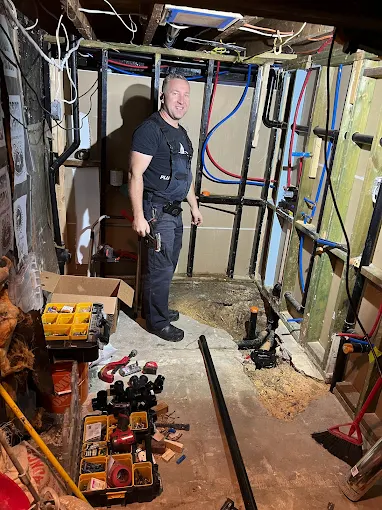
Interior renovation rough-in plumbing in progress
This renovation-stage photo gives rough-in, repiping, and interior plumbing pages a stronger proof image than generic stock-style service graphics.
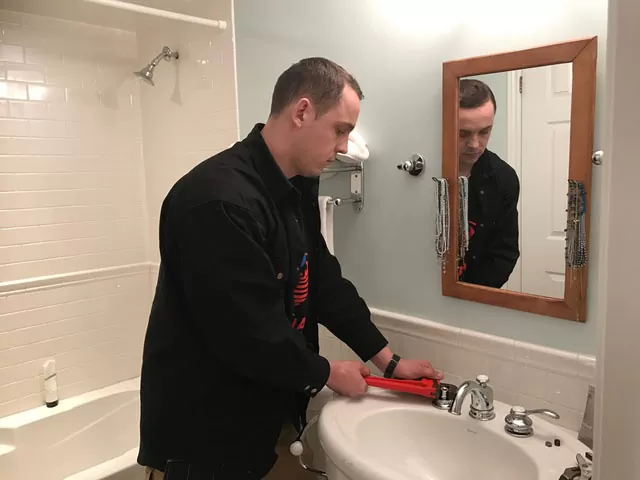
Technician handling a residential interior plumbing service call
This is a useful general indoor-service photo for interior plumbing pages where homeowners want to see a real technician on site instead of generic brand graphics.
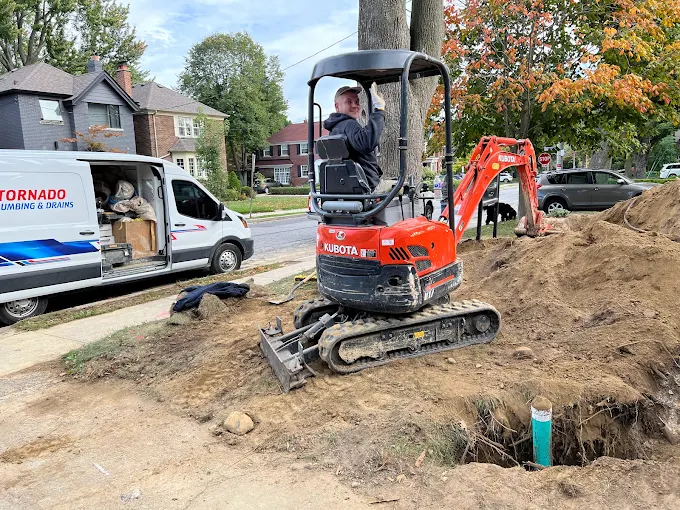
Residential service-line excavation in progress
This proof image shows the work stage where access, depth, and the surface route are already affecting time and cost on a buried service-line job.
Customer stories related to this topic
These customer stories pair real review quotes with the service pages most closely related to this guide.
Kevin
October 2019“I called a couple of plumbers to help investigate a water leak in our main water line. Sergey at Tornado Plumbing was the most attentive and the only contractor that actually came to our place to look at the issue. All other contractors simply recommended replacing the water main and provided a quote using Google Maps and did not show up at the house at all. Sergey provided me with the option to fix the leak which was located just below the slab in the basement, but his recommendation was to replace our side of the water main as it was old lead pipe. Once our side was completed I could notify the city and they would schedule a time to replace the city side using a city contractor. We had some water damage in our basement because of the leak so Sergey scheduled a team to arrive within 24 hours after signing the project estimate. The team that arrived were excellent. They needed to do a little discovery to find the main water line in our front property as the location marking wasn't exact. They didn't get discouraged and found the old lead pipe and completed the work by torpedoing a new ¾" copper line from inside the house. The leak had created a lot of water under the basement slab which made the work a little difficult but the team worked in to the evening to make sure everything was complete, holes filled back in, new concrete poured, and to be sure the water in the house was working as expected. Everything was cleaned up perfectly and Sergey followed up on the work within a couple of days when he was back in the area to provide another estimate. Overall the experience with Tornado Plumbing was excellent. We need to install a sump pump (Sergey's recommendation) and replace our basement slab in the future – I'll definitely be calling Sergey at Tornado Plumbing.”
Most relevant to Main Water Line Repair & Replacement in Toronto & the GTA.
Google place photo: Tornado Plumbing & DrainsMark Maybank
August 2020“Troy and Mike were great to work with.”
pappy boy
December 2020“They did a great drain repair and power drain wash at my house - fair price for hard work. Happy with their service. I recommend.”
Read next in this topic
These related guides help you compare cost, scope, and next steps without starting over.
Best local service areas for this topic
Use one of these city pages when you want the same problem explained through local housing, flood risk, access, and neighbourhood-specific plumbing context.
Licensed, insured, reviewed Toronto plumbers
Serving Toronto & the GTA since 2015 — over 1,200 completed jobs.
Master plumber T95-4969603 · Plumbing contractor T94-4992639 · Drain contractor T87-4722944 · Building renovator T85-4728632 · Plumbing license FI6216638.
4.9-star Google rating from 320+ reviews. 400+ HomeStars reviews (Best of 2019–2025). BBB-accredited.
Same-day and after-hours dispatch across Toronto, Etobicoke, North York, Scarborough, York, Mississauga, and Burlington.
25-year workmanship warranty
Every job Tornado Plumbing & Drains completes in Toronto and the GTA — repair, install, replacement, drain work, sewer work, fixture work — is backed by a 25-year workmanship warranty. The written terms are provided with every quote. If our work fails within 25 years of the install date, we come back and make it right.
Quick answer
Replacing an aged or seized main shut-off valve in Toronto with a modern quarter-turn ball valve typically costs $280–$750 depending on access. The replacement is non-negotiable when the existing valve won't fully close, leaks at the stem, is corroded, or is older than ~20 years — exactly the conditions where it'll fail when you need it most. Quarter-turn ball valves don't seize, operate in seconds, and are the standard for any modern plumbing install. Annual exercise (open/close cycle) extends valve life on existing installs.
Why this is the cheapest plumbing insurance
Quarter-turn ball valves are 100% open or 100% closed and don't seize. Older gate valves are prone to stem corrosion and stuck stems.
Toronto code requires a functional main shutoff at the water service entry. An inoperable shutoff is a code violation triggered by failed home inspections.
Average burst-pipe damage in Toronto when the main can't be shut off in 5 minutes: $8,000–$25,000 in finishes (insurance industry data).
A main shutoff replacement is typically a 1–2 hour job. Some homes may need an additional isolation valve at the meter if the existing valve is buried in finished wall.
Annual exercise (open/close cycle) extends gate-valve life — most homeowners never do this, which is why the valve fails when it's needed.
Toronto Water owns the meter and shutoff at the curb-stop (street side); the homeowner owns and is responsible for the main shutoff inside the home.
From our service data: ~30% of older Toronto homes we visit have a main shutoff that won't fully close. We discover this on the diagnostic visit, not during the actual emergency.
Real Toronto main shutoff replacement prices (2026)
Existing valve at standard mechanical-room location, copper or brass body, accessible without wall-opening. 1-hour visit.
Standard accessible replacement
$280 – $480
Existing valve at standard mechanical-room location, copper or brass body, accessible without wall-opening. 1-hour visit.
Replacement requiring drywall opening
$420 – $750
Existing valve buried in finished wall. Includes drywall cut and rough patch (paint/finish separately).
Add second isolation valve at meter
+$180 – $320
Best practice on older installs — gives you a backup shutoff inside the home that isn't dependent on the curb-stop.
Whole-home repipe valve replacement
Included
Whole-home repipe scope (PEX or copper) includes new shutoff as standard. Don't pay for it twice.
When to replace vs exercise
Replace now when
Valve won't close fully (water still flows downstream). Visible corrosion, leaks at the stem packing, or rust at the body. Valve is older than ~20 years and has never been replaced. You don't know whether it works (haven't operated it in 5+ years).
Annual exercise is enough when
Valve closes fully, opens fully, no leaks. Valve is a quarter-turn ball valve in good condition. You exercise the valve at least annually.
Free check on any visit
We test the main shutoff on every diagnostic visit at no charge. If it fails, we tell you on the spot — and quote the replacement. Most replacements happen during the same visit if you decide to proceed.
Where Toronto homes typically have their main shutoff
Older Toronto homes (pre-1990): typically near the front of the basement, where the water service enters from the street side. Often buried in cob-webs or behind boxes — homeowners frequently don't know where it is until the emergency. Newer suburban GTA builds (1990+): typically in a dedicated mechanical room with the water meter and main shutoff together, easily accessible. Condos and townhouses: usually a dedicated valve in the unit's mechanical closet, plus a building-side valve the property manager controls. We mark the location during every install or service visit so the homeowner knows where to go in an emergency. Many Toronto insurers now ask whether the homeowner can locate and operate the main shutoff — knowing the answer is part of the basic homeowner readiness.
Old gate valve vs modern quarter-turn ball valve
| What matters | Gate valve (older) | Quarter-turn ball valve (modern) |
|---|---|---|
| How you operate it | Many turns of a round handle; easy to lose track of open vs closed | 90-degree handle turn; closes in seconds, handle position shows state at a glance |
| Failure mode | Stem corrodes and seizes; sliding gate wears and won't fully seal | No sliding gate or stem packing to seize; reliably 100% open or 100% closed |
| When it fails on you | Won't close during the burst-pipe emergency you bought it for | Stays operable for the life of the install |
| Stem and seal leaks | Stem packing leaks with age — a common slow drip | No stem packing to leak |
| Typical service life | Seizes within 15-25 years; needs annual exercise to last | Decades with no exercise routine required |
| Code standing in Toronto | Inoperable gate valve fails home inspection and breaches the functional-shutoff requirement | Modern code default; the standard upgrade on any shut-off valve replacement |
Where to go next
Service page with full scope, ball valve options, and the install warranty.
Whole-home inspection that includes shutoff testing — annual or pre-emergency.
If multiple valves are aged, repipe of the affected section is sometimes the better economic answer.
Full water-line scope including main service replacement and PRV install.
Sources cited in this guide
Find out if your shutoff actually works
We test the main shutoff on every diagnostic visit. If it fails, replace before the next emergency proves it. Book at Shut-Off Valve Replacement & Installation. Calls go through 647-784-8448.
Common questions about Toronto main shutoff valves
How do I test if my main shutoff actually works?
Turn it clockwise until firm, then open a faucet downstream. If water continues to flow, the valve isn't sealing. Don't force it — old gate valves can break the stem off in your hand. Call for assessment instead.
Where should the main shutoff be?
Inside the home, on the supply side of the water meter, immediately accessible. Best practice (and modern code) puts it at a height and location where any adult in the household can find and operate it in 30 seconds without tools or instructions.
Why are quarter-turn ball valves better than gate valves?
Ball valves: handle rotates 90 degrees, valve is fully open or fully closed, no stem packing to leak, no internal threads to seize. Gate valves: handle rotates many turns, valve uses a sliding gate that wears, stem packing leaks with age, gate seizes from corrosion or scale. Modern code defaults to ball valves; replacing aged gates is the standard upgrade.
Is the work warrantied?
Yes — Tornado's 25-year workmanship warranty applies to the valve install: the connection, the body, the operation. The valve mechanism itself carries the manufacturer warranty (typically 5–10 years on quality brands like Apollo or Watts).
Explore more