Frozen Pipes in Toronto: Prevention, Safe Thawing, and Repair Options
By Serhiy Marunchuk, Master Plumber · Licence T95-4969603 · Updated September 5, 2026
Toronto frozen pipes are most common in exterior walls, unheated garages, and uninsulated crawlspaces during cold snaps below -15°C. Safe thawing: open the faucet, apply gentle heat, never use open flame. Call a plumber if the pipe has burst or you can't locate the freeze.
Published February 26, 2026 · Last updated September 5, 2026
On this page
Related services
Get a free estimate
Introduction
Toronto winters reliably produce sub-zero stretches that freeze pipes in vulnerable locations — exterior walls, unheated garages, uninsulated crawlspaces, hose-bib spigots. The good news: most frozen pipes can be safely thawed without burst. The bad news: a frozen pipe that bursts when it thaws is one of the leading causes of mid-winter water-damage claims in Toronto. This guide covers prevention before the cold snap, safe thawing during, and when to call a licensed plumber. If a frozen pipe has already split or burst, skip the thawing steps and call our emergency plumbing service before the ice plug lets go.
Related services for this guide
If this article matches what you are dealing with, use one of these links to move into the service or broader category that makes the most sense.
Project photos related to this guide
These real project photos help show what this kind of work looks like in the field, not just on the page.
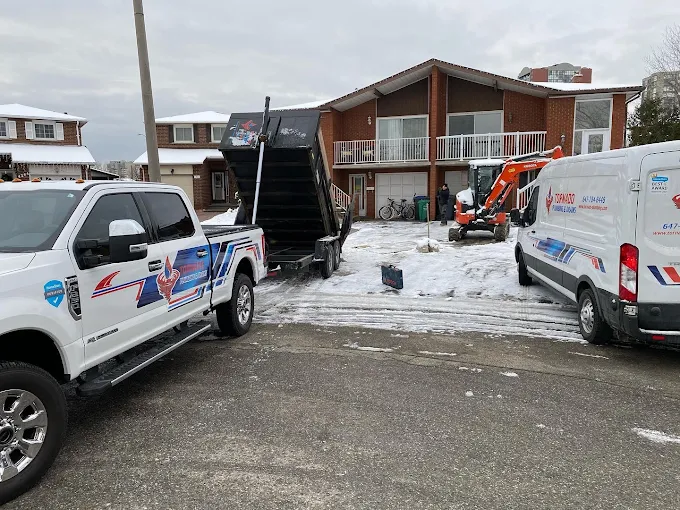
Winter emergency plumbing jobsite with trucks and excavation equipment
This winter jobsite photo helps emergency-service pages show what a real response looks like when the problem cannot wait and outdoor access, weather, and urgency all affect scope.

Serhiy on an active plumbing job site
This owner-led job-site photo reinforces that the company is showing real field work, not stock construction imagery.

Technician working under a kitchen sink
This is a straightforward interior-service photo that supports fixture repair, leak investigation, and small-space plumbing work.
Customer stories related to this topic
These customer stories pair real review quotes with the service pages most closely related to this guide.
Cameron Bishop
November 2020“Troy did an amazing job for us. Kitchen sink backed up, and we tried everything (all the easy tricks) to no avail. Tornado came in same day and successfully diagnosed the issue. He came back next day and went above and beyond (including a few extras that we never even asked for, but were very valuable add ons), finishing the job right on time and budget. Great experience with this entire company, even with the head office contact who helped book us in quickly and efficiently (great response time from Mike as well throughout). Highly recommend, and they've now become our go-to for anything plumbing related.”
Most relevant to Emergency Plumbing Service in Toronto & the GTA.
Google place photo: Tornado Plumbing & DrainsKaryn pope
December 2021“I can not say enough great stuff about our dealings with this company from the first phone call and consultation, to fitting us in the same day due to our own work constraints, to the quality of the work performed. Peter’s servicing of a most difficult drainage problem, was extremely knowledgeable, calm, patient, determined and persistent in solving our issues. His work was clean and tidy and respectful of our property. From start to finish this company was a true delight to use and pricing was very fair. I highly recommend them.”
Most relevant to Emergency Plumbing Service in Toronto & the GTA.
Google place photo: Tornado Plumbing & DrainsR D
March 2019“After the recent wild deep freeze/thaw we had in the GTA, we had a burst pipe in our basement. After calling around a number of plumbers and checking reviews, Tornado not only gave me the lowest quote, but more importantly, was the only one able to come do the job within a couple of hours. Sergey drove across the city so that I wouldn't have to wait till the next day with my water shut off. He updated me when he was a little delayed (appreciated this), and was clean and meticulous while he completed the job. He was great to talk to, gave tips on things he saw and generally put me at ease during a stressful situation. All in all, i'm 100% satisfied with him and am glad to have found a good reliable plumber if needed in the future.”
Most relevant to Burst Pipe Repair in Toronto & the GTA.
Google place photo: Tornado Plumbing & DrainsRead next in this topic
These related guides help you compare cost, scope, and next steps without starting over.
Best local service areas for this topic
Use one of these city pages when you want the same problem explained through local housing, flood risk, access, and neighbourhood-specific plumbing context.
Licensed, insured, reviewed Toronto plumbers
Serving Toronto & the GTA since 2015 — over 1,200 completed jobs.
Master plumber T95-4969603 · Plumbing contractor T94-4992639 · Drain contractor T87-4722944 · Building renovator T85-4728632 · Plumbing license FI6216638.
4.9-star Google rating from 320+ reviews. 400+ HomeStars reviews (Best of 2019–2025). BBB-accredited.
Same-day and after-hours dispatch across Toronto, Etobicoke, North York, Scarborough, York, Mississauga, and Burlington.
25-year workmanship warranty
Every job Tornado Plumbing & Drains completes in Toronto and the GTA — repair, install, replacement, drain work, sewer work, fixture work — is backed by a 25-year workmanship warranty. The written terms are provided with every quote. If our work fails within 25 years of the install date, we come back and make it right.
Quick answer
Frozen pipes in Toronto are most common in exterior walls, unheated garages, and uninsulated crawlspaces during cold snaps below -15°C. Prevention: insulate exposed pipes, keep heat above 13°C in unfinished spaces, drip cold faucets during cold snaps, disconnect outdoor hose-bib supplies in fall. Safe thawing: open the affected faucet, apply gentle heat (hair dryer, heat tape), never an open flame. Call a plumber if the pipe has burst or you can't locate the freeze. A 1/8″ frozen-pipe split releases 950+ litres per day at typical home pressure once thawed.
How do you safely thaw a frozen pipe in Toronto?
Open the affected faucet, then apply gentle heat (hair dryer, heat tape, or space heater) starting at the faucet and working back toward the freeze; never use an open flame. Pipes freeze at -7°C or colder, mostly below -15°C cold snaps. Call a plumber if it has burst — a 1/8″ split releases 950+ litres per day once thawed.
Toronto frozen pipe facts
Pipes typically freeze at -7°C ambient or colder, depending on insulation and exposure.
A 1/8″ frozen-pipe split releases 950+ litres per day at typical home pressure once thawed.
Frozen-pipe burst-and-thaw is the leading cause of mid-winter burst-pipe insurance claims in Toronto (IBC data).
Heat tape (UL-listed) is safe and effective for known-vulnerable pipes; foam pipe insulation handles the rest.
Outdoor hose-bib freeze-up is one of the most common causes — disconnect the hose in the fall and use a frost-free hose bib for permanent fix.
Open-flame thawing (propane torches) is the leading cause of attic and wall fires from amateur thawing — never use it.
Tornado dispatches frozen-pipe thawing same-day and after-hours during Toronto cold snaps.
DIY thaw vs call
DIY thaw is fine when
Pipe is accessible (visible, can apply heat directly). Freeze is at a known location (specific faucet not running). Pipe hasn't burst (no water dripping or visible damage). You're comfortable with the heat-source instructions.
Call when
Pipe has burst or shows signs of splitting (water dripping, ice expansion). Freeze is in a wall or behind drywall (need pro to locate without damage). You can't find the source of the no-water condition. Multiple pipes are frozen simultaneously.
What we bring
Thawing equipment (heat coil, hot water lines, thermal imaging to locate the freeze), pipe replacement materials, valve isolation tools. Most frozen-pipe calls are 1–2 hours total — locate, thaw, repair if burst, restore service.
Where Toronto pipes freeze most often
Toronto's housing stock has known freeze-vulnerable spots: north-wall kitchen sinks (cabinet against an exterior wall), unheated mudroom and garage supply lines, hose-bib spigots that weren't disconnected in fall, basement laundry tubs against exterior walls, and crawlspace runs in older homes without insulation. Cold snaps below -15°C are when these freeze; longer cold periods (multi-day) are when even normally-warm pipes freeze. Pre-winter prevention (foam insulation, heat tape on known-vulnerable runs, hose-bib disconnect) is meaningfully cheaper than emergency thawing or burst repair. Frost-free hose bibs are the permanent fix for outdoor freeze risk.
Sources cited in this guide
What to have ready when you call about a frozen pipe
Have your main shutoff located before you start thawing — if the frozen section has split, water flows the moment the ice releases, and the difference between a wet floor and a flooded basement is how fast you can close that valve.
Which fixture or run lost flow — north-wall kitchen tap, basement laundry tub, garage line, hose bib, or whole sections — and whether any other taps in the house still run.
Whether you see, hear, or feel any water escaping (drips, a bulge, a frost patch on the pipe, water staining drywall) — this tells us thaw vs. burst before we arrive.
Where your main water shutoff is, and whether you have already closed it; if you have not located it, say so on the call and we will walk you through it.
The location and access to the suspected freeze — exterior-wall cabinet, unheated crawlspace, garage, attic run — and whether it is reachable or behind finished walls.
What you have already tried (open faucet, hair dryer, space heater) and for how long — and confirm no open flame or propane torch has been used.
A photo of the affected pipe, the fixture, and any visible water damage, plus the temperature in that space if it is unheated.
Whether this same pipe has frozen in past winters, so we can quote thawing now and a permanent fix (insulation, heat tape, repipe, or frost-free hose bib) together.
Where to go next
When the situation in this guide already matches what we cover, Frozen Pipe Thawing & Repair is the page where you book the visit and see the full scope, pricing, and warranty.
Thawing is the emergency; preventing the next freeze is the engineering. The Plumbing Repairs & Installations category covers pipe insulation, repiping vulnerable runs, and outdoor faucet replacement so the pattern doesn't repeat.
After the first-response steps
If you have a frozen line right now, Frozen Pipe Thawing & Repair is the booking page — safe thawing same day. If the same line keeps freezing winter after winter, Pipe Repair & Repiping is where the permanent fix lives.
Common questions about frozen pipes
How do I know a pipe is frozen?
The usual sign is no water or a weak trickle at one fixture during freezing weather, especially on exterior walls, garages, crawlspaces, or poorly heated rooms. Frost on exposed pipe and sudden pressure loss after a cold night are also warning signs.
What should I never use to thaw a frozen pipe?
Never use an open flame, torch, heat gun aimed at combustible materials, or any method that can overheat plastic pipe. Use gentle heat, keep the faucet open, and call if the pipe is hidden, inaccessible, cracked, or near electrical.
Should I shut the water off if a pipe freezes?
If you see a split, hear running water, or suspect the pipe may burst when thawed, shut the main valve. If there is no visible leak, opening the affected faucet can relieve pressure while thawing, but monitor closely because a frozen pipe may already be cracked.
Why do frozen pipes burst after they thaw?
Ice blocks the line and pressure builds between the blockage and the closed fixture. The split may stay sealed by ice until thawing starts, then water escapes quickly. That is why thawing must be slow and watched carefully.
Can you repair frozen pipe damage the same day?
In many cases, yes. The repair depends on access, pipe material, and how much pipe split. We can isolate the damaged section, restore water where possible, and recommend insulation or rerouting if the same run is likely to freeze again.
Explore more