Burst Pipe in Toronto: What to Do Right Now, Repair Options, and Prevention
By Serhiy Marunchuk, Master Plumber · Licence T95-4969603 · Updated September 5, 2026
Active burst pipe right now in Toronto: (1) shut off the main water; (2) kill power to any area where water is near outlets; (3) photograph everything for insurance; (4) contain the spread; (5) call a licensed plumber. Damage cost is mostly finishes — fast shutoff is the difference between $1,500 and $25,000.
Published February 26, 2026 · Last updated September 5, 2026
On this page
Related services
Get a free estimate
Introduction
If you have a burst pipe right now in Toronto, the order matters: shut off the main water, then kill electricity if water is near outlets or the panel, then document for insurance, then contain the spread, then call. Most burst-pipe damage cost is finishes — drywall, hardwood, cabinets — not the plumbing repair itself. Fast shutoff is the difference between a $1,500 and a $25,000 claim. This guide walks through the steps, the repair options once we arrive, and the prevention measures (PRV, pipe insulation, frost-free hose bibs) that prevent the next one. If the pipe has already burst, our emergency plumbing service dispatches across Toronto and the GTA same-day and after-hours.
Related services for this guide
If this article matches what you are dealing with, use one of these links to move into the service or broader category that makes the most sense.
Project photos related to this guide
These real project photos help show what this kind of work looks like in the field, not just on the page.
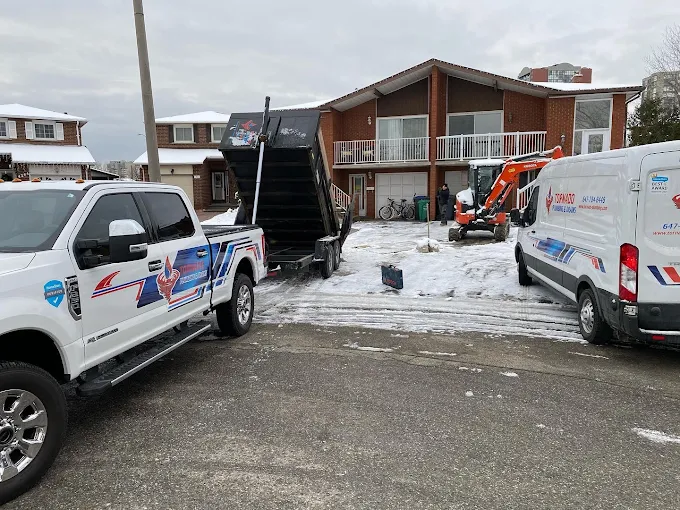
Winter emergency plumbing jobsite with trucks and excavation equipment
This winter jobsite photo helps emergency-service pages show what a real response looks like when the problem cannot wait and outdoor access, weather, and urgency all affect scope.

Serhiy on an active plumbing job site
This owner-led job-site photo reinforces that the company is showing real field work, not stock construction imagery.

Technician working under a kitchen sink
This is a straightforward interior-service photo that supports fixture repair, leak investigation, and small-space plumbing work.
Customer stories related to this topic
These customer stories pair real review quotes with the service pages most closely related to this guide.
R D
March 2019“After the recent wild deep freeze/thaw we had in the GTA, we had a burst pipe in our basement. After calling around a number of plumbers and checking reviews, Tornado not only gave me the lowest quote, but more importantly, was the only one able to come do the job within a couple of hours. Sergey drove across the city so that I wouldn't have to wait till the next day with my water shut off. He updated me when he was a little delayed (appreciated this), and was clean and meticulous while he completed the job. He was great to talk to, gave tips on things he saw and generally put me at ease during a stressful situation. All in all, i'm 100% satisfied with him and am glad to have found a good reliable plumber if needed in the future.”
Most relevant to Burst Pipe Repair in Toronto & the GTA.
Google place photo: Tornado Plumbing & DrainsShu Pui Lui
May 2022“I am very happy with Peter and Naz's work replacing part of my pipe that was causing the blockage. They came on the same day I called them and the work was done by end of the following day. The area they had to dig was tricky between a tree and interlock but they made an effort to avoid taking my interlock apart which saved me from more repair work. The quote was fair and Peter is professional and trustworthy. I highly recommend them.”
Most relevant to Emergency Plumbing Service in Toronto & the GTA.
Google place photo: Tornado Plumbing & DrainsRob Azzam
April 2026“A true FIVE STAR service from Sergiy at Tornado Plumbing! We needed an urgent service, he came same day, did a great job, left a clean area behind him, and all at very competitive pricing!! Very reasonable and great service. Thank you!!! We will be calling you again!”
Most relevant to Emergency Plumbing Service in Toronto & the GTA.
Google place photo: Tornado Plumbing & DrainsRead next in this topic
These related guides help you compare cost, scope, and next steps without starting over.
Best local service areas for this topic
Use one of these city pages when you want the same problem explained through local housing, flood risk, access, and neighbourhood-specific plumbing context.
Licensed, insured, reviewed Toronto plumbers
Serving Toronto & the GTA since 2015 — over 1,200 completed jobs.
Master plumber T95-4969603 · Plumbing contractor T94-4992639 · Drain contractor T87-4722944 · Building renovator T85-4728632 · Plumbing license FI6216638.
4.9-star Google rating from 320+ reviews. 400+ HomeStars reviews (Best of 2019–2025). BBB-accredited.
Same-day and after-hours dispatch across Toronto, Etobicoke, North York, Scarborough, York, Mississauga, and Burlington.
25-year workmanship warranty
Every job Tornado Plumbing & Drains completes in Toronto and the GTA — repair, install, replacement, drain work, sewer work, fixture work — is backed by a 25-year workmanship warranty. The written terms are provided with every quote. If our work fails within 25 years of the install date, we come back and make it right.
Quick answer
If you have a burst pipe right now in Toronto: (1) shut off the main water supply; (2) shut off electricity to the affected area if water is near outlets or panels; (3) photograph everything for insurance; (4) contain the spread (towels, buckets, move valuables); (5) call a licensed plumber for emergency dispatch — Tornado: 647-784-8448. Most burst-pipe damage cost is finishes, not the plumbing repair itself — fast shutoff is the key to limiting it. Damage with shutoff in 5 min: $1,500–$5,000. With shutoff after 30+ min: $8,000–$25,000+.
How much does burst pipe water damage cost in Toronto (2026)?
A burst pipe in Toronto typically costs $1,500-$5,000 when you shut off the main water within 5 minutes, but $8,000-$25,000+ if shutoff takes 30+ minutes. Most of that cost is damaged finishes (drywall, hardwood, cabinets), not the plumbing repair itself, so fast shutoff is what limits it.
Why fast shutoff matters
Burst-pipe damage cost in Toronto when shutoff happens within 5 minutes: typically $1,500–$5,000 in finishes.
Same burst, shutoff after 30+ minutes: typically $8,000–$25,000+ — almost all of it finishes, not plumbing.
Common burst-pipe causes in Toronto: frozen-and-thawed pipe (winter), failed shutoff/valve (any season), corroded copper at fittings, high pressure from missing PRV.
Modern shutoff valves (quarter-turn ball) operate in seconds; older gate valves often seize. Test annually.
Insurance claim documentation requirement: licensed plumber's invoice + cause-of-loss report.
Average Toronto winter burst-pipe insurance claim (IBC data): meaningful contributor to mid-winter water-damage claim volume.
Most insurers require prompt notification (24–48 hours) and licensed-plumber invoice for sudden-and-accidental claims to pay.
Repair scope after the immediate emergency
Spot repair when
Single failure point on otherwise sound pipe. Modern PEX or copper. Cause is identifiable (single freeze, single fitting failure). $300–$1,200 typical.
Section repipe when
Multiple pinholes in copper from past 5 years (whole-line corrosion, not isolated failure). Galvanized pipe — replace, don't patch. Pipe is exposed and another freeze-prone section is visible.
Whole-home repipe when
Multiple bursts within 12 months. Aged galvanized throughout. Insurance has flagged the property after multiple claims. Major reno opening up the walls anyway.
Toronto-specific burst-pipe patterns
Toronto's freeze-thaw winters are the dominant burst-pipe driver. Pipes in exterior walls, unheated garages, and uninsulated crawlspaces are especially vulnerable during cold snaps below -15°C. Older central-Toronto homes with copper supply often see corrosion-driven pinhole leaks at fittings — a different failure mode than freeze. Newer suburban GTA with PEX rarely sees either pattern. Pressure-reducing valves (PRV) are required where the City supply pressure exceeds 80 PSI; missing or failed PRV stresses pipes and contributes to bursts. We assess all of this on the repair visit and quote the prevention scope.
Sources cited in this guide
Where to go next
When the situation in this guide already matches what we cover, Burst Pipe Repair is the page where you book the visit and see the full scope, pricing, and warranty.
After the immediate repair, the next decision is whether the pattern of failures means more pipe is at end of life. The Plumbing Repairs & Installations category covers pipe repair, repiping, and inspection so you can see the bigger picture.
After the first-response steps
Once the main is shut and the immediate failure is contained, Burst Pipe Repair is the booking page. If the failure pattern points to more pipe at end of life, Pipe Repair & Repiping is the next conversation.
What to have ready when you call about a burst pipe
Have the dispatch number ready and call before you start mopping up — the faster we're on the way, the less the finishes side of the loss grows.
Confirm whether you've already shut off the main water valve — and whether the leak actually stopped after you did (if it didn't, the burst may be on a separate line).
Where the burst is: which floor and room, and whether it's in a finished wall/ceiling, an exterior wall, an unheated garage, or a crawlspace — that tells us if it's likely a freeze or a corroded-fitting failure.
A few photos: the visible source if you can see it, water lines on the wall/ceiling, and the affected room from a couple of angles — same shots your insurer will want.
Pipe type if you know it: copper, PEX, or galvanized — and the home's rough age, which helps us stock the right cut-and-patch fittings on the truck.
Which finished areas are already wet (drywall, hardwood, cabinets, ceiling below) so we can size the response and tell you what to keep contained.
Whether electricity to the affected area is still on, and if water is anywhere near outlets or the panel.
Your insurer's name and claim number if you've already opened a claim — we provide the cause-of-loss letter and licensed-plumber invoice most policies require.
Common questions about burst pipes
What is the first thing to do when a pipe bursts?
Shut the main water valve, open a nearby faucet to relieve pressure, move valuables away from the leak, and take photos for insurance before cleanup changes the scene. If water is near electrical outlets or panels, stay clear and treat it as an emergency.
Can a burst pipe be patched or does it need replacement?
It depends on pipe material, split length, corrosion, accessibility, and whether the failure came from freezing, age, or movement. A small isolated split may be repaired; brittle, corroded, or repeatedly frozen sections are often better replaced so the same line does not fail again.
How fast should a plumber come for a burst pipe?
Same day is the right expectation, and active flooding should be treated as immediate dispatch. Even after the main valve is closed, the home may be without water and the damaged line still needs a pressure-safe repair before service is restored.
What should I photograph for a burst pipe insurance claim?
Photograph the pipe failure, wet flooring, walls, ceilings, damaged contents, the shutoff valve, and any standing water before materials are removed. Keep plumber invoices and notes because they help show what failed and what repair was needed.
How can I prevent another burst pipe?
Insulate exposed runs, seal cold-air leaks, keep heat on in vulnerable rooms, disconnect exterior hoses, repair weak shutoff valves, and replace pipe sections that show corrosion or previous freeze damage. Prevention is especially important in Toronto cold snaps.
Explore more