Lead Water Service Replacement (Toronto): Health Risk, Free Testing, and the Free City-Side Replacement Program
By Serhiy Marunchuk, Master Plumber · Licence T95-4969603 · Updated August 17, 2026
Many pre-1955 Toronto homes have lead service lines. The City pays for the public-side replacement (curb-stop to main) when you replace the private side. Free water-lead testing through Toronto Public Health.
Published February 26, 2026 · Last updated August 17, 2026
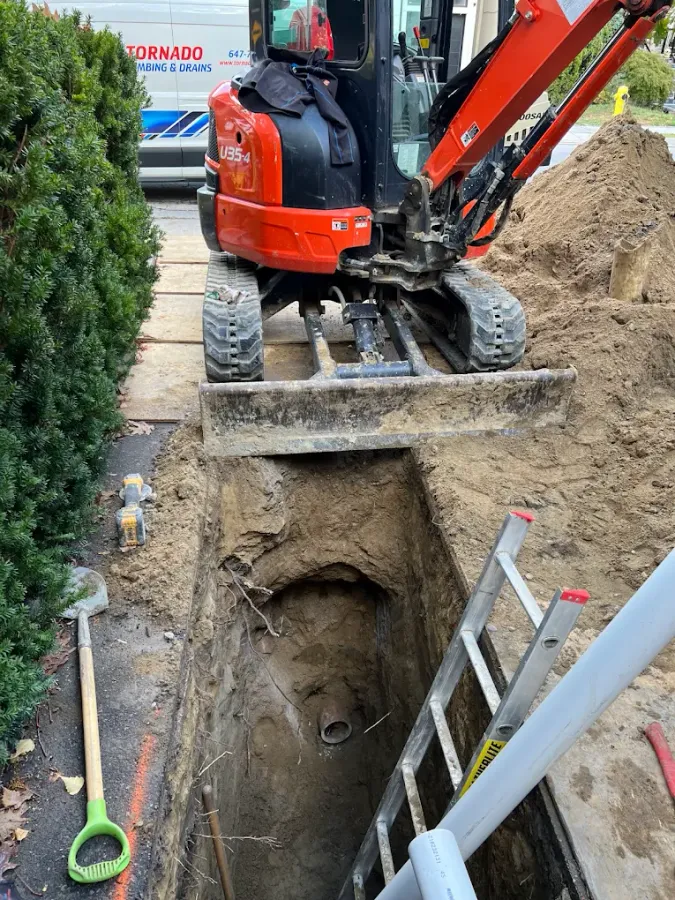
Introduction
Lead service lines are one of the few residual health risks in Toronto's water infrastructure — and the City has been actively eliminating them through a homeowner-cooperation program since the 1990s. If you live in a pre-1955 home and haven't tested your water for lead, this guide is for you. It explains the health context (Health Canada's 0.005 mg/L guideline), the free testing program through Toronto Public Health, and how the City's Lead Service Replacement Program pays for the public-side replacement when you replace the homeowner side at the same time. If you need the work handled rather than researched, see lead pipe replacement Toronto for pricing, process, and booking. The private-side work is handled through our main water line repair and replacement service, coordinated with the City's public-side crew.
Related services for this guide
If this article matches what you are dealing with, use one of these links to move into the service or broader category that makes the most sense.
Project photos related to this guide
These real project photos help show what this kind of work looks like in the field, not just on the page.
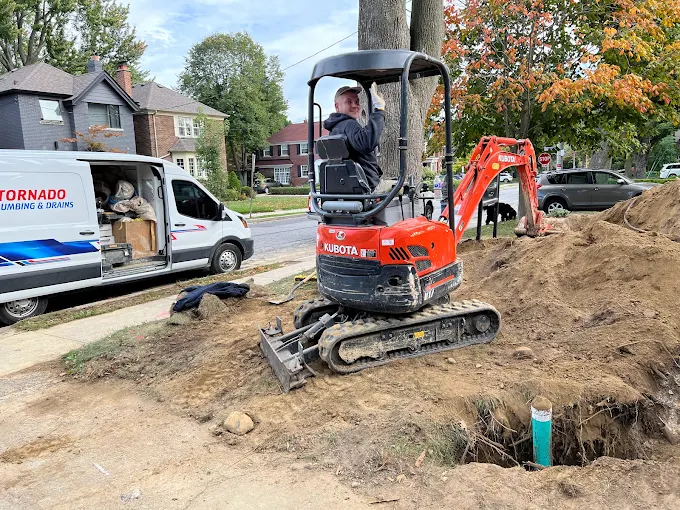
Residential service-line excavation in progress
This proof image shows the work stage where access, depth, and the surface route are already affecting time and cost on a buried service-line job.
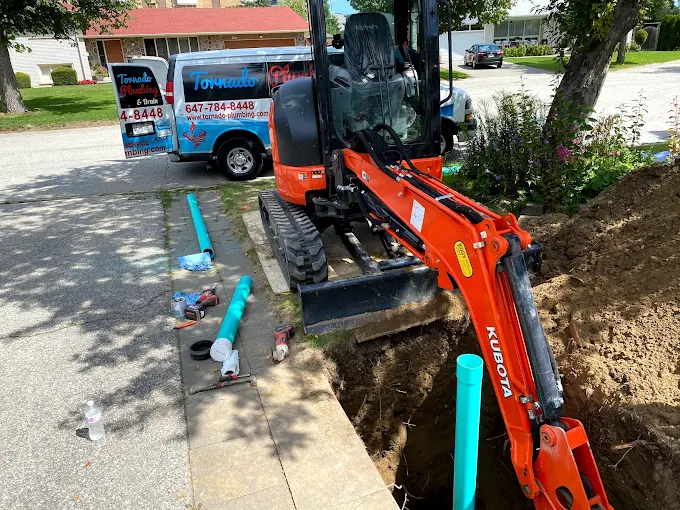
Underground water-service trench open for replacement work
This trench photo shows the buried-service stage that usually drives price through access depth, route length, and surface restoration, not just the pipe itself.

Front-yard excavation for a water-service upgrade
The excavation is open and the new service-line material is on site, which is the phase where replacement and upgrade work becomes visible to the homeowner.
Customer stories related to this topic
These customer stories pair real review quotes with the service pages most closely related to this guide.
Kevin
October 2019“I called a couple of plumbers to help investigate a water leak in our main water line. Sergey at Tornado Plumbing was the most attentive and the only contractor that actually came to our place to look at the issue. All other contractors simply recommended replacing the water main and provided a quote using Google Maps and did not show up at the house at all. Sergey provided me with the option to fix the leak which was located just below the slab in the basement, but his recommendation was to replace our side of the water main as it was old lead pipe. Once our side was completed I could notify the city and they would schedule a time to replace the city side using a city contractor. We had some water damage in our basement because of the leak so Sergey scheduled a team to arrive within 24 hours after signing the project estimate. The team that arrived were excellent. They needed to do a little discovery to find the main water line in our front property as the location marking wasn't exact. They didn't get discouraged and found the old lead pipe and completed the work by torpedoing a new ¾" copper line from inside the house. The leak had created a lot of water under the basement slab which made the work a little difficult but the team worked in to the evening to make sure everything was complete, holes filled back in, new concrete poured, and to be sure the water in the house was working as expected. Everything was cleaned up perfectly and Sergey followed up on the work within a couple of days when he was back in the area to provide another estimate. Overall the experience with Tornado Plumbing was excellent. We need to install a sump pump (Sergey's recommendation) and replace our basement slab in the future – I'll definitely be calling Sergey at Tornado Plumbing.”
Most relevant to Main Water Line Repair & Replacement in Toronto & the GTA.
Google place photo: Tornado Plumbing & DrainsKim S
March 2025“These guys were great! Came quickly, were courteous, knowledgeable and efficient. When they were done, they ran the camera through the entire drain again to show me that all the roots were taken care of. I’ll be calling them again, this time BEFORE my basement floods!”
Kripansh Sharma
February 2020“Called them to unclog a drain in the basement. Explained me in detail what steps they were going to take to resolve the problem and got the job done promptly. Amazing service and reasonable pricing. Thank you!”
Read next in this topic
These related guides help you compare cost, scope, and next steps without starting over.
Best local service areas for this topic
Use one of these city pages when you want the same problem explained through local housing, flood risk, access, and neighbourhood-specific plumbing context.
Licensed, insured, reviewed Toronto plumbers
Serving Toronto & the GTA since 2015 — over 1,200 completed jobs.
Master plumber T95-4969603 · Plumbing contractor T94-4992639 · Drain contractor T87-4722944 · Building renovator T85-4728632 · Plumbing license FI6216638.
4.9-star Google rating from 320+ reviews. 400+ HomeStars reviews (Best of 2019–2025). BBB-accredited.
Same-day and after-hours dispatch across Toronto, Etobicoke, North York, Scarborough, York, Mississauga, and Burlington.
25-year workmanship warranty
Every job Tornado Plumbing & Drains completes in Toronto and the GTA — repair, install, replacement, drain work, sewer work, fixture work — is backed by a 25-year workmanship warranty. The written terms are provided with every quote. If our work fails within 25 years of the install date, we come back and make it right.
Quick answer
Lead water service lines exist in many pre-1955 Toronto homes (and some up to 1965) and are a documented health risk under Health Canada's drinking-water guidance — maximum acceptable concentration of 0.005 mg/L. Toronto's Priority Lead Water Service Replacement Program covers the public-side replacement (curb-stop to main) at no cost to the homeowner when the private side is replaced concurrently. Private-side replacement typically runs $4,500–$14,000 depending on length, depth, and method. Free water-lead testing is available through Toronto Public Health for any homeowner who suspects lead service.
Lead service line facts every Toronto homeowner should know
Health Canada drinking-water guideline for lead: 0.005 mg/L maximum acceptable concentration. Lower is better; zero is the goal.
Most Toronto lead service lines exist in homes built before 1955; some installed up to 1965.
City of Toronto's Lead Service Replacement Program: City pays for the public-side (curb-stop to main) replacement at no cost when the private side is replaced concurrently by a licensed contractor.
Free water-lead testing is available through Toronto Public Health for any homeowner who requests it. The test confirms whether lead is present in your supply.
Modern replacement materials: Type-K copper (50+ year service life) or HDPE PE-4710 (75+ year service life). Both lead-free and City-approved.
Health risks of lead exposure are highest for children and pregnant women — Health Canada specifically calls out these groups.
The City replaces the public side (curb-stop to main) at no cost under the priority program — coordinating it with your private-side replacement gets both halves done the same day and removes all lead at once. The homeowner pays the full private-side cost ($4,500–$14,000); there is no City rebate for the private side.
When to act on lead service replacement
Replace immediately when
Water-lead test confirms lead present at any concentration. Children or pregnant women in the home. Pre-1955 build with no prior service-line replacement on record. Selling the home soon (lead disclosure becomes a buyer concern).
Mitigate while planning when
Replacement is scheduled but not yet completed. Use Toronto Public Health-recommended interim measures: NSF/ANSI Standard 53 lead-removal filters at point of use, run cold water 30+ seconds before drinking after taps have been unused for hours, never use hot tap water for cooking or baby formula.
What we coordinate
Tornado pulls the City permit, books the public-side coordination through the Lead Service Replacement Program, performs the private-side replacement, and provides the documentation package. Homeowner books the post-install water test through Toronto Public Health.
Toronto's lead-elimination commitment
The City of Toronto has a publicly-stated goal of eliminating lead service lines by 2030. The Priority Lead Water Service Replacement Program is the active mechanism, and it's well-funded — the City actively promotes free testing and incentivizes coordinated replacement through no-cost public-side coverage. Toronto's older central, east, and west neighbourhoods (Cabbagetown, Riverdale, Leslieville, the Beaches, the Annex, Forest Hill, Rosedale) have the highest concentration of remaining lead service lines. Toronto Public Health provides free testing kits and the City maintains a real-time Lead Service Map that flags known properties. If you're in one of these neighbourhoods and haven't tested, the request is free and worthwhile.
Replacement material: Type-K copper vs HDPE PE-4710
| Factor | Type-K copper | HDPE PE-4710 |
|---|---|---|
| Service life | 50+ years | 75+ years |
| Lead-free & City-approved | Yes | Yes |
| Install method | Open-cut or trenchless | Best suited to trenchless pull-through |
| Lawn/driveway disruption | Higher if open-cut trenching is needed | Lower — fused line pulled through with minimal digging |
| Corrosion resistance | Excellent; rigid, proven track record | Excellent; flexible, no soldered joints to fail |
| Typical use case | Shorter runs, exposed/accessible routing | Longer runs, or to preserve hardscaping in a water service upgrade |
Where to go next
Service page with full scope, City program coordination, and the install warranty.
If you're upsizing pipe diameter as part of the replacement (renovation, addition, pool).
Method-specific page for trenchless replacement that preserves driveway and lawn.
Detailed pricing for the private-side replacement scope.
Sources cited in this guide
Get tested, get scheduled
Free water-lead testing: Toronto Public Health. Replacement scope and City coordination: book at Lead Water Service Replacement. Calls go through 647-784-8448.
Common questions about Toronto lead service replacement
How do I know if my home has a lead service line?
Three ways: (1) request a free water-lead test through Toronto Public Health; (2) check the City's online Lead Service Map by address; (3) visually inspect the service line where it enters your home — lead is dull grey, soft, scratch-able with a coin, with rounded fittings (no threads). Pre-1955 homes are highest probability.
Will the City pay for the entire replacement?
No — the City pays only for the public-side portion (from the curb-stop to the City main). The homeowner is responsible for the private-side replacement (curb-stop to home entry), which is $4,500–$14,000 depending on length, depth, and method. The savings vs uncoordinated replacement come from the no-cost public side.
What if I just replace the private side and leave the public side lead?
Doesn't work — water flowing through the remaining lead public-side picks up lead before it reaches your home. Health Canada and Toronto Public Health both specifically warn against partial replacement. The City program is structured to ensure full replacement; coordinating both sides is the right answer.
Are there interim measures I can take while waiting?
Yes. NSF/ANSI Standard 53 certified lead-removal filters at point of use (kitchen tap, especially for drinking and cooking water). Run cold water 30+ seconds before drinking, especially in the morning or after taps have been unused. Never use hot tap water for cooking or baby formula (lead leaches more in hot water). These are interim — full replacement is the permanent fix.
Is the work warrantied?
Yes — Tornado's 25-year workmanship warranty applies to the private-side install. Modern materials (Type-K copper, HDPE PE-4710) carry their own multi-decade material warranties from the manufacturer. The City's public-side install carries the City's warranty.
Explore more