Water Service Upgrade in Toronto (2026): When to Replace or Upsize Your Water Main
By Serhiy Marunchuk, Master Plumber · Licence T95-4969603 · Updated August 17, 2026
Upgrade your Toronto water service when the existing line is undersized, aged copper or galvanized, lead, or when an addition or pool is being added. 3/4″ to 1″ HDPE upgrade adds 25–40% delivery capacity at peak demand.
Published February 26, 2026 · Last updated August 17, 2026
Introduction
A water service upgrade isn't always about replacing a failing line — sometimes it's about upsizing a perfectly functional but undersized service to handle a home's actual demand. Toronto homeowners commonly upgrade when adding a pool, building an addition, finishing a basement bathroom, or finally fixing the morning-shower pressure problem that's existed since the home was built. This guide walks through when the upgrade is worth it, what 1″ HDPE actually delivers vs the 1/2″ or 3/4″ in your home today, and how the upgrade ties into the City's permit and meter coordination. If you need the work handled rather than researched, see water service upgrade Toronto for pricing, process, and booking. If the existing line is failing rather than merely undersized, start with main water line repair and replacement — the scope and pricing differ from an upgrade.
Related services for this guide
If this article matches what you are dealing with, use one of these links to move into the service or broader category that makes the most sense.
Project photos related to this guide
These real project photos help show what this kind of work looks like in the field, not just on the page.
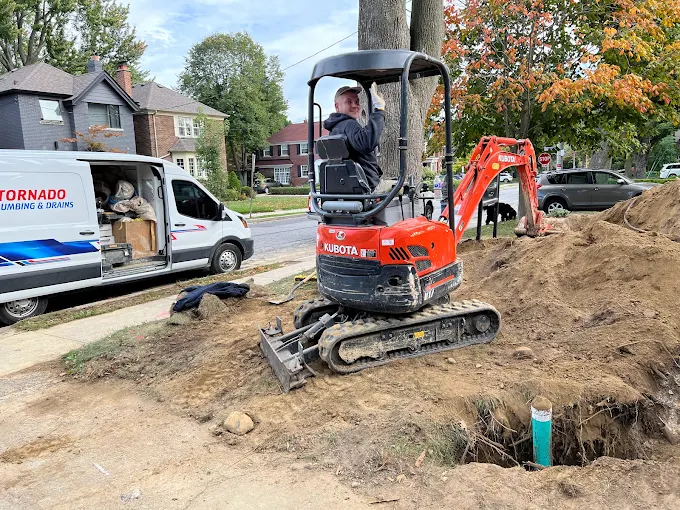
Residential service-line excavation in progress
This proof image shows the work stage where access, depth, and the surface route are already affecting time and cost on a buried service-line job.
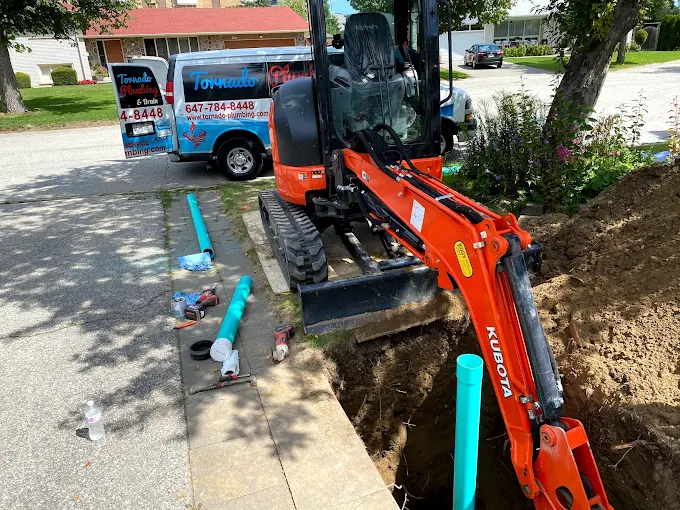
Underground water-service trench open for replacement work
This trench photo shows the buried-service stage that usually drives price through access depth, route length, and surface restoration, not just the pipe itself.

Front-yard excavation for a water-service upgrade
The excavation is open and the new service-line material is on site, which is the phase where replacement and upgrade work becomes visible to the homeowner.
Customer stories related to this topic
These customer stories pair real review quotes with the service pages most closely related to this guide.
Kevin
October 2019“I called a couple of plumbers to help investigate a water leak in our main water line. Sergey at Tornado Plumbing was the most attentive and the only contractor that actually came to our place to look at the issue. All other contractors simply recommended replacing the water main and provided a quote using Google Maps and did not show up at the house at all. Sergey provided me with the option to fix the leak which was located just below the slab in the basement, but his recommendation was to replace our side of the water main as it was old lead pipe. Once our side was completed I could notify the city and they would schedule a time to replace the city side using a city contractor. We had some water damage in our basement because of the leak so Sergey scheduled a team to arrive within 24 hours after signing the project estimate. The team that arrived were excellent. They needed to do a little discovery to find the main water line in our front property as the location marking wasn't exact. They didn't get discouraged and found the old lead pipe and completed the work by torpedoing a new ¾" copper line from inside the house. The leak had created a lot of water under the basement slab which made the work a little difficult but the team worked in to the evening to make sure everything was complete, holes filled back in, new concrete poured, and to be sure the water in the house was working as expected. Everything was cleaned up perfectly and Sergey followed up on the work within a couple of days when he was back in the area to provide another estimate. Overall the experience with Tornado Plumbing was excellent. We need to install a sump pump (Sergey's recommendation) and replace our basement slab in the future – I'll definitely be calling Sergey at Tornado Plumbing.”
Most relevant to Main Water Line Repair & Replacement in Toronto & the GTA.
Google place photo: Tornado Plumbing & DrainsHIPPO POTAMUS
October 2024“always fantastic service from tornado plumbing, arrived on time, very friendly guys, fixed my leaky pipe, will use again.”
Jason Milligan
July 2026“Tornado have always done great work for us. Highly recommend”
Read next in this topic
These related guides help you compare cost, scope, and next steps without starting over.
Best local service areas for this topic
Use one of these city pages when you want the same problem explained through local housing, flood risk, access, and neighbourhood-specific plumbing context.
Licensed, insured, reviewed Toronto plumbers
Serving Toronto & the GTA since 2015 — over 1,200 completed jobs.
Master plumber T95-4969603 · Plumbing contractor T94-4992639 · Drain contractor T87-4722944 · Building renovator T85-4728632 · Plumbing license FI6216638.
4.9-star Google rating from 320+ reviews. 400+ HomeStars reviews (Best of 2019–2025). BBB-accredited.
Same-day and after-hours dispatch across Toronto, Etobicoke, North York, Scarborough, York, Mississauga, and Burlington.
25-year workmanship warranty
Every job Tornado Plumbing & Drains completes in Toronto and the GTA — repair, install, replacement, drain work, sewer work, fixture work — is backed by a 25-year workmanship warranty. The written terms are provided with every quote. If our work fails within 25 years of the install date, we come back and make it right.
Quick answer
Upgrade your Toronto water service when (1) the existing line is undersized for the home (low pressure with multiple fixtures running), (2) the line is aged copper or galvanized with corrosion symptoms, (3) the line is lead, or (4) you're adding a pool, addition, or finished basement that increases peak demand. Typical upgrade from 1/2″ or 3/4″ to 1″ HDPE costs $5,500–$12,000, adds 25–40% delivery capacity, and resolves the pressure ceiling that smaller services impose. The upgrade requires a Toronto plumbing permit and water-service permit; the City coordinates the meter and curb-stop side.
What the upgrade actually delivers
Standard residential service sizing in Toronto: 3/4″ or 1″ HDPE for single-family homes; 1.25″–2″ for larger homes or homes with additions/pools.
1/2″ to 1″ upgrade: ~4× cross-sectional area, ~2.5× flow capacity at the same pressure.
3/4″ to 1″ upgrade: ~78% more cross-sectional area, ~25–40% more delivery capacity at peak demand.
Galvanized service lines (1940s–60s) corrode internally — 60–80 year service life is at end. Replacement is the only fix; flushing or descaling won't restore capacity.
City of Toronto coordinates water-meter and service-size changes; an upgraded service often requires a meter upsize too — done as part of the same scheduling.
Lead service lines: the upgrade can be paired with the City's Lead Service Replacement Program (free public-side replacement) — same dig, two outcomes.
Modern materials: Type-K copper (50+ year service life) or HDPE PE-4710 (75+ year service life). Both City-approved; HDPE preferred for trenchless installs.
When the upgrade is worth it
| Situation | Likely current service | Recommended upgrade | Typical cost (installed) |
|---|---|---|---|
| Pressure complaints with multiple fixtures running | 1/2″ or aged 3/4″ | 1″ HDPE | $5,500 – $9,500 |
| Adding a pool | 3/4″ | 1″ HDPE | $6,500 – $11,000 |
| Building an addition (3+ bath) | 3/4″ | 1″ or 1.25″ HDPE | $7,500 – $13,500 |
| Lead service line | Lead (varied diameter) | 1″ HDPE + City pays public side | $4,500 – $14,000 net (private side only) |
| Galvanized corrosion | 1/2″ or 3/4″ galvanized | 1″ HDPE (or 3/4″ if demand is moderate) | $5,500 – $12,000 |
| Aged copper at 50+ years | 3/4″ copper | 1″ HDPE or copper | $5,500 – $11,000 |
| Renovating to a luxury kitchen + 4 bath | 3/4″ or 1″ | 1.25″ HDPE for high-demand homes | $8,500 – $16,000 |
Replace vs upsize — the decision
Same-size replacement is enough when
Existing service is sized adequately for the home's current and planned demand (no pressure issues, no expansion). Existing line is at end-of-life or has failed. You're not changing the home's fixture count or peak demand.
Upsize when
You have low pressure during peak use (morning showers + dishwasher + laundry conflict). You're adding fixtures, a pool, or an addition. Your existing service is undersized at 1/2″ in a modern multi-bath home. You're already opening the trench for replacement — the marginal cost of upsize is small relative to doing it as a separate project later.
What we recommend on the diagnostic
Site visit measures static and dynamic pressure, calculates current peak demand, and quotes both same-size replacement and upsize options when both apply. The right choice is the one that matches your demand pattern with margin — not the cheapest immediate option.
Coordinating with the City of Toronto
Water service upgrades in Toronto require a plumbing permit (residential plumbing permit fees $190–$850 depending on scope) plus a water-service permit, and the City coordinates the meter and curb-stop side. We pull both permits and coordinate with Toronto Water for the City-side scheduling. If the upgrade is paired with a lead service replacement, the public-side replacement is no-cost under the Lead Service Replacement Program. For homes with mature trees over the route, we plan the trenchless approach to preserve roots and surface restoration cost. Most upgrades complete in 1–3 days from start to inspection sign-off.
Where to go next
Service page with full scope, sizing options, and the install warranty.
Method-specific page that preserves driveway and mature landscaping.
When upgrade is paired with lead removal — City pays the public side.
Sometimes the answer to pressure complaints is the PRV settings — diagnose before upsizing.
Full water-line category — repair, replace, upgrade, lead-specific.
Sources cited in this guide
Diagnose before upsizing
Book a diagnostic at Water Service Upgrade — pressure test plus sizing audit. If lead is suspected, Lead Water Service Replacement. Calls go through 647-784-8448.
Common questions about Toronto water service upgrades
Will an upgraded service actually fix my pressure problem?
Often yes — if the existing service is undersized. But not always: low pressure can also be caused by a stuck pressure-reducing valve, a partial blockage, or low City supply pressure in your area. We diagnose with a pressure test before recommending the upgrade. Sometimes a $400 PRV adjustment fixes what looks like a service-line problem.
Is 1″ always better than 3/4″?
Bigger isn't always better. 1″ delivers more capacity at peak demand, but oversized service can also cause velocity-related issues and is more expensive to install. Standard practice for most Toronto single-family homes (3 bath or fewer) is 3/4″; 4+ bath homes, pools, or pressure-sensitive uses justify 1″.
Do I need a permit?
Yes. Toronto requires a plumbing permit and a water-service permit for any water-service replacement or upgrade. Tornado pulls both as part of the install scope. Skipping permits is a future resale problem and an insurance dispute trigger.
Explore more