Water Service Line Replacement Cost in Toronto (2026): Trenchless vs Open-Cut, Lead vs Copper
By Serhiy Marunchuk, Master Plumber · Licence T95-4969603 · Updated August 17, 2026
Trenchless replacement runs $4,500–$8,500. Open-cut runs $6,000–$14,000. Lead service line? The City pays for the public-side replacement when you replace the private side concurrently.
Published March 26, 2026 · Last updated August 17, 2026
Introduction
Replacing your water service line is the kind of project most homeowners only do once — and the price varies more than almost any other plumbing job because it depends on what's buried underneath your driveway and lawn. This guide gives you the real 2026 Toronto numbers for both trenchless (mole and pipe-burst) and open-cut, the lead-replacement program details, and the four factors that decide which method works for your specific lot.
Related services for this guide
If this article matches what you are dealing with, use one of these links to move into the service or broader category that makes the most sense.
Project photos related to this guide
These real project photos help show what this kind of work looks like in the field, not just on the page.
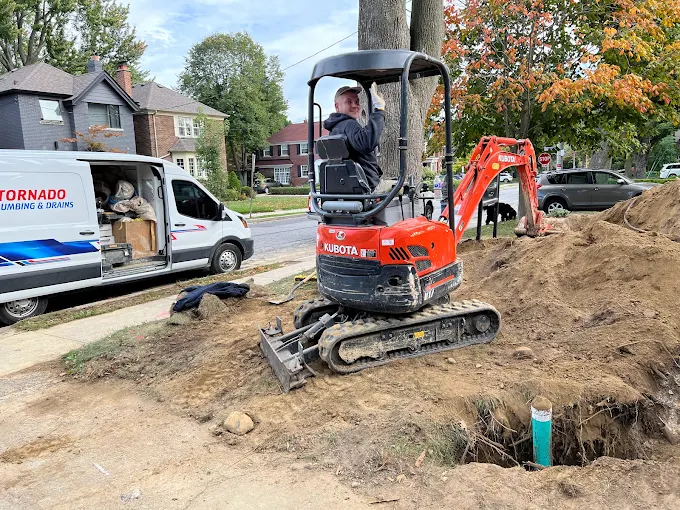
Residential service-line excavation in progress
This proof image shows the work stage where access, depth, and the surface route are already affecting time and cost on a buried service-line job.
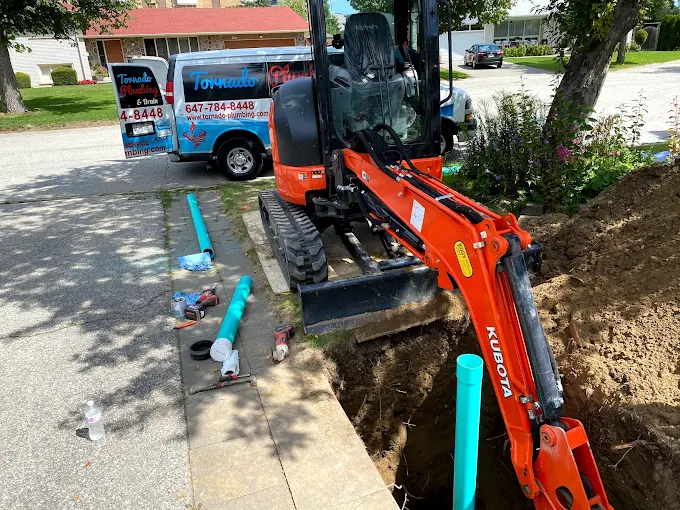
Underground water-service trench open for replacement work
This trench photo shows the buried-service stage that usually drives price through access depth, route length, and surface restoration, not just the pipe itself.

Front-yard excavation for a water-service upgrade
The excavation is open and the new service-line material is on site, which is the phase where replacement and upgrade work becomes visible to the homeowner.
Read next in this topic
These related guides help you compare cost, scope, and next steps without starting over.
Best local service areas for this topic
Use one of these city pages when you want the same problem explained through local housing, flood risk, access, and neighbourhood-specific plumbing context.
Licensed, insured, reviewed Toronto plumbers
Serving Toronto & the GTA since 2016 — over 1,200 completed jobs.
Master plumber T95-4969603 · Plumbing contractor T94-4992639 · Drain contractor T87-4722944 · Building renovator T85-4728632 · Plumbing license FI6216638.
180+ five-star Google reviews. 400+ HomeStars reviews (Best of 2019–2025). BBB-accredited.
Same-day and after-hours dispatch across Toronto, Etobicoke, North York, Scarborough, York, Mississauga, and Burlington.
25-year workmanship warranty
Every job Tornado Plumbing & Drains completes in Toronto and the GTA — repair, install, replacement, drain work, sewer work, fixture work — is backed by a 25-year workmanship warranty. The written terms are provided with every quote. If our work fails within 25 years of the install date, we come back and make it right.
Quick answer
Water service line replacement in Toronto in 2026 typically runs $4,500–$8,500 for trenchless (mole or pipe-burst) and $6,000–$14,000 for open-cut. The price is driven by service length (Toronto lots vary 30–90 ft), surface restoration (driveway, mature lawn, hardscape), and method choice. If your existing line is lead, the City of Toronto pays for the public-side replacement (curb-stop to main) when the homeowner replaces the private side concurrently — a meaningful offset on the total project cost.
How much does water service line replacement cost in Toronto in 2026?
Water service line replacement in Toronto in 2026 typically costs $4,500-$8,500 trenchless (mole or pipe-burst) and $6,000-$14,000 open-cut. Price is driven by service length (30-90 ft) and surface restoration. If your line is lead, the City covers the public-side replacement at no cost when you replace the private side concurrently.
What you should know before booking
Toronto residential water service depth: ~6 ft minimum (frost line), often 7–9 ft at the property line.
Service-line lengths in Toronto vary from ~30 ft on smaller lots to 90+ ft on older deep lots — the dominant cost driver after method.
Modern materials: Type-K copper (50+ year service life) or HDPE PE-4710 (75+ year life). Both are City-approved.
Trenchless avoids tearing up the lawn and walkway but needs entry and exit pits and is unsuitable for shallow or shared services.
Open-cut is sometimes the only option on shallow service or where the route runs under a structure.
Toronto's Lead Service Replacement Program: City pays for the public-side (curb-stop to main) replacement when the homeowner replaces the private side concurrently. Free water-lead testing available through Toronto Public Health.
Health Canada drinking-water guideline for lead: 0.005 mg/L maximum acceptable concentration. Lead service lines exist in many pre-1955 Toronto homes.
Real Toronto water service replacement prices (2026)
30–50 ft service, accessible entry/exit pits, soft soil. Fastest method, least surface disturbance. 1-day install plus inspection.
Trenchless (mole) — short run
$4,500 – $6,500
30–50 ft service, accessible entry/exit pits, soft soil. Fastest method, least surface disturbance. 1-day install plus inspection.
Trenchless (mole or burst) — long run
$6,500 – $8,500
50–90 ft service, more pipe, more pulling time. Pipe-burst can upsize from 1/2″ or 3/4″ to 1″ HDPE in the same pull.
Open-cut — driveway / paved surface
$8,000 – $14,000
Saw-cut and dig through driveway or hardscape, full pipe replacement, surface restoration. Restoration typically 25–35% of the total.
Open-cut — lawn only
$6,000 – $10,000
Lawn excavation is cheaper to restore than paved surface. Mature trees on the route can complicate the dig.
Lead service replacement (private side)
$4,500 – $14,000
Same construction as standard replacement; the City pays for the public-side (curb-stop to main) at no cost when scheduled concurrently. Net cost is the homeowner-side only.
Permit + City coordination
$340 – $850
Toronto permit fees, public-side appointment coordination, locate (Ontario One Call), and inspection. Tornado handles all of this as part of the install scope.
Early warning signs: catch the failing line before it bursts
| What you're seeing | Most likely cause | Right next step |
|---|---|---|
| Pressure drop, all fixtures | Service-line corrosion or partial blockage | Diagnostic + pressure test → spot repair or replacement |
| Rusty water on first draw | Galvanized service line corroding | Replacement (galvanized can't be repaired effectively) |
| Rusty water at all times | Internal corrosion + sediment | Replacement, with water test pre/post |
| Wet spot in lawn during dry weather | Active leak in service line | Locate + repair or replace |
| Wet spot in driveway / hardscape | Service-line leak under paved surface | Camera/sonde locate, then trenchless or open-cut |
| Doubled water bill, no explanation | Hidden leak (service line, slab, or in-wall) | Whole-home leak detection + service-line check |
| Lead service line (pre-1955 home) | Health risk + future replacement liability | City Lead Service Replacement Program |
Repair vs replace decision
Spot repair makes sense when
Single-section failure on an otherwise sound line. Line is recent (post-2000 HDPE/PEX) and the leak is from external damage. Service line has been repaired before and held for years.
Replace the whole line when
Existing line is galvanized (corrodes throughout, multiple repairs won't hold). Existing line is lead (health risk + City program). Line is older than 50 years (copper at end of life). Multiple leaks within the past few years (spot repairs are buying time).
What we recommend on the diagnostic
Visit includes pressure test, locate, water-quality check, and visual confirmation of pipe material at the entry point. We quote both spot repair and full replacement when both are options, with cost-comparison and life-expectancy estimates.
Trenchless vs open-cut — what each is good for
| Factor | Trenchless (mole/burst) | Open-cut |
|---|---|---|
| Surface disturbance | Two pits (~3' x 3' each) | Full trench along route |
| Driveway/hardscape impact | Minimal | Significant — saw-cut, dig, restore |
| Lawn impact | Minimal | Full strip |
| Pipe size upsize possible | Yes (pipe-bursting) | Yes |
| Suitable for shallow service | Limited | Yes |
| Suitable for shared service | No | Yes |
| Soft-soil suitability | Yes (mole) | Yes |
| Tree-root navigation | Bursting handles roots | Excavation cuts through |
| Typical timeline | 1 day install + inspection | 2–4 days install + restoration |
| Cost range (Toronto, 2026) | $4,500–$8,500 | $6,000–$14,000 |
Picking the right method for your lot
Trenchless is the right call when
Service depth is at or below frost line (6+ ft). Soil is sandy, loamy, or otherwise mole-friendly (most Toronto soil is). Surface above the route is finished (driveway, hardscape, mature lawn) and you want to preserve it. Service is single-property (not shared with a neighbour).
Open-cut is the right call when
Service is shallow (less than 5 ft) or runs under a foundation footing. Service is shared with an adjacent property. Service has a complete collapse or unusual obstruction. The route is already exposed (e.g., driveway being replaced anyway). Soil is rocky or uncooperative for trenchless.
What we recommend on the diagnostic visit
We do a site walk and locate the service route, check soil and surface conditions, confirm depth via probe or sonde, and quote both methods if both are feasible. The cheaper method isn't always the right method — we explain the trade-offs and let you decide.
Three Toronto service-line replacements from the past 90 days
Etobicoke, suburban lot, trenchless mole — 60 ft of corroded galvanized service, low pressure throughout the home, no driveway disturbance budget. Pipe-burst from 3/4″ to 1″ HDPE. Total: $7,200. 1-day install, 2 small pits restored same day. Pressure increased from 38 PSI to 64 PSI at the kitchen sink.
Roncesvalles, century home, lead replacement combined with City — Pre-1955 home with lead service line. City confirmed eligibility for public-side replacement at no cost. Tornado replaced private side via open-cut (lawn only) for $7,800. City performed public-side replacement same day. Free water-lead testing post-install confirmed below detection limit.
The Beaches, deep service under driveway, open-cut — 8.5 ft service depth, 75 ft length, route under fully paved driveway. Trenchless ruled out due to depth and rock. Open-cut $13,400 including driveway restoration. Customer scheduled the work to coincide with planned driveway repaving, saving ~$2,800 on restoration.
What to have ready when you call
Six answers determine method, scope, and whether the City lead-replacement program applies.
What's prompting the replacement — low pressure, leak, lead concern, planned upgrade?
Property age (pre-1955 likely lead, 1955–80 likely copper, 1980+ likely copper or HDPE)?
Approximate distance from property line to where the service enters the home?
What's on top of the service route — driveway, lawn, hardscape, mature trees?
Have you had the City do a free water-lead test?
Is this part of a renovation (driveway replacement, basement reno) where access is already opening up?
Why Toronto service lines are a layered archaeology
Toronto's water service line stock reflects 100+ years of installation: lead in pre-1955 builds (especially in central, east, and west neighbourhoods), copper in 1955–1980 builds, HDPE/PEX in modern builds. Galvanized pipe shows up in some 1940s–60s installs and corrodes internally regardless of method. The City's priority Lead Water Service Replacement Program means public-side replacements are well-funded and well-coordinated — but homeowners have to initiate the private-side replacement to trigger the public-side coverage. Toronto's also one of the few major Canadian cities where 6 ft+ service depth is standard (frost protection), which directly affects which trenchless methods are practical.
Where to go next
The trenchless service page — mole and pipe-burst scope, pricing, and warranty.
If you're not sure between repair and full replacement — this is the diagnostic-and-decide page.
Specific to lead service lines — coordinates with the City's public-side program.
If you're upsizing pipe diameter for added capacity (renovation, addition, pool).
Health risks, City program details, and what to expect from the testing process.
Sources cited in this guide
Ready to book the diagnostic
Book at Trenchless Water Line Replacement for trenchless scope, Main Water Line Repair & Replacement for the diagnostic visit, or Lead Water Service Replacement if lead is the concern. Calls go through 647-784-8448 with same-day dispatch.
Common questions about Toronto water service replacement cost
How much does it cost to replace a water service line in Toronto in 2026?
Trenchless: $4,500–$8,500. Open-cut: $6,000–$14,000. Lead service replacement (private side): $4,500–$14,000 with the City covering the public-side replacement at no cost when scheduled concurrently. Final price depends on length, method, and surface restoration.
Is trenchless always cheaper?
Usually yes for the construction itself, and significantly cheaper if your driveway or hardscape would otherwise need restoration. But trenchless requires entry and exit pits, doesn't work on shared services, and has soil and depth requirements. We quote both methods on the diagnostic visit when both are feasible.
Will the City pay for any of my service replacement?
If your existing line is lead, yes — the City's Lead Service Replacement Program covers the public-side (curb-stop to main) replacement at no cost when the homeowner replaces the private side concurrently. For non-lead replacements, the homeowner pays for both sides. Free water-lead testing is available through Toronto Public Health to confirm whether lead is present.
How long does the replacement take?
Trenchless: typically 1 day for the install plus inspection 2–7 days later. Open-cut: 2–4 days for the install plus restoration time (several more days for paved-surface jobs). Water service is briefly interrupted during the swap-over (a few hours).
Will I have water during the work?
Mostly yes. We use a temporary supply (garden hose connection from a neighbour or front-yard tap) during the actual swap-over so you have water for sanitation and basic use. Total no-water windows are usually 2–4 hours.
Is the work warrantied?
Yes — Tornado's 25-year workmanship warranty applies to the install. Modern materials (Type-K copper, HDPE PE-4710) carry their own multi-decade material warranties from the manufacturer. The combination is what gives most homeowners 50+ years of service from a single replacement.
Explore more