Sewer Line Rerouting in Toronto & the GTA
Toronto & the GTA • Call 647-784-8448
Sometimes the existing sewer route is itself the problem. The line runs under an addition, under a mature tree that keeps sending roots into the joints, or along a path that no longer makes sense after a renovation. In those cases, the smarter answer is to put the line somewhere it can actually be maintained. Tornado Plumbing & Drains designs and installs rerouted sewer paths across Toronto and the GTA when relocation is the right long-term spend.
Last updated April 24, 2026
When this service makes sense
Part of Drain & Sewer Services in Toronto & the GTA
Book this service when
Book this when the existing sewer route is the problem — it runs under an addition, a slab, a driveway, or a tree that keeps sending roots into the same joints, and repairing in place would mean tearing up what sits above it.
Common signs
- The line backs up in the same spot every few months no matter how often it is snaked, because waste keeps pooling at one fixed belly or joint
- A driveway, garage pad, or interlock patio sits directly over the run, so opening it to repair means tearing up the surface
- The lateral was buried under a newer poured floor, sunroom, or basement slab and any in-place fix means breaking that new concrete
- Camera footage shows the pipe offset, crushed, or separated at a depth where digging the current line is far harder than running a fresh one alongside it
If you're not sure, compare these too
- Sewer Line Replacement - when the existing route is fine and only the pipe is failing
- Trenchless Sewer Line Replacement - when the pipe can be replaced along the same path without opening the surface
On this page
Quick guide and key details
What changes price and scope
- Length and depth of the new path.
- Surfaces above and soil conditions.
- Whether the city tap or building drain connection has to be modified.
How a professional visit usually unfolds
1. Survey + design
Map the existing route and design the new path. Slope, depth, and access drive the design.
2. Permits + locates
Pull permits and book public utility locates. Required for excavation.
3. Trench / excavate
Open the new route at correct depth and slope. Foundation of the rerouted line.
4. Install new pipe
Lay new ABS or PVC pipe with correct grade and bedding. Permanent new route.
5. Connect and test
Tie into the building drain and the city connection. Service restored on the new path.
Recent Sewer Line Rerouting work
These real project photos show the kind of work this service involves, so you can see examples before you book.
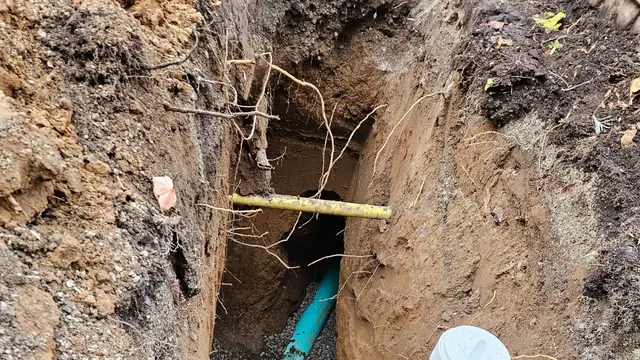
PVC sewer reroute laid into a yard trench
This photo documents the new underground drain path before final cover and restoration, which is useful proof for rerouting and spot-repair pages.
Sewer rerouting pricing (Toronto 2026)
| Scope | Starting from | Typical range |
|---|---|---|
| Short reroute on open lawn (≤ 25 ft) | $5,500 | $5,500 to $11,000 |
| Reroute under landscaping | $7,500 | $7,500 to $15,000 |
| Reroute under driveway / hardscape | $10,000 | $10,000 to $20,000 |
Ranges are for planning and triage. Final pricing depends on access, urgency, materials, and whether the visit stays isolated once the area is opened.
Cities Where This Service Is a Strong Fit
Related Services
- Drain Cleaning
Drain cleaning and repair in Toronto: we clear clogged sinks, tubs and main drains, then camera-check recurring backups so the fix lasts. From $139.
- Drain Repair
Drain repair in Toronto: cracked, root-filled & collapsed drains fixed by spot repair, CIPP relining or excavation. From $400. Call 647-784-8448.
- Hydro Jetting Services
Hydro jetting in Toronto & GTA for grease, sludge, scale, and root buildup in branch lines, kitchen drains, main sewer laterals, and commercial drains.
- Drain Camera Inspection
Drain camera inspection in Toronto from $180: see roots, bellies, offsets and breaks on video before you pay for any repair, with a recording you keep.
- Sewer Cleaning
Main sewer line cleaning in Toronto: cleanout snaking, jetting and root cutting for recurring basement backups. Call 647-784-8448; 25-yr warranty.
- Root Intrusion Removal
Tree root removal from sewer and drain lines in Toronto & GTA: mechanical cutting, jetting, foaming root treatment, and trenchless repair when roots keep
- Sewer Cleanout Installation
Sewer cleanout installation in Toronto from $650: interior & exterior access for cleaning, camera & inspection. Licensed & insured. Book online.
- Sewer Line Repair
Sewer line repair in Toronto from $2,400: the camera finds the offset, break or root joint and we fix that section instead of digging up the whole line.
- Trenchless Sewer Line Repair
Trenchless sewer line repair in Toronto without the full dig: CIPP lining & point repair for offsets, cracks & root joints. From $2,400. Call 647-784-8448.
- Trenchless Sewer Line Replacement
Trenchless sewer line replacement in Toronto & GTA: pipe bursting or full-length CIPP lining instead of open-cut digging, and how we choose between them.
- Sewer Line Replacement
Sewer line replacement in Toronto: collapsed, bellied or root-damaged pipe, camera-diagnosed. Trenchless or open-cut. Call 647-784-8448; 25-yr warranty.
- Drain Basin Services
Outdoor drain cleaning in Toronto & GTA: catch basin cleaning, storm drain cleanout, yard and area drains, sump and ejector basin work, and basin replacement.
Related Guides
- Drain Cleaning Cost in Toronto (2026): Honest Prices by Method
Drain cleaning cost in Toronto in 2026: $189 for a fixture snake, $350 to $650 for a main-line snake, $400 to $1,400 for jetting, and which one your clog needs.
- Plumbing Cost Guide Toronto 2026: Every Service, Real Numbers
Real Toronto plumbing prices in 2026 — repairs $180–$700, fixture installs $400–$1,800, water heater $2,200–$4,500, sewer work $4,500–$25,000+.
- Drain Camera Inspection Cost in Toronto (2026): What the Price Actually Buys You
Drain camera inspection cost in Toronto in 2026: $250 to $650 for a standard scope, $500 to $900 with a sonde locate, and when it is worth paying for.
- Hydro Jetting Cost in Toronto (2026): Real Prices, Real Pipe Conditions
What hydro jetting really costs in Toronto in 2026, $400 to $1,400 by line size and condition, and why it costs more than snaking but lasts longer.
Licensed, insured, reviewed Toronto plumbers
- Serving Toronto & the GTA since 2015 — over 1,200 completed jobs.
- Master plumber T95-4969603 · Plumbing contractor T94-4992639 · Drain contractor T87-4722944 · Building renovator T85-4728632 · Plumbing license FI6216638.
- 4.9-star Google rating from 320+ reviews. 400+ HomeStars reviews (Best of 2019–2025). BBB-accredited.
- Same-day and after-hours dispatch across Toronto, Etobicoke, North York, Scarborough, York, Mississauga, and Burlington.
25-year workmanship warranty
Every job Tornado Plumbing & Drains completes in Toronto and the GTA — repair, install, replacement, drain work, sewer work, fixture work — is backed by a 25-year workmanship warranty. The written terms are provided with every quote. If our work fails within 25 years of the install date, we come back and make it right.
Moving the line, not just fixing it
Rerouting changes where the lateral travels between your house and the city connection, instead of repairing the same failing path it sits on now. We trace the existing run with a camera inspection, mark it on the surface, then design a new gravity path that holds the required slope, clears the obstruction, and ties back into the municipal sewer or your buried cleanout. It is an excavation-and-new-pipe job, so the aim is a route you can actually snake and inspect for decades — not another buried problem under the same tree or slab.
What homeowners notice before a reroute makes sense
- The line backs up in the same spot every few months no matter how often it is snaked, because waste keeps pooling at one fixed belly or joint
- A driveway, garage pad, or interlock patio sits directly over the run, so opening it to repair means tearing up the surface
- The lateral was buried under a newer poured floor, sunroom, or basement slab and any in-place fix means breaking that new concrete
- Camera footage shows the pipe offset, crushed, or separated at a depth where digging the current line is far harder than running a fresh one alongside it
- The existing path crosses a neighbour's property or a registered easement and has to be brought back onto your own land
- A tree the homeowner wants to keep sits squarely on the line, so the only way to stop the root intrusion for good is to move the pipe out of the root zone
What's included
- Camera inspection and line locating to confirm depth, slope, and the exact obstacle that makes the current route unworkable
- A new route design with verified gravity fall, plus locates for gas, water, and hydro before any digging starts
- City of Toronto (or local municipal) plumbing permit, drawings, and inspection sign-off where the reroute touches the municipal connection
- Excavation of the new trench, installation of new PVC or approved pipe, bedding, and a tie-in to the city sewer or an accessible cleanout
- Abandoning, capping, or grouting the old line so it cannot collapse or trap water once it is out of service
- Backfill, compaction, and restoration of disturbed lawn, walkway, or driveway, with debris and spoil hauled away
- Post-install camera verification and a written 25-year workmanship warranty on the new run
Rerouting is the right call when:
- The existing line runs under a planned or existing addition.
- Mature trees keep sending roots into the same joints.
- Renovation requires a different layout for the building drain.
- The current route prevents proper slope or access.
- Repeated repairs along the same path are no longer cost-effective.
- Future serviceability is a priority.
Sewer rerouting cost
Rerouting is generally more involved than spot repair because the new path is dug from scratch. Pricing depends on length, depth, surfaces above, soil conditions, and whether the city tap or building drain connection requires modification. Short reroutes through open lawn stay in the lower range. Longer reroutes that cross hardscape or a driveway cost more due to restoration.
When rerouting is overkill
Rerouting is the right answer when the existing route is the actual problem. If the line condition is the issue and the route is fine, repair, lining, or pipe bursting is usually a better spend than building a new path.
What to share when you call
- Why the reroute is being considered.
- Current route and intended new route if known.
- Surfaces over both the old and new paths.
- Renovation plans that affect the building drain.
- Permit and locate status.
- Photos and a rough sketch of the property.
Toronto context
Rerouting a sewer in Toronto comes up when the existing path runs under a new addition, a structural pier, or a tree the homeowner doesn't want to lose. We design the new alignment around the obstacles, pull the permit, and connect to the existing main sewer or city tap with documented slope.
What to confirm before approving a reroute
- The new route should be designed for proper slope and future access.
- The old line should be capped or removed properly.
- Restoration scope should be detailed in writing for both routes.
Useful info on the call: reason for rerouting, both routes, surfaces, and renovation plans.
Frequently asked questions
When is rerouting better than repairing in place?
When the existing route runs through a problem area — under an addition, near aggressive tree roots, or in a path that no longer suits the home. Repeat repairs in the same place is the usual signal.
Do I need a permit?
Yes. Sewer rerouting in Toronto requires plumbing and excavation permits. We pull them as part of the project.
What happens to the old line?
The old line is capped or removed depending on what is best for the site. Leaving it open or unsealed can cause settling or odour.
Will the new route last longer?
Yes, when designed correctly. New pipe, proper slope, away from problem trees and obstacles — that combination removes the cause of repeat failures.
Sewer Line Rerouting: real customer reviews
What customers say about our sewer line rerouting work, in their own words, straight from their Google reviews.
kevin
May 2024“I had a cast iron stack in my bsmt with a huge crack that was just about to give out. After obtaining a few quotes I decided to hire Tornado given the positive reviews, fair pricing, and there fast response time. The crew were here within an hour, very professional, worked quickly, and left the space immaculate. I recommend them without hesitation. Thank you Serhiy and crew!”
Most relevant to Sewer Line Repair in Toronto & the GTA.
Google place photo: Tornado Plumbing & Drains
“Highly recommend Tornado Plumbing. Serhiy is professional, punctual, and incredibly efficient. We had to get are main line corrected along with properly venting are current plumbing and a drain floor drain added for are laundry room. Serhiy and his team looked over the job, advised on some better recommendations to insure we proper flow. Work was completed, fully cleaned up. I’ll never recommend another plumber, one of the best in the city. Truly appreciate the honesty and quality work.”
Most relevant to Drain & Sewer Services in Toronto & the GTA.
Google place photo: Tornado Plumbing & DrainsLuis Escobar
May 2021“I asked Tornado to come and inspect my main drain as it was constantly backing up and causing the house to smell like sewage. They came quickly and helped me identify the problem: roots inside the old clay pipe. Since the problem was really bad, they schedule the repair the very next day and finish the job without any issues in less than 2 days. During the job excavation, they identified the water supply line being lead (really bad for you) and recommended to do the replacement to 3/4" cooper. They offered me a generous discount since the excavation was already completed, so I took them up on the offer to replace both pipes at once. They completed the job without any issues and within the time previously agreed (less than 2 days), and all while having very little disturbances to our water and drain usage during the work. Overall great job!”
Most relevant to Drain & Sewer Services in Toronto & the GTA.
Google place photo: Tornado Plumbing & DrainsAuthoritative sources for this service
Public references — City of Toronto programs, federal guidelines, and standards bodies — used for the rules and figures cited on this page.
- NASSCO PACP — Pipeline Assessment Certification Program (sewer condition coding)(standard)
- City of Toronto — Plumbing permits(city)
- Ontario Building Code — Part 7: Plumbing Services(regulator)
- City of Toronto — Priority Lead Water Service Replacement Program(city)
- City of Toronto — Combined sewers and basement flooding(city)
- City of Toronto Sewer Use Bylaw — Chapter 681(city)
Other services homeowners often compare with this one
If your situation could fit one of these adjacent services instead, open the page that matches more closely before you book.
Fast answers before you call
When is rerouting better than repairing in place?
When the existing route runs through a problem area — under an addition, near aggressive tree roots, or in a path that no longer suits the home. Repeat repairs in...
Do I need a permit?
Yes. Sewer rerouting in Toronto requires plumbing and excavation permits. We pull them as part of the project.
What happens to the old line?
The old line is capped or removed depending on what is best for the site. Leaving it open or unsealed can cause settling or odour.
Will the new route last longer?
Yes, when designed correctly. New pipe, proper slope, away from problem trees and obstacles — that combination removes the cause of repeat failures.
Book Sewer Line Rerouting today.
Tornado Plumbing & Drains handles Sewer Line Rerouting across Toronto and the GTA. Call 647-784-8448 or book online for a clean diagnosis, written scope, and the 25-year workmanship warranty on every install and repair.