Drain Camera Inspection Cost in Toronto (2026): What the Price Actually Buys You
A real Toronto camera inspection runs $250–$650 for most residential lines and $500–$900 with a sonde locate marking exact street position. Here's what's in the report — and what to push back on if it's missing.
Published March 28, 2026 · Last updated April 26, 2026
Introduction
A drain camera inspection answers a question no other plumbing service can: what does the inside of your pipe actually look like? In Toronto, that question matters more than almost anywhere — clay laterals from before 1955, cast iron from the 1950s–80s, and trees old enough to have grown through both. The price you pay for the inspection isn't really for the camera time; it's for the diagnosis you walk away with: pipe material, joint condition, root presence, line slope, and whether your next $500 should be a snake or your next $12,000 should be a trenchless replacement. This guide gives you the actual 2026 Toronto numbers, what a proper PACP-coded report looks like, and the four questions to ask before you pay for a 'free' inspection.
Related services for this guide
If this article matches what you are dealing with, use one of these links to move into the service or broader category that makes the most sense.
Project photos related to this guide
These real project photos help show what this kind of work looks like in the field, not just on the page.
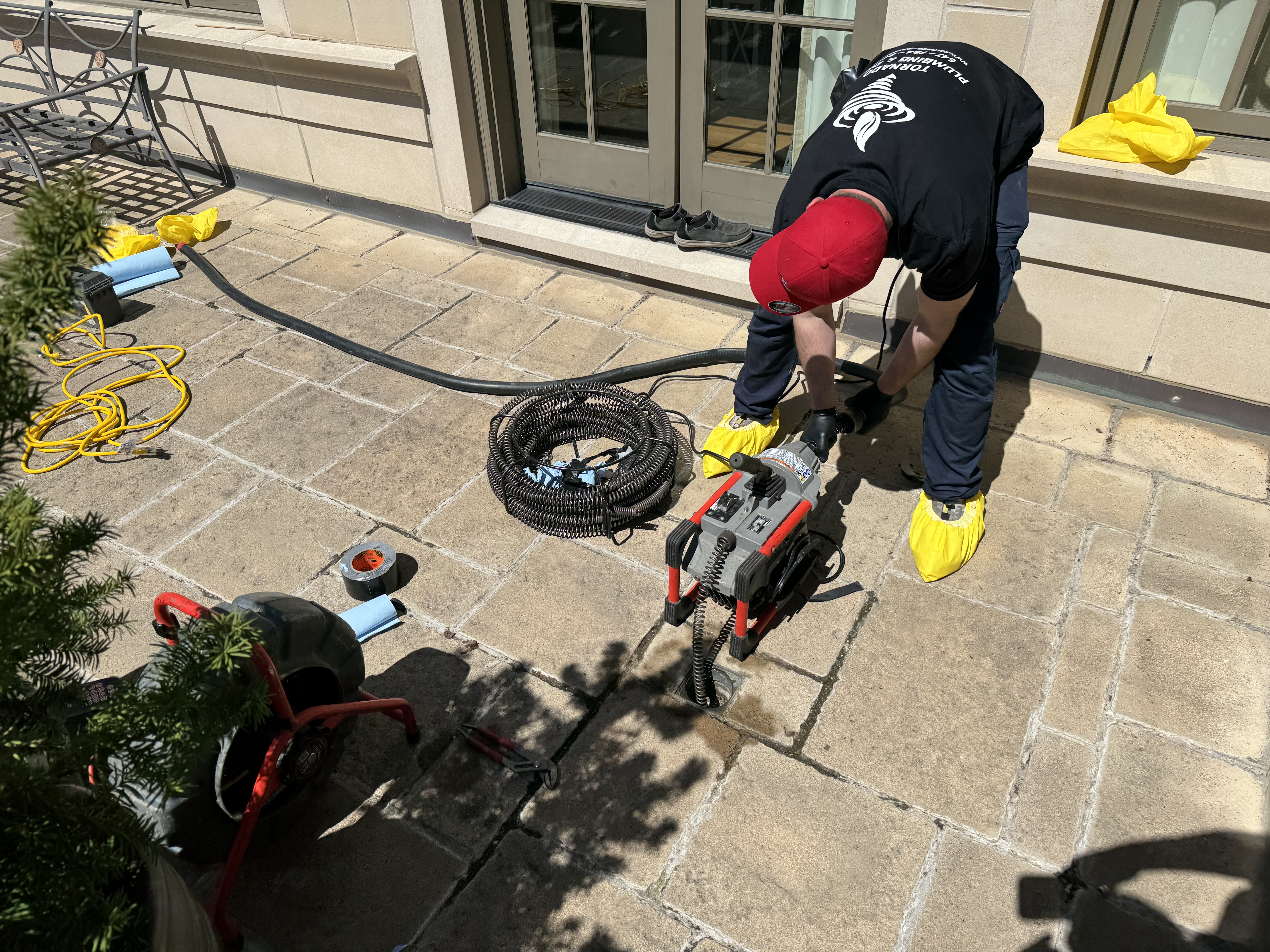
Close-up of drain access and service equipment
This photo focuses on the actual drain access point and the equipment staged to inspect and clear the affected line.
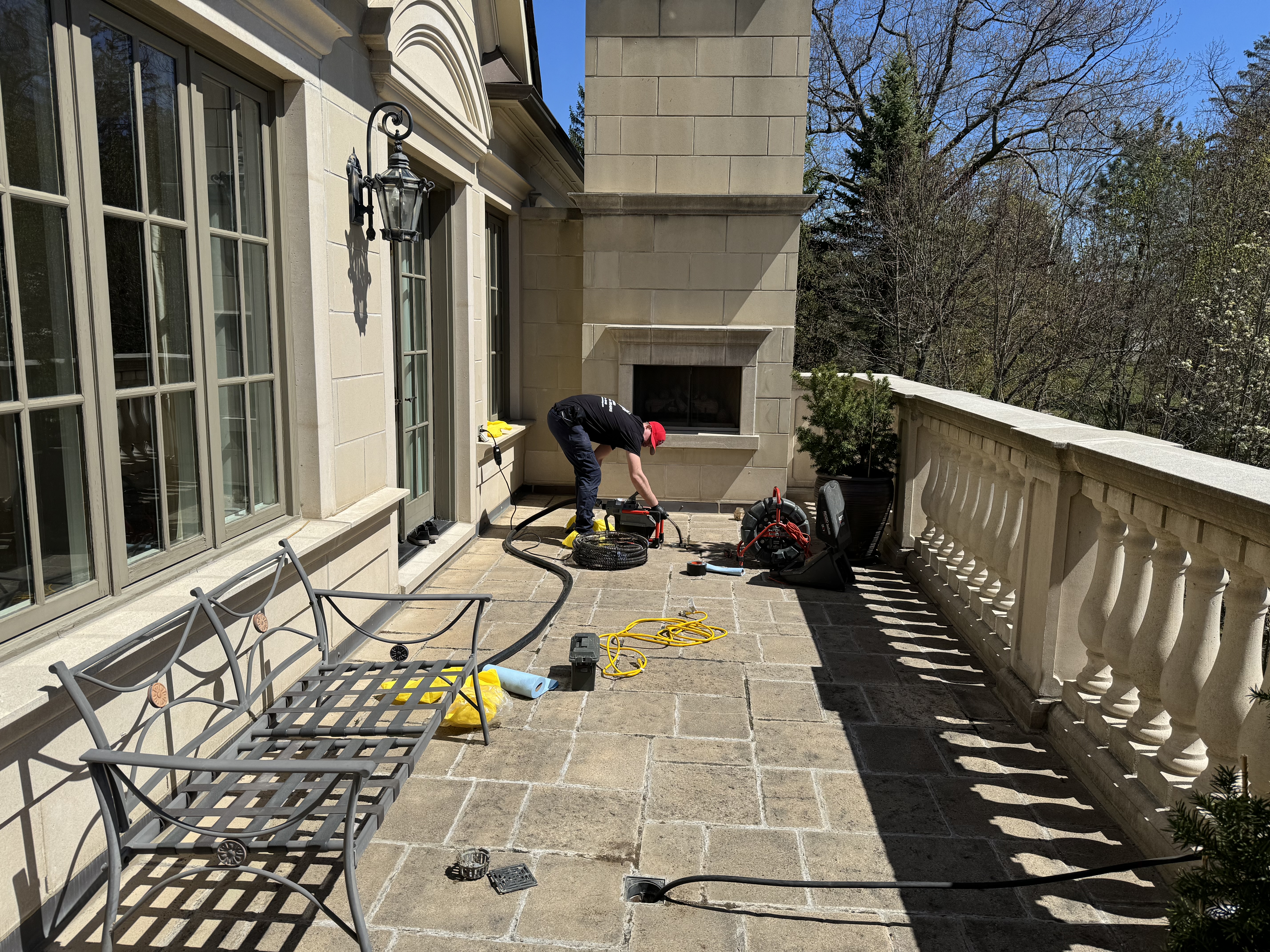
Drain service setup on a stone terrace
This wider view shows the real access conditions and equipment footprint during an exterior drain inspection and clearing visit.
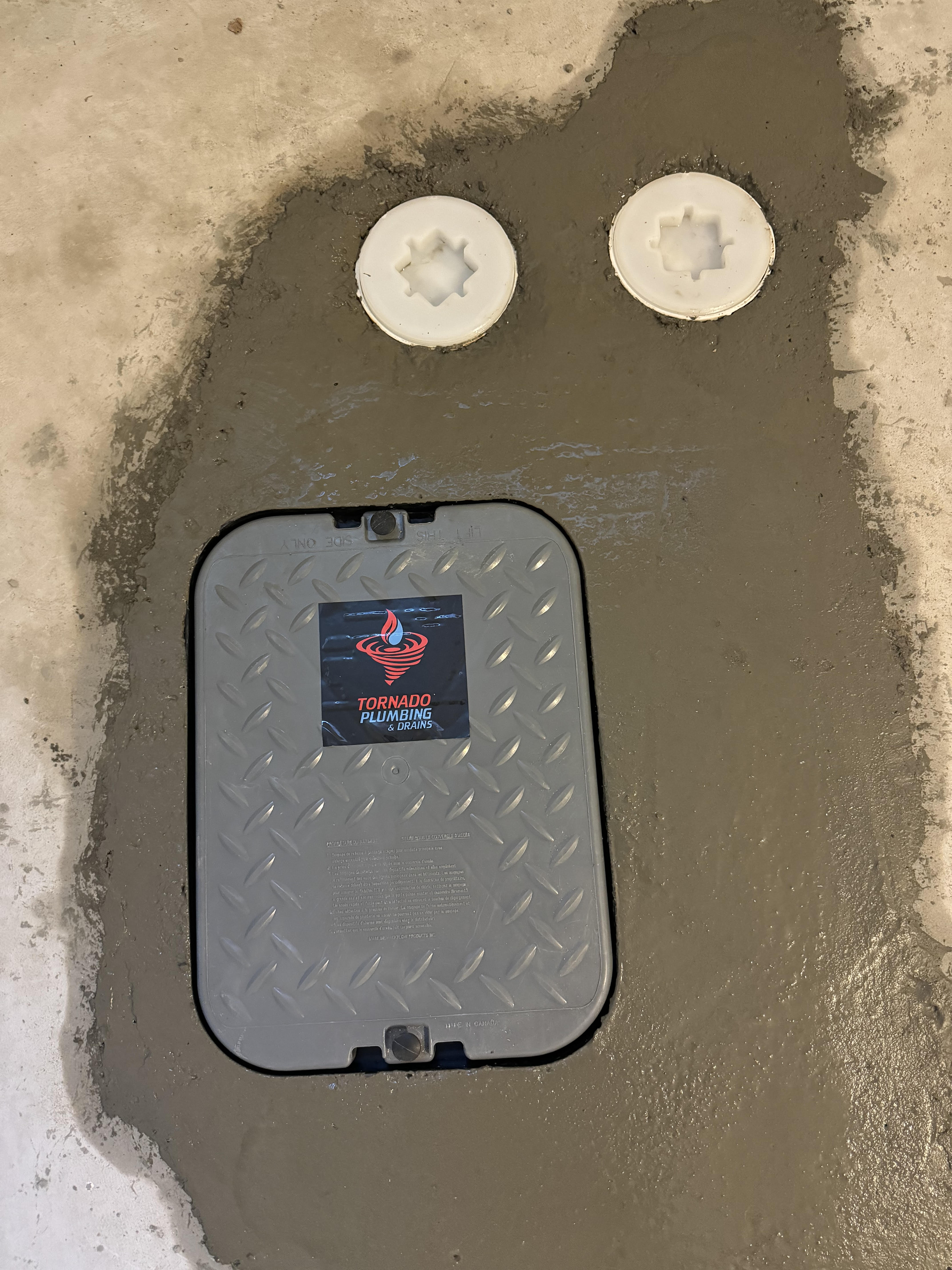
Backwater-valve access finished after concrete patch
This result photo shows the finished access point after basement flood-protection plumbing was installed and the floor was restored.
Read next in this topic
These related guides help you compare cost, scope, and next steps without starting over.
Best local service areas for this topic
Use one of these city pages when you want the same problem explained through local housing, flood risk, access, and neighbourhood-specific plumbing context.
Licensed, insured, reviewed Toronto plumbers
Serving Toronto & the GTA since 2016 — over 1,200 completed jobs.
Master plumber T95-4969603 · Plumbing contractor T94-4992639 · Drain contractor T87-4722944 · Building renovator T85-4728632 · Plumbing license FI6216638.
180+ five-star Google reviews. 400+ HomeStars reviews (Best of 2019–2025). BBB-accredited.
Same-day and after-hours dispatch across Toronto, Etobicoke, North York, Scarborough, York, Mississauga, and Burlington.
25-year workmanship warranty
Every job Tornado Plumbing & Drains completes in Toronto and the GTA — repair, install, replacement, drain work, sewer work, fixture work — is backed by a 25-year workmanship warranty. The written terms are provided with every quote. If our work fails within 25 years of the install date, we come back and make it right.
Quick answer
A drain camera inspection in Toronto in 2026 typically runs $250–$450 for a single fixture or branch line, $350–$650 for a full sewer main with cleanout access, and $500–$900 when the inspection includes a sonde locate marking exact depth and street position (required before any dig or trenchless quote). The price covers the camera run, recorded video footage, and a written condition report — not just a 30-second 'we looked at it.' Avoid 'free inspections' that are gated behind a service you didn't ask for.
What to know before booking
Push-cameras with self-leveling heads handle 2″–4″ lines up to ~150 ft. Mainline crawlers handle 4″–12″ runs and longer footage with onboard recording.
A sonde locate marks the camera-head position to within ±1 ft horizontally and ±6 in vertically — required before any dig, trenchless, or property-line locate.
Most common findings on Toronto residential mains (Tornado service data, last 1,200+ inspections): root intrusion ~38%, cracked clay laterals ~22%, bellies/sags ~14%, grease coating ~11%.
PACP (Pipeline Assessment Certification Program from NASSCO) is the industry-standard coding for documenting line condition. Ask whether the report follows it.
Real estate / property-purchase inspections often need both: footage AND a written report formatted for the buyer's lawyer or insurer.
Insurance claims after a sewer backup are routinely paid faster when the file includes a dated, recorded camera inspection from a licensed contractor.
Real Toronto camera inspection prices (2026)
Kitchen, laundry, or bath-group branch up to ~50 ft with available cleanout access. Includes recorded video and a one-page condition note. Typical visit 45–60 minutes.
Single fixture / branch
$250 – $450
Kitchen, laundry, or bath-group branch up to ~50 ft with available cleanout access. Includes recorded video and a one-page condition note. Typical visit 45–60 minutes.
Full residential sewer main
$350 – $650
House cleanout to property line, typical 60–90 ft run. Includes recorded video, written condition report, root-intrusion / belly / crack notes, and recommended next steps. 60–90 minutes on site.
Inspection + sonde locate
$500 – $900
Everything above plus a sonde locate marking the exact horizontal position and depth of the line at any point of interest. Required before any dig, trenchless quote, or shared-line locate.
Pre-purchase / due-diligence
$450 – $850
Real estate inspection scope. Includes recorded footage, written report formatted for the buyer's lawyer, photo stills of any defects with timestamps. Some buyers also request the sonde locate at this stage.
Pulled-toilet or roof-vent access
+$150 – $300
If there's no accessible cleanout, the camera goes through a pulled toilet or down a roof vent. The premium covers the pull, the reset, the mess control, and the wax-ring replacement.
What a real inspection report includes
A proper Toronto camera inspection report includes: (1) the recorded video file, time-stamped, in a format your insurer or lawyer can play; (2) a written narrative of pipe material, total run length inspected, and condition by section; (3) photo stills of any defect with footage time-codes for cross-reference; (4) PACP-style condition codes (cracks, fractures, deformation, root intrusion, infiltration); (5) measured slope or belly depth if a sag is present; (6) recommended next-step scope (clean, spot repair, trenchless, full replacement) with rationale. Reports that are just a five-minute video and 'looks fine' are not what you're paying for. Tornado provides the full deliverable as a standard part of every inspection.
When you actually need a camera inspection
Book the inspection when
You've had recurring backups (more than once in 12 months) at the same location. You're buying a property and want to know what's underground before closing. You've had a single major backup and need to know whether cleaning will hold. You're planning a renovation that touches the underground plumbing. Your insurer asked for documentation of the line condition.
Skip the inspection when
You've got a single, fresh, one-fixture clog (snake it, see if it returns). The pipe failure is already obvious — water visible, pipe broken, line collapsed (camera won't change the repair scope). The line was inspected in the last 12 months and nothing has changed.
What we do instead
When the symptom is a single fresh clog, we recommend snaking first and only camera if it recurs. When the failure is already obvious, we go straight to repair scope. When inspection makes sense, we run the full PACP-style scope so you don't pay twice.
Three Toronto camera inspections from the last 90 days
Forest Hill, pre-purchase inspection — 1934 house, buyer wanted underground due-diligence before closing. Camera and sonde locate revealed two offset clay joints, one root mass at 42 ft from the cleanout, and a 1.5-inch belly at 67 ft. Total: $720 (camera + sonde + report). Buyer renegotiated $14,000 off the purchase price using the report as evidence.
Etobicoke, recurring main backup — Customer had been snaked twice in 18 months by another company. Camera revealed a continuous root mat across 30 ft of clay lateral plus a hairline fracture at the bend. Total: $480 inspection. Subsequent quote: trenchless lining at $9,200 instead of repeated cleaning. Three-year follow-up: zero backups.
Scarborough, post-flood insurance documentation — Sewer backup during heavy rain, insurer requested camera footage to confirm the cause. Camera showed combined-sewer surcharge as the proximate cause, no defects in the homeowner's lateral. Total: $410 inspection. Insurance approved the claim for restoration; homeowner subsequently installed a backwater valve under the City subsidy.
What to have ready when you call
These six answers determine the access plan, the scope, the deliverable format, and the time on site — and tighten the on-site quote to the dispatch number.
What's the symptom — recurring backup, pre-purchase, post-flood insurance, or planning a renovation?
Is there an accessible cleanout, or do we need to access through a pulled toilet or roof vent?
What's the property age — pre-1955 (likely clay), 1955–1980 (likely cast iron), 1980+ (likely ABS/PVC)?
Is a sonde locate part of the scope, or just the inspection?
Who needs to see the report — you, an insurer, a lawyer, a buyer's agent?
Have any prior plumbers given you a verbal opinion you want documented?
Why Toronto's pipe stock makes camera inspection different
Toronto's underground is a layered map of plumbing history. Pre-1955 builds — common across the central, east, and west neighbourhoods (Roncesvalles, Leslieville, the Beaches, Forest Hill, Cabbagetown) — usually have clay laterals at the property line. Mid-century builds (1955–80) often have cast-iron transitions. Post-1980 builds in Scarborough, Etobicoke, and the suburbs are mostly ABS or PVC. Mature street trees grown over decades target the smallest joint they can find, which is why Toronto's root-intrusion rate on clay laterals is meaningfully higher than newer GTA suburbs. The City's combined-sewer system in older neighbourhoods means a backup during heavy rain isn't always 'your line's fault' — and a camera inspection is the only way to prove it to your insurer.
Where to go next
Service page with full scope, deliverable list, and the warranty terms. Where you book the inspection visit.
If the camera reveals a defect, this is the category page where you compare the repair options — clean, spot repair, lining, or replacement.
Once you know what's wrong, this is the repair page with method-by-method scope and pricing.
If the camera shows a continuous defect over more than a few feet, trenchless lining or bursting is usually the right call.
The visual reference for what root intrusion, bellies, cracks, and offsets look like on camera.
Sources cited in this guide
Ready to book the inspection
Book a Drain Camera Inspection when recurring backups, a property purchase, or post-flood insurance documentation makes the underground question worth answering. If you already know there's a defect, Drain & Sewer Services is the repair-options category. Calls go through 647-784-8448 with same-day and after-hours dispatch across Toronto and the GTA.
Common questions about Toronto camera inspection cost
Why pay for an inspection when companies advertise 'free camera with cleaning'?
A 'free' camera tied to a cleaning is usually a 30-second look meant to upsell more cleaning. A standalone, paid inspection is a structured deliverable: recorded video, PACP-style report, sonde locate if needed, and a written condition assessment that holds up for insurance and lawyer review. If the cleaning was actually needed, you pay for both — and have the documentation to prove the result. If the cleaning wasn't needed, the standalone inspection saves you the unnecessary cleaning fee.
How long does a Toronto sewer-main camera inspection take?
Typical 60–90 minutes for a residential main from cleanout to property line, including setup, the camera run, recording, and the written report. Pulled-toilet access adds 30 minutes. Sonde locate adds 15–30 minutes per point. Pre-purchase due-diligence with full deliverable usually closes around 90 minutes total.
Is sonde locate the same as the inspection?
No — they're complementary. The camera answers 'what's wrong in there.' The sonde answers 'where exactly is that defect, in terms of street position and depth.' You need both before any dig or trenchless quote: the camera tells you the repair, the sonde tells the crew where to dig the entry pit.
Will the inspection damage anything?
No. Push-cameras and crawlers are designed to navigate a 2″–12″ pipe without contact wear that would damage even an aged clay or cast-iron line. The wax ring on a pulled toilet is replaced as part of the visit; that's the only consumable involved.
Can the camera find an underground leak in the supply line, not the drain?
No — sewer cameras only inspect drain lines. Pressurized supply-line leaks are diagnosed with acoustic listening, thermal imaging, or tracer-gas. Different tool, different visit. If the call started about a supply leak, see our Leak Detection guide for the right scope.
Do you provide the footage afterward?
Yes. Every Tornado camera inspection includes the recorded video file, the written report, and any photo stills with footage time-codes — emailed to you within 24 hours of the visit. The footage is yours to share with insurers, lawyers, real-estate agents, or future plumbers.
Is the inspection warrantied?
The interpretation is. If we miss a defect on camera that should have been called out, we re-inspect at no charge and update the report. The inspection itself is non-destructive, so 'workmanship warranty' applies to the diagnostic accuracy and the report quality — both backed by our 25-year workmanship warranty.
Explore more