My Basement Is Flooding Right Now: Step-by-Step (Toronto, 2026)
By Serhiy Marunchuk, Master Plumber · Licence T95-4969603 · Updated September 15, 2026
First, do not enter standing water near outlets, baseboard heaters, or appliances. Kill the breaker if you can reach it dry, then read the steps below in order.
Published March 28, 2026 · Last updated September 15, 2026
Introduction
If you came to this page during an active flood, the priority is your safety, then your insurance file, then the plumbing. The steps below are in the order an experienced Toronto plumber would walk you through on the dispatch call — written so you can actually do them while we're on our way. Skim once, then go. Tornado dispatches across the GTA in 60–90 minutes for active flooding events: 647-784-8448. Once the water stops, prevention is the real fix — a backwater valve and sump pump installation are the two upgrades that stop the next flood.
Related services for this guide
If this article matches what you are dealing with, use one of these links to move into the service or broader category that makes the most sense.
Project photos related to this guide
These real project photos help show what this kind of work looks like in the field, not just on the page.
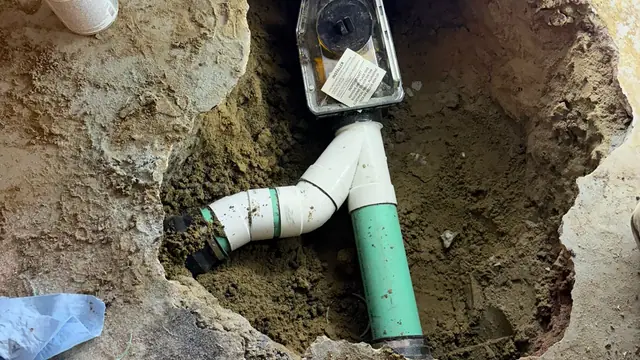
Mainline backwater valve set below the basement floor
Backwater valve installation, August 2026. The building drain was cut below the slab, the mainline valve set with its clear inspection lid facing up, and a cleanout branch added so the line can be serviced without disturbing the valve.
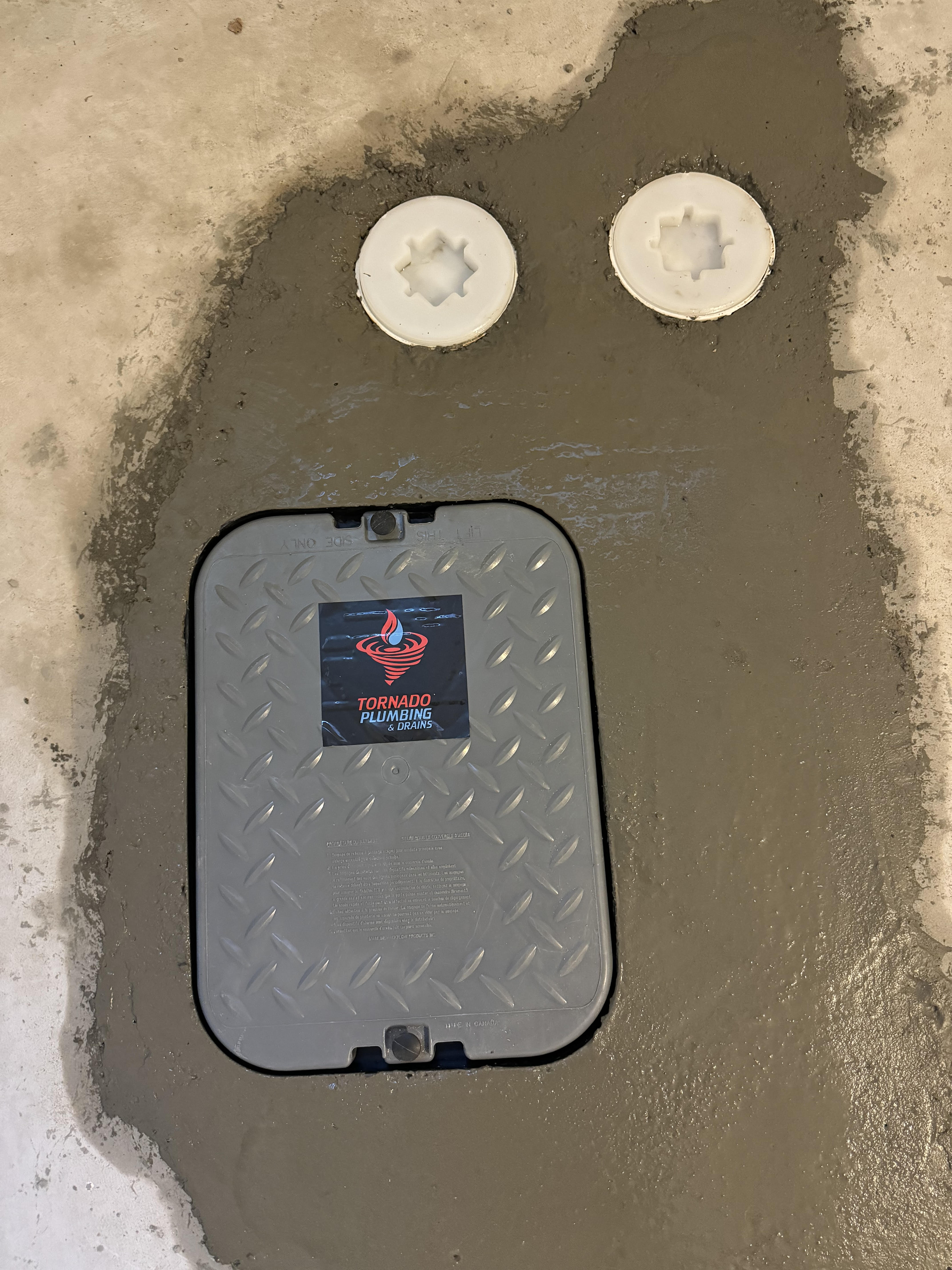
Backwater-valve access finished after concrete patch
This result photo shows the finished access point after basement flood-protection plumbing was installed and the floor was restored.
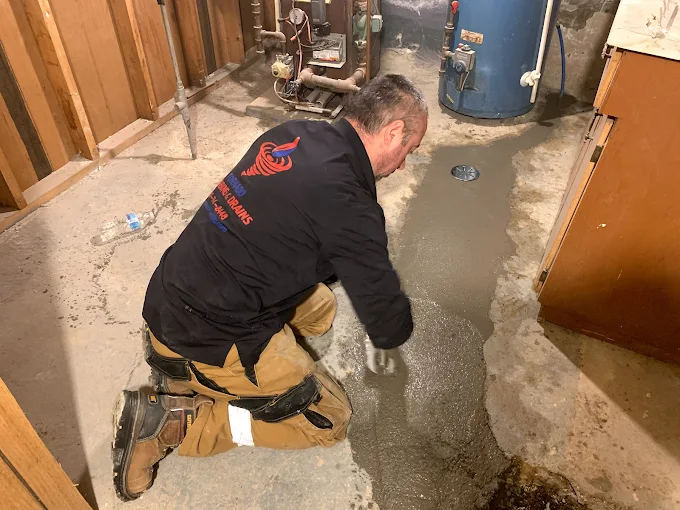
Basement floor patched back after flood-prevention plumbing work
Finished concrete patch after below-floor flood-prevention work, showing the restored surface homeowners see after the plumbing is installed.
Customer stories related to this topic
These customer stories pair real review quotes with the service pages most closely related to this guide.
Michael Slapsys
May 2024“Fast, competent, reliable, clean and reasonably priced. Can’t say enough good things about our experience with Serhiy and his team. We had our entire waste water lines, from stack to city hook-up replaced, and some plumbing redone (basement toilet was given a much needed vent and backwater valve was installed). They spent three nine hour days (non-stop) and got the job done with minimal disruption (start at 7:30 am end at 4:30 pm each and every day). Serhiy took care of permits and coordinated inspection of waste water valve by Toronto inspectors, and the City rebate cheque for waste water valve came in a week (City of TO says processing may take ten weeks). I completed the online application in ten minutes. Highly recommend Tornado Plumbing. I’ve dealt with at least two other plumbing and drain contractors (we have several properties to manage (big family)) they’re the only ones we’ll call in the future when and if the need arises. I wish them good health and much success!”
Most relevant to Backwater Valve Installation in Toronto & the GTA.
Google place photo: Tornado Plumbing & DrainsClaudia Lang
May 2019“Serhij and his team did a great job on waterproofing our basement and placing a french drain, as well as hooking up a new sump pump. They dug down to the bottom of the house foundation, drained a pond that we wanted to get rid of and left the place completely tidy. All for a very fair and reasonable price. Highly recommended.”
Most relevant to Sump Pump Installation in Toronto & the GTA.
Google place photo: Tornado Plumbing & DrainsMR Verxcy
April 2019“We were happy with Tornado plumbing from start and finish. Sergey came on the time to give us a quotation,he found the cracks in our foundation wall also our sump pump didn't work also. We are 100% satisfied with the crew ,they keep job site clean even weather wasn't great, the power flash the driveway and my basement is dry we are so happy!!! Highly recommend”
Most relevant to Sump Pump Installation in Toronto & the GTA.
Google place photo: Tornado Plumbing & DrainsRead next in this topic
These related guides help you compare cost, scope, and next steps without starting over.
Best local service areas for this topic
Use one of these city pages when you want the same problem explained through local housing, flood risk, access, and neighbourhood-specific plumbing context.
Licensed, insured, reviewed Toronto plumbers
Serving Toronto & the GTA since 2015 — over 1,200 completed jobs.
Master plumber T95-4969603 · Plumbing contractor T94-4992639 · Drain contractor T87-4722944 · Building renovator T85-4728632 · Plumbing license FI6216638.
4.9-star Google rating from 320+ reviews. 400+ HomeStars reviews (Best of 2019–2025). BBB-accredited.
Same-day and after-hours dispatch across Toronto, Etobicoke, North York, Scarborough, York, Mississauga, and Burlington.
25-year workmanship warranty
Every job Tornado Plumbing & Drains completes in Toronto and the GTA — repair, install, replacement, drain work, sewer work, fixture work — is backed by a 25-year workmanship warranty. The written terms are provided with every quote. If our work fails within 25 years of the install date, we come back and make it right.
Quick answer — do these things in this order
1) Shut off electricity to the basement at the breaker — only if you can reach it without stepping in water. 2) Turn off the main water supply at the meter. 3) Get people and pets out of the affected room, especially if the water smells, looks dark, or came from a floor drain. 4) Photograph everything for insurance — water lines on walls, soaked contents, the source if visible. 5) Call a licensed plumber for emergency dispatch — Tornado: 647-784-8448. 6) Only start water removal once the source is contained. Do not enter standing water near energized outlets or appliances; that is a fatal risk.
What should I do if my basement is flooding right now in Toronto?
If your basement is flooding right now: shut off electricity to the basement at the breaker (only if you can reach it without standing in water), turn off the main water supply, get people and pets out, photograph everything for insurance, then call a licensed plumber. Tornado dispatches across the GTA in 60 to 90 minutes for active floods: 647-784-8448.
What this guide covers — and doesn't
Use this guide when
Choose a different page when
Best next step
What you should know in the first 5 minutes
Average Toronto basement flood claim in 2024: approximately $43,000 (Insurance Bureau of Canada). Most of that is finishes, not the plumbing repair.
Sewage backup is Category-3 "black water" under the IICRC S500 industry standard — requires PPE, containment, and disinfection. Not a DIY scope.
Most Ontario insurance policies require a licensed plumber's invoice and proof of an installed backwater valve and/or sump pump for sewer-backup claims to be paid.
Standing water at energized outlets, appliances, or panels is a fatal electrocution risk. Kill the breaker before entering — or wait for a tech with the right gear.
Photographing water lines, soaked contents, and visible damage in the first hour materially improves insurance claim outcomes (per IBC adjuster guidance).
Tornado dispatches across Toronto, Etobicoke, North York, Scarborough, York, Mississauga, and Burlington with 60–90 minute typical arrival in active flood situations.
What NOT to do (real mistakes that make claims worse)
Don't enter standing water near outlets or appliances without confirming the power is off. The most common preventable injury we see is from this exact step.
Don't move or throw out damaged contents before your insurance adjuster sees them. The claim payout is anchored to documented loss; damaged-and-discarded contents become disputed.
Don't run the sump pump if the discharge is into the flooded area. Check that the discharge actually leaves the basement before powering up the pump.
Don't pour bleach or chemicals on sewage water. It doesn't disinfect adequately, creates fumes, and complicates the IICRC-certified restoration process.
Don't sign a 'we'll handle the insurance' contract from a restoration firm that knocked on your door. Toronto sees a wave of door-to-door restoration sales after major storm events; some are legitimate, many aren't. Use a firm referred by your plumber, your insurer, or someone you trust.
Don't try to fix the source yourself if it's behind drywall, in a wall cavity, or on the supply main. A mis-fixed pipe under pressure becomes a worse leak fast.
What to do based on what's flooding
| Source | Immediate action | What's likely needed |
|---|---|---|
| Burst pipe (clean water from above or in wall) | Shut main water. Photograph. Call. | Burst pipe repair, cut-and-patch, possible drywall and finish restoration. |
| Hot water tank failure (water around the tank) | Shut hot supply at the tank. Drain via the drain valve if accessible. | Tank replacement; possible code-upgrade items (expansion tank, drip pan). |
| Sewage from a floor drain or basement toilet | Stay out of the water. Stop running ANY water in the home. | Sewer cleaning + backwater valve install. Category-3 restoration. |
| Water seeping through walls or floor cracks | Sandbag if available. Check sump pump is running. | Waterproofing assessment, sump pump check, weeping-tile review. |
| Window-well overflow | Cover well if possible. Check exterior drainage. | Window-well drain cleaning, surface grading, possible cover replacement. |
| Source unclear | Containment + photos. Don't guess. | Diagnostic visit; we identify the source on arrival. |
After the immediate emergency: the next 48 hours and the next 30 days
Next 24 hours: water extraction, drying with commercial-grade air movers and dehumidifiers, antimicrobial treatment if Category-3 water was involved, content inventory for the insurance file, plumbing repair scope confirmed in writing.
Next 7 days: insurance adjuster visit and scope agreement, restoration contractor mobilization for finishes, mould prevention monitoring with moisture meters in wall cavities and behind cabinets.
Next 30 days: prevention scope decision — backwater valve, sump pump, weeping-tile disconnect — under the City of Toronto's $6,650 subsidy. Most homeowners coming out of a flood do this work because the next storm is statistically certain. We provide the scope-and-cost letter the insurer often asks for as a condition of continued coverage.
Why Toronto basement floods follow a predictable pattern
Most active basement flood calls we run in Toronto fall into three pattern groups: (1) summer-storm sewer backups in older neighbourhoods on combined sewer (about 25% of the city), where sanitary surcharges and pushes back through floor drains; (2) winter burst-pipe failures from frozen-and-thawed lines in exterior walls or unheated mechanical spaces; (3) sump pump failures during power outages when the primary pump can't run on a dead grid and there's no battery backup. Knowing your home's pattern — neighbourhood, sewer type, primary risk vector — is what we ask about on the dispatch call. The City's Basement Flooding Protection Subsidy is structured around the first pattern; battery-backup pumps and pipe insulation address the others.
What to have ready when you call dispatch
Have this in front of you before you dial 647-784-8448 — a 60-second clear description gets the right truck moving instead of a second call back.
Your postal code and the nearest cross-streets, so we can route the closest stocked truck and give you a real ETA.
Where the water is coming from — burst pipe above, around the hot water tank, up through a floor drain or toilet, or seeping through walls or floor cracks.
Whether the water is clean or sewage (dark, smells, came up from a drain) — this changes the truck, the gear, and the safety approach we dispatch with.
Whether you've shut off the main water and whether you could safely kill the basement breaker, so we know what's still live on arrival.
Whether you have a sump pump and a backwater valve installed — and if the sump is currently running — which most insurers ask about for the claim.
A few photos of the source and the water lines on the wall, ready to text — this starts your insurance file and helps us diagnose before we walk in.
Clear access: which door to use, where the panel and meter are, and whether stairs to the basement are themselves flooded.
Where to go next
Active emergency right now? This is the booking page. Same-day and after-hours dispatch standard.
If water came up through a floor drain or basement toilet — Category-3 containment scope.
Specific to floor-drain backup — the most common Toronto basement flood source.
If a pipe has clearly failed — repair, cut-and-patch, and pressure test.
What happens in the 48 hours and 30 days after the emergency stops.
After the emergency: the City rebate that covers up to $6,650 of prevention.
Sources cited in this guide
Active emergency? Call now.
647-784-8448 — same-day and after-hours dispatch standard across Toronto, Etobicoke, North York, Scarborough, York, Mississauga, and Burlington. Tell us where the water is coming from, whether you've shut the main, and whether it's clean or sewage. We dispatch with the right gear.
Common questions during an active flood
Should I keep running the sump pump?
Only if you can confirm the discharge is exiting the basement (not pumping back into a flooded room or onto a saturated zone that re-enters). If yes, leave it running. If unsure, leave it off and tell the dispatch tech — running into a closed loop can damage the pump and won't lower the water level.
Can I use the toilet or run water during a sewage backup?
No. Every flush, every sink run, every washing-machine cycle adds to the backup. Stop using all water in the home until a plumber has cleared the main. We tell you on the dispatch call when it's safe to resume.
Will my insurance cover this?
For sudden burst-pipe and fixture failures: yes, almost always. For sewer backup: only if you carry the sewer-backup endorsement, and most insurers now require an installed backwater valve and/or sump pump for the endorsement to apply. For groundwater seepage: depends on the policy. The plumber's invoice and cause-of-loss letter are required by the adjuster — we provide both as standard.
How fast can you actually get here?
Active flood calls in Toronto and the immediate GTA: 60–90 minutes typical from dispatch to arrival, faster if a tech is already in the area. Major-storm events with multiple simultaneous calls run longer; we triage by severity (active sewage > active burst > contained > non-active). We give a real ETA on the dispatch call, not a guess.
What does the after-hours emergency call cost?
Diagnosis and source containment: $250–$650 for clean-water; $900–$3,500+ for sewage backup with required Category-3 containment. Restoration of finishes is a separate scope and usually goes through the insurer. See our Emergency Plumbing Cost guide for detailed pricing by scenario.
After the emergency stops, what should I do about the next storm?
Most Toronto homeowners coming out of a flood install backwater valve, sump pump (with battery backup), and where applicable weeping-tile disconnect — all under the City's $6,650 subsidy. The next storm is statistically certain in southern Ontario; the prevention pays back through both rebate and reduced insurance premium. See the Toronto Basement Flooding Subsidy guide.
Explore more