Emergency Plumber Cost in Toronto (2026): Real Numbers, Not Ranges
Most after-hours plumbing calls in Toronto land between $250 and $1,400 depending on what's actually leaking — here's what each scenario costs and what your insurance will actually pay for.
Published March 30, 2026 · Last updated April 26, 2026
On this page
Related services
Get a free estimate
Introduction
Most homeowners only call an emergency plumber once or twice in a decade, which is why the price feels like a guess. It isn't — every emergency call has the same four cost drivers (time of day, what's leaking, where it's leaking through, and how fast you can stop it), and once you know those, the number stops being a mystery. This guide walks through real Toronto 2026 emergency-plumbing prices by scenario, what the after-hours premium actually looks like on a Tornado invoice, what your home insurance will and won't pay for, and how to keep a small leak from becoming a $43,000 finished-basement claim.
Related services for this guide
If this article matches what you are dealing with, use one of these links to move into the service or broader category that makes the most sense.
Project photos related to this guide
These real project photos help show what this kind of work looks like in the field, not just on the page.
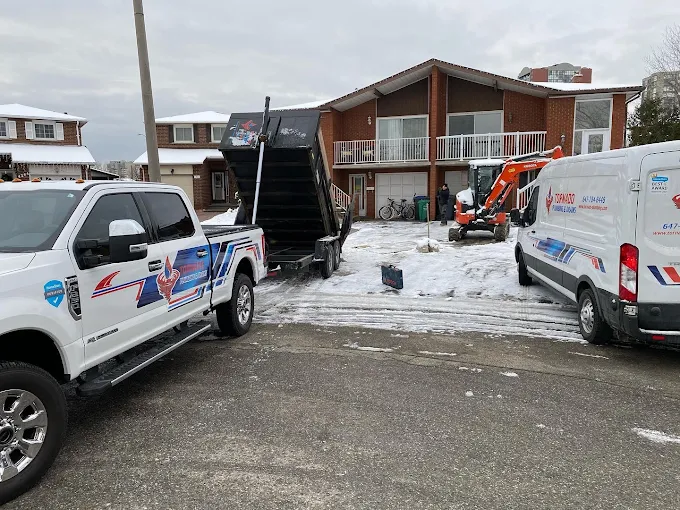
Winter emergency plumbing jobsite with trucks and excavation equipment
This winter jobsite photo helps emergency-service pages show what a real response looks like when the problem cannot wait and outdoor access, weather, and urgency all affect scope.
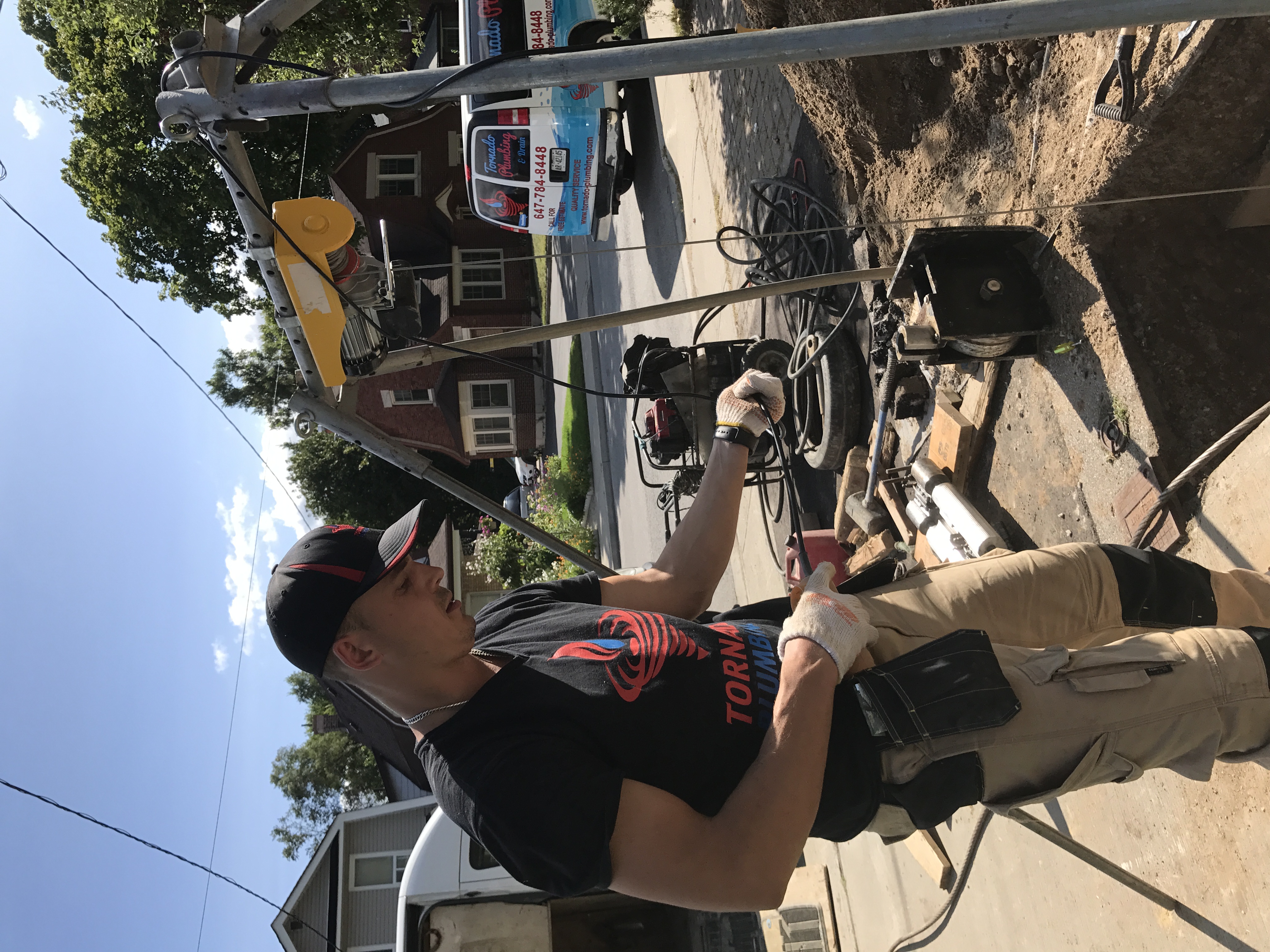
Serhiy on an active plumbing job site
This owner-led job-site photo reinforces that the company is showing real field work, not stock construction imagery.
Technician working under a kitchen sink
This is a straightforward interior-service photo that supports fixture repair, leak investigation, and small-space plumbing work.
Read next in this topic
These related guides help you compare cost, scope, and next steps without starting over.
Best local service areas for this topic
Use one of these city pages when you want the same problem explained through local housing, flood risk, access, and neighbourhood-specific plumbing context.
Licensed, insured, reviewed Toronto plumbers
Serving Toronto & the GTA since 2016 — over 1,200 completed jobs.
Master plumber T95-4969603 · Plumbing contractor T94-4992639 · Drain contractor T87-4722944 · Building renovator T85-4728632 · Plumbing license FI6216638.
180+ five-star Google reviews. 400+ HomeStars reviews (Best of 2019–2025). BBB-accredited.
Same-day and after-hours dispatch across Toronto, Etobicoke, North York, Scarborough, York, Mississauga, and Burlington.
25-year workmanship warranty
Every job Tornado Plumbing & Drains completes in Toronto and the GTA — repair, install, replacement, drain work, sewer work, fixture work — is backed by a 25-year workmanship warranty. The written terms are provided with every quote. If our work fails within 25 years of the install date, we come back and make it right.
Quick answer
In Toronto in 2026, expect $250–$650 for an after-hours diagnosis and shut-off of a clean-water leak, $450–$1,400 for a burst pipe with cut-and-patch through drywall or ceiling, and $900–$3,500+ for a sewage backup that needs containment and disinfection. After-hours dispatch (6 PM–8 AM, weekends, statutory holidays) typically adds $80–$200 over the daytime call-out. The single biggest variable on the final invoice isn't the plumbing — it's how much finished surface (drywall, hardwood, tile, ceiling) the leak ran through before you shut the water off.
What the numbers actually look like
After-hours premium across the GTA in 2026: typically $80–$200 over the standard daytime dispatch fee.
A burst-pipe call where the homeowner shuts the main within 5 minutes: typically $1,500–$5,000 in total damage. Same burst with shutoff after 30 minutes: $8,000–$25,000+ — almost all of it finishes, not plumbing.
Sewage backup is Category-3 "black water" under the IICRC S500 industry standard — required PPE, containment barriers, and chemical disinfection add roughly $300–$900 to the standard repair.
Average Toronto basement-flood insurance claim in 2024: approximately $43,000 (Insurance Bureau of Canada). Plumbing repair is rarely more than 10% of that total — restoration and finishes are the rest.
Most Ontario home-insurance policies require a licensed plumber's invoice and proof of an installed backwater valve or sump pump for a sewer-backup claim to be paid.
The Toronto Basement Flooding Protection Subsidy (expanded May 1, 2026) covers up to $6,650 of the prevention work — backwater valve, sump pump, weeping-tile disconnect — that prevents the next emergency call entirely.
Real Toronto emergency-plumbing prices by scenario (2026)
Diagnosed, shut off at the closest valve, repaired with one fitting or a short pipe section. Most fixture-supply leaks (toilet shutoff, sink supply, hose bib) and dishwasher / washing-machine line failures fall here. Adds for after-hours: $80–$200.
Clean-water leak, isolated
$250 – $650
Diagnosed, shut off at the closest valve, repaired with one fitting or a short pipe section. Most fixture-supply leaks (toilet shutoff, sink supply, hose bib) and dishwasher / washing-machine line failures fall here. Adds for after-hours: $80–$200.
Burst pipe with cut-and-patch
$450 – $1,400
Leak path runs through drywall, ceiling tile, or finished wall. Includes drywall opening, pipe replacement (typically copper or PEX section), pressure test, and rough patch. Painting and texture matching are extra and usually go through the homeowner's restoration contractor or insurance.
Frozen pipe, thawed + repaired
$380 – $1,100
Thawing a known-location freeze is fast. The cost grows when the pipe has split during the freeze and water releases when it thaws — at that point it becomes a burst-pipe job.
Hot water tank leak (live)
$320 – $850
Isolation, drain-down, leak diagnosis, and either a part replacement (T&P valve, dip tube, drain valve) or a temporary patch until same-day or next-day tank replacement. Full tank replacement is a separate scope ($2,200–$4,200 — see hot-water-tank cost guide).
Sewage backup
$900 – $3,500+
Diagnosis, drain-line clearing, water removal, IICRC-S500-compliant Category-3 containment and disinfection. Restoration of finishes is a separate scope and usually goes through the insurer. Sewage cleanup almost always points to a backwater-valve recommendation.
Active basement flood
Quoted on site
Source identification, immediate stabilization, water extraction coordination, and damage documentation for the insurer. The plumbing portion is usually the smallest part of the total bill — what matters is fast, documented dispatch so the insurance file is clean.
What this guide does — and doesn't — cover
Use this guide when
Choose a different page when
Best next step
What to have ready when you call
The clearer the dispatch call, the faster the right truck rolls and the closer the on-site quote will be to the phone estimate.
Where is the water coming from — fixture, ceiling, basement floor, or you can't tell?
Is the water still moving, and have you found the main shutoff?
Is the water clean, grey (sink/laundry), or sewage (smell, came from a floor drain)?
Is the affected area finished (drywall, hardwood, tile) or unfinished (concrete, mechanical room)?
Have you called your insurer yet, and do you have a claim number?
What postal code, and is the building a house, condo unit, or multi-unit?
Three calls we ran in the last 90 days, anonymized with real numbers
Scarborough, Tuesday 11:47 PM — pinhole leak in a copper hot-water line above a finished kitchen ceiling. Homeowner found the main shutoff in two minutes; ceiling damage limited to one drywall panel. Total invoice: $487 (after-hours premium $135, repair labour and materials $352). Drywall and paint went through the homeowner's restoration contractor at ~$650.
Etobicoke, Sunday 2:15 PM — washing-machine standpipe sewage backup during a heavy-rain event, finished basement. Drain main backed up, waste pushed through the floor drain. Total invoice: $1,840 plumbing + $4,200 IICRC restoration through partner firm. Insurer paid both, less the deductible. Customer subsequently installed a backwater valve under the City subsidy (net out-of-pocket ~$1,800 after the $1,250 rebate).
North York, Friday 7:30 AM — frozen-then-burst kitchen-supply line behind a north-wall sink cabinet, -19°C overnight. Burst released for ~25 minutes before homeowner located shutoff. Total plumbing invoice: $620. Total claim cost including hardwood replacement and cabinet refinishing: $11,300, paid by insurer.
Why Toronto pricing differs from suburban GTA
Three things make emergency plumbing in the City of Toronto specifically different from the suburban GTA: (1) the housing stock — older century homes in the central, east, and west neighbourhoods mix copper, galvanized, cast iron, and lead in ways that take longer to diagnose than a 2010 build in Vaughan; (2) the combined-sewer system — about 25% of the city is on combined sanitary-and-storm sewers that surcharge during heavy rain, which is why so many emergency calls during summer storms involve floor drains rather than supply lines; and (3) condo and tenant access — high-rise emergencies in downtown towers add property-management coordination time that single-family suburban calls don't have. Tornado dispatches across Toronto, Etobicoke, North York, Scarborough, York, Mississauga, and Burlington with same-day windows in most postal codes.
What your home insurance will actually cover
Most Ontario home-insurance policies treat plumbing emergencies in three buckets: (1) sudden and accidental leaks (burst pipes, fitting failures, fixture failures) — covered under standard water-damage coverage, including restoration of finishes; (2) sewer backup — only covered if you carry a sewer-backup endorsement, and most insurers now require an installed backwater valve and/or sump pump for the endorsement to apply; (3) gradual leaks (slow drips behind a wall over months) — usually excluded as 'gradual deterioration' unless you can show you couldn't reasonably have known. The plumbing portion of an emergency call is almost always paid by the insurer when the cause is sudden — what insurers fight on is restoration scope, not the plumbing invoice. A licensed plumber's cause-of-loss letter is what aligns those two.
Where to go next
Active emergency right now? This is the page where you book the visit, see the dispatch window for your postal code, and get the call-back number direct.
Compare the full emergency category — burst pipe, frozen pipe, sewage backup, leak detection — and pick the closest fit before you call.
If the failure is a clear pipe burst, this is the specific service page with scope, pricing, and the cut-and-patch detail.
If water came up through a floor drain, toilet, or laundry standpipe, this is the right scope — Category-3 containment is part of it.
After the emergency: the City subsidy that covers up to $6,650 of prevention work so the next storm is uneventful.
Sources cited in this guide
Active emergency? Call now.
Active leak, burst pipe, or sewage backup right now: 647-784-8448. Same-day and after-hours dispatch is standard across Toronto, Etobicoke, North York, Scarborough, York, Mississauga, and Burlington. For non-active situations, Emergency Plumbing Service is the booking page; Emergency Plumbing is the full category overview.
Common questions about Toronto emergency plumbing pricing
How much should an after-hours plumber in Toronto cost in 2026?
For most clean-water emergencies, $250–$650 total — that includes the after-hours dispatch premium ($80–$200), diagnosis, shutoff, and a single-fitting or short-pipe-section repair. Burst pipes through finished surfaces run higher because of cut-and-patch labour. Sewage backup is its own category at $900–$3,500+ because of mandatory containment.
Will my home insurance cover the emergency plumber's bill?
For sudden-and-accidental events (burst pipe, fitting failure, fixture failure), yes — almost always. The plumbing invoice is rarely the part insurers push back on; what they scope-control is restoration. Sewage backup is only covered if you carry a sewer-backup endorsement, and most insurers now require an installed backwater valve and/or sump pump for the endorsement. Slow leaks discovered after months are usually excluded as 'gradual deterioration.'
What's the difference between Tornado's after-hours surcharge and a flat-rate emergency fee some companies advertise?
We charge a transparent after-hours surcharge ($80–$200 over daytime dispatch) plus the actual repair work at standard rates. Some companies advertise a flat 'emergency fee' that bundles dispatch and the first hour, which can look cheaper on the phone but ends up higher when the actual repair takes 90 minutes. Ask for the dispatch fee, the hourly rate, and the surcharge separately — that's how you compare apples to apples.
Can I just shut the water off and wait until morning?
For an isolated supply-side leak you've fully shut off, yes — the morning rate is meaningfully lower. For sewage backup, no — Category-3 water needs containment within 24–48 hours to prevent mould growth (IICRC S500). For an actively leaking water heater you've drained, you can usually wait. For a burst pipe in a finished wall, even shut off, the longer drying time without a documented cause-of-loss letter can complicate the insurance claim.
What does Tornado bring on a typical emergency dispatch?
Standard truck inventory covers PEX, copper, and ABS pipe and fittings; full valve and shutoff inventory; basic drywall opener and patch material; water-extraction wet-vac; thermal imaging and acoustic listening for hidden leaks; pressure-test gauges; and PPE for Category-3 sewage work. We run licensed master and journeyman plumbers, not subcontractors. Our trucks carry the parts to finish 95%+ of emergency calls on the first visit.
Is the work warrantied?
Yes — every repair we complete is backed by our 25-year workmanship warranty. The written terms come with the quote. If our work fails within 25 years of the install date, we return and make it right at no charge. Manufacturer warranties on parts (water heaters, valves, fixtures) are separate and pass through to the homeowner per the manufacturer terms.
Are you actually licensed and insured?
Yes. Master plumber T95-4969603, Plumbing contractor T94-4992639, Drain contractor T87-4722944, Building renovator T85-4728632, Plumbing license FI6216638. $5M general liability, WSIB cleared. Tornado has been serving Toronto and the GTA since 2016 with over 1,200 completed jobs and BBB accreditation.
Explore more