Tankless vs Tank Water Heaters in Ontario (2026): Real Cost, Lifespan, and the Toronto-Specific Decision Factors
By Serhiy Marunchuk, Master Plumber · Licence T95-4969603 · Updated August 17, 2026
Tankless saves 25–35% energy for low-to-moderate use households, lasts 18–22 years vs 10–15 for tank, and never runs out of hot water. Tank costs $2,000–$3,500 less upfront and recovers better for high-simultaneous demand. The right call depends on your demand pattern and existing infrastructure.
Published February 26, 2026 · Last updated August 17, 2026
Introduction
The tankless-vs-tank decision in Ontario isn't an article-of-faith argument — it's a practical comparison driven by your household's actual hot-water demand pattern, your existing gas-line size, and the venting route in your basement. This guide gives you the real 2026 numbers (Tornado-installed costs, NRCan published efficiency data, manufacturer lifespan claims), the math on payback, and the cases where tank actually beats tankless in Toronto homes.
Related services for this guide
If this article matches what you are dealing with, use one of these links to move into the service or broader category that makes the most sense.
Project photos related to this guide
These real project photos help show what this kind of work looks like in the field, not just on the page.
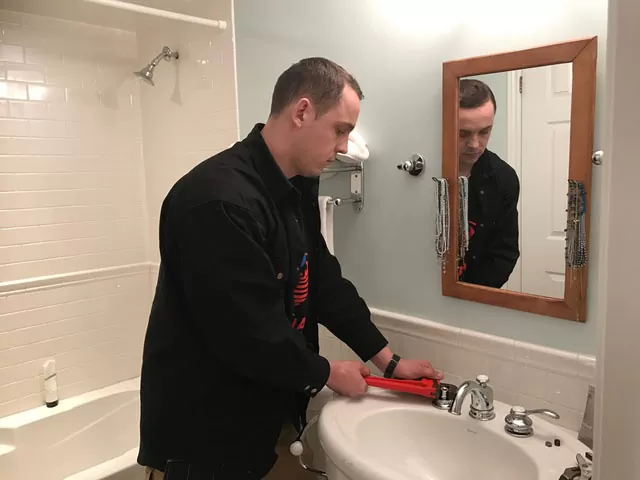
Technician handling a residential interior plumbing service call
This is a useful general indoor-service photo for interior plumbing pages where homeowners want to see a real technician on site instead of generic brand graphics.
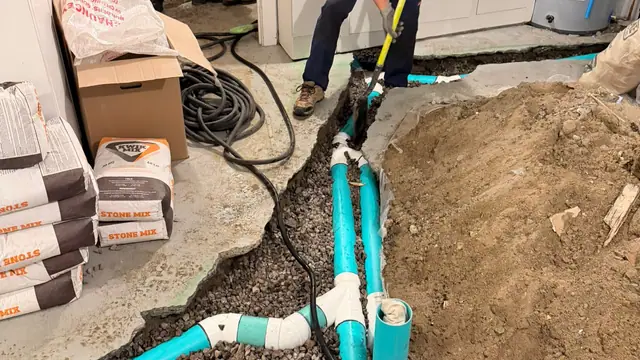
Basement floor opened to replace the under-slab drain lines
Interior drain re-piping, August 2026. The slab was cut along the drain route, the old lines removed, and new PVC drain connections laid on gravel with stub-ups for the fixtures above.
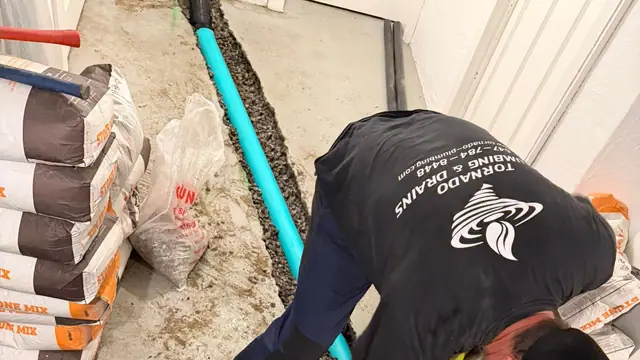
Bedding the new basement drain run in gravel
Same August 2026 basement drain project: each fitting is supported and the run is bedded in clear gravel before restoration, so the slope set during installation does not move.
Customer stories related to this topic
These customer stories pair real review quotes with the service pages most closely related to this guide.
Ed Talaj
February 2020“Initially had a back-up problem with downstairs basement sinks. After many failed attempts ( and lost money ) to resolve the problem with others, I finally placed a call to Tornado Plumbing. Next day Sergey examined the situation and determined the issue was underneath the floor. One day later Sergey ( and Boris ) broke and dug up 14 ft. of my basement floor to replace the damaged/ broken drain pipes and finally address the real problem. They were courteous, efficient and explained all steps in the process. The job itself took one day to complete and the basement was left clean and tidy. Sergey (and crew ) were prompt, efficient and professional. They FIXED my problem and RESPECTED my home. That is called customer service and satisfaction in any trade. Quality work ! Highly recommended !!!”
Greg Tsarev
May 2022“Professional service and fair price. Definitely recommend and will use again if needed.”
H Yilmaz
October 2025“Had an issue where there was an inner blockage down the toilet line where it caused a flood in my washroom. The team came in on time, put in a camera, found the issue deep down the pipe, and removed it. These guys are my go to guys for every plumbing issue that I have had for the past five years because they're very good at diagnosing issues and getting it resolved in a timely manner.”
Read next in this topic
These related guides help you compare cost, scope, and next steps without starting over.
Best local service areas for this topic
Use one of these city pages when you want the same problem explained through local housing, flood risk, access, and neighbourhood-specific plumbing context.
Licensed, insured, reviewed Toronto plumbers
Serving Toronto & the GTA since 2015 — over 1,200 completed jobs.
Master plumber T95-4969603 · Plumbing contractor T94-4992639 · Drain contractor T87-4722944 · Building renovator T85-4728632 · Plumbing license FI6216638.
4.9-star Google rating from 320+ reviews. 400+ HomeStars reviews (Best of 2019–2025). BBB-accredited.
Same-day and after-hours dispatch across Toronto, Etobicoke, North York, Scarborough, York, Mississauga, and Burlington.
25-year workmanship warranty
Every job Tornado Plumbing & Drains completes in Toronto and the GTA — repair, install, replacement, drain work, sewer work, fixture work — is backed by a 25-year workmanship warranty. The written terms are provided with every quote. If our work fails within 25 years of the install date, we come back and make it right.
Quick answer
Tankless water heaters last 18–22 years (vs 10–15 for tank), save 25–35% on energy for low-to-moderate use households, and never run out of hot water — but cost $2,000–$3,500 more upfront and may require a gas-line upgrade in older Toronto homes. Tank water heaters cost less ($2,200–$4,200 vs $4,500–$6,500 tankless), install faster (3–4 hours vs full day), and recover well for high-simultaneous-demand households. The right choice depends on your household's actual demand pattern and your existing gas/venting infrastructure. Both require TSSA-licensed install in Ontario.
Is tankless or tank better in Ontario, and what does each cost in 2026?
A tank water heater costs $2,200-$4,200 installed versus $4,500-$6,500 for tankless, but tankless lasts 18-22 years (vs 10-15), never runs out, and saves 25-35% energy for low-to-moderate use households. Choose tank for high-simultaneous-demand homes; tankless for efficiency and longevity. Both require TSSA-licensed install.
Real numbers behind the decision
Tankless lifespan with annual descaling: 18–22 years (Rinnai/Navien published). Tank lifespan in Toronto's moderately hard water: 10–15 years with annual flushing, 6–8 without.
Energy savings: 25–35% (low-use household), 8–15% (high-use household) per Natural Resources Canada. Standby losses are the main savings driver.
Tankless install in Toronto typically requires 3/4″ gas line and Category-IV stainless venting; older homes often need a gas-line upsize ($400–$1,200 add).
Tankless flow: 6–11 GPM at 70°F rise — sufficient for 2–3 simultaneous fixtures depending on the unit. Tanks support more simultaneous demand at the cost of recovery time.
Total cost of ownership over 20 years: typically favours tankless for low-to-moderate use households, tank for high-simultaneous-demand households (large families with multiple morning showers).
Toronto water hardness (~120–140 mg/L CaCO₃) means annual descaling is required for tankless to maintain warranty. Skipping voids manufacturer coverage.
TSSA-licensed install required for both technologies (gas appliance regulations). ESA inspection required for any electric component.
Tankless vs Tank head-to-head (Toronto, 2026)
| Factor | Tank (40-gal gas) | Tankless (high-efficiency) |
|---|---|---|
| Upfront install cost | $2,200 – $4,200 | $4,500 – $6,500 |
| Service life (annual maintenance) | 10–15 years | 18–22 years |
| Energy efficiency | Standard atmospheric: ~60%; power-vent: ~70% | 0.93–0.96 UEF (Energy Star certified) |
| Annual maintenance cost | $140 (flush) — often skipped | $220–$380 (descaling, required for warranty) |
| Hot water capacity | 40 gal stored, ~5–6 GPM recovery | Endless, 6–11 GPM at 70°F rise |
| Simultaneous demand handling | Excellent until tank empties | Limited by GPM rating |
| Footprint | 55″–60″ tall, 22″ wide | ~30″ tall × 18″ wide, wall-mounted |
| Venting | Atmospheric (chimney) or power-vent | Stainless Category-IV sidewall |
| Gas-line requirement | 1/2″ usually adequate | 3/4″ required, often upsize |
| Lifetime cost (20-yr, 4-person household) | $5,800–$9,400 (with replacement at year 12) | $7,000–$11,200 (incl. annual descaling) |
| TSSA license required | Yes (gas) | Yes (gas + venting) |
Which choice fits which household
Tank is the right call when
Large family with frequent simultaneous demand (multiple morning showers + dishwasher + laundry). Existing gas line is 1/2″ and you don't want the upgrade cost. Budget is the primary constraint. Existing chimney is sized for atmospheric and you want to reuse it.
Tankless is the right call when
1–4 person household with predictable demand (sequential rather than fully simultaneous use). You want the longer service life and lower 20-year operating cost. Mechanical room is space-constrained. New build or major reno where venting and gas can be sized for tankless from the start.
What we recommend on site
We size on the dispatch visit by measuring fixture-unit demand, checking the existing gas-line size and pressure, and assessing the venting route. The right answer is whatever fits your demand pattern and infrastructure — not a default toward one technology. About 60% of our Toronto installs end up tank; 40% tankless.
Three Toronto household decisions from the past 90 days
Etobicoke, 4-person family with 3 simultaneous-shower mornings — Tank chosen (60-gal power-vent). Tankless ruled out because the family's peak demand exceeded a single tankless unit's GPM. Total: $3,600. Customer reports zero cold-shower events.
Riverdale, 2-person household, gas-line upsize already done in basement reno — Tankless chosen (Rinnai RU199). Existing tank had failed; venting and gas already tankless-ready. Total: $5,200. Annual hot-water energy bill dropped from ~$680 to ~$430 = $250/yr savings.
Forest Hill, 5-person household with no morning peak conflict — Despite high total demand, the family showers were sequential (parents at 6 AM, kids at 7 AM). Tankless chosen (Navien NPE-A2 series). Total: $6,100 including 3/4″ gas-line upsize. Customer reports endless hot water and savings on the gas bill — best of both worlds for this specific demand pattern.
Why Toronto's housing stock complicates the decision
Two Toronto-specific issues make tankless more expensive in older homes than the brochure pricing suggests. First, gas-line sizing — many pre-1990 Toronto homes have 1/2″ gas service lines that handle a tank fine but not a tankless's higher BTU input. Upsizing the gas line from the meter adds $400–$1,200 to the install. Second, venting — tankless units use sealed Category-IV stainless venting through the sidewall, which means new penetrations through century-home brick or stucco. Suburban GTA homes built post-2000 are usually tankless-ready (3/4″ gas, easy sidewall venting); older central, east, and west Toronto homes routinely need infrastructure upgrades. We assess all of this on the diagnostic visit so the quote is accurate before you commit. Both technologies require TSSA-licensed gas-fitter install in Ontario.
Where to go next
Service page with brand options (Rinnai, Navien, Noritz), gas-line and venting scope, and the install warranty.
Service page for tank installs — atmospheric, power-vent, and direct-vent.
If your existing unit is under 8 years old and you're considering repair before replacement.
Annual service required for tankless warranty in Toronto's water hardness.
Detailed cost breakdown by tank type, size, and venting.
Sources cited in this guide
Get a sized quote on site
Book the diagnostic visit at Tankless Water Heater Installation or Hot Water Tank Installation & Replacement. We size on site, quote both technologies when both are feasible, and explain the tradeoffs. Calls go through 647-784-8448.
Common questions about tankless vs tank in Toronto
Will a tankless really save me money in Toronto?
Yes for low-to-moderate use households (1–4 people), where the 25–35% energy savings on standby losses pay back the upfront premium within 8–12 years and continue saving over the unit's 18–22 year lifespan. For very high-use households the savings shrink because there's less standby loss to recapture. Run the math on your actual gas bill — most Toronto households see meaningful savings with tankless.
Why does tankless cost more to install in older Toronto homes?
Gas-line upsize ($400–$1,200) — older homes often have 1/2″ gas that handles a tank fine but not a tankless. Sidewall venting through century-home brick or stucco adds labour. Both are one-time costs; the savings are ongoing. Newer suburban GTA homes are usually tankless-ready and have lower install costs.
Is tankless better for the environment?
Yes for total energy use — both because of higher efficiency and because the unit lasts ~50% longer (less manufacturing impact per year of service). NRCan classifies tankless as the higher-efficiency category for residential gas water heating.
Can I run two showers and the dishwasher at the same time on tankless?
Depends on the unit's GPM rating and your inlet water temperature. A 9 GPM unit handles 2 showers (3 GPM each) plus a dishwasher (1.5 GPM) with margin. A 6 GPM unit struggles. We size for your actual peak demand, not the brochure spec.
Explore more