Main Water Line Repair & Replacement in Toronto: Spot the Warning Signs Before the Failure
Catching a failing main water line in Toronto early often means a $2,000 spot repair instead of a $12,000 replacement. The four warning signs every homeowner should know — and what each one usually means.
Published February 25, 2026 · Last updated April 26, 2026
Introduction
Toronto residential water service lines fail in predictable patterns: pressure slowly drops, the water bill creeps up, you notice a wet patch in the lawn or driveway, or the water turns rusty intermittently. Most of these signals show up months before the line actually bursts. Catching them early is the difference between a $2,000 spot repair and a $12,000 full replacement. This guide walks through each warning sign, what it usually means, and when the right scope is repair versus replacement.
Related services for this guide
If this article matches what you are dealing with, use one of these links to move into the service or broader category that makes the most sense.
Project photos related to this guide
These real project photos help show what this kind of work looks like in the field, not just on the page.
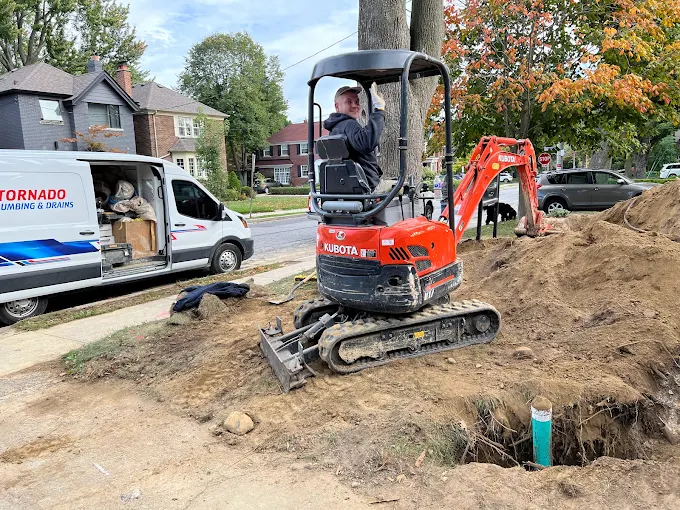
Residential service-line excavation in progress
This proof image shows the work stage where access, depth, and the surface route are already affecting time and cost on a buried service-line job.
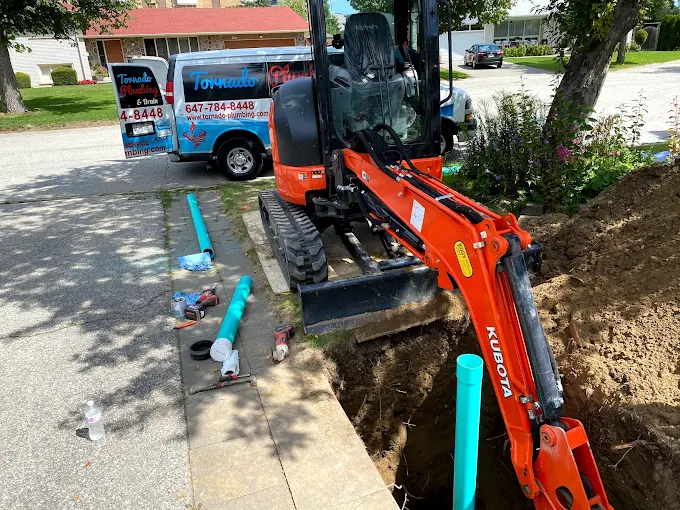
Underground water-service trench open for replacement work
This trench photo shows the buried-service stage that usually drives price through access depth, route length, and surface restoration, not just the pipe itself.
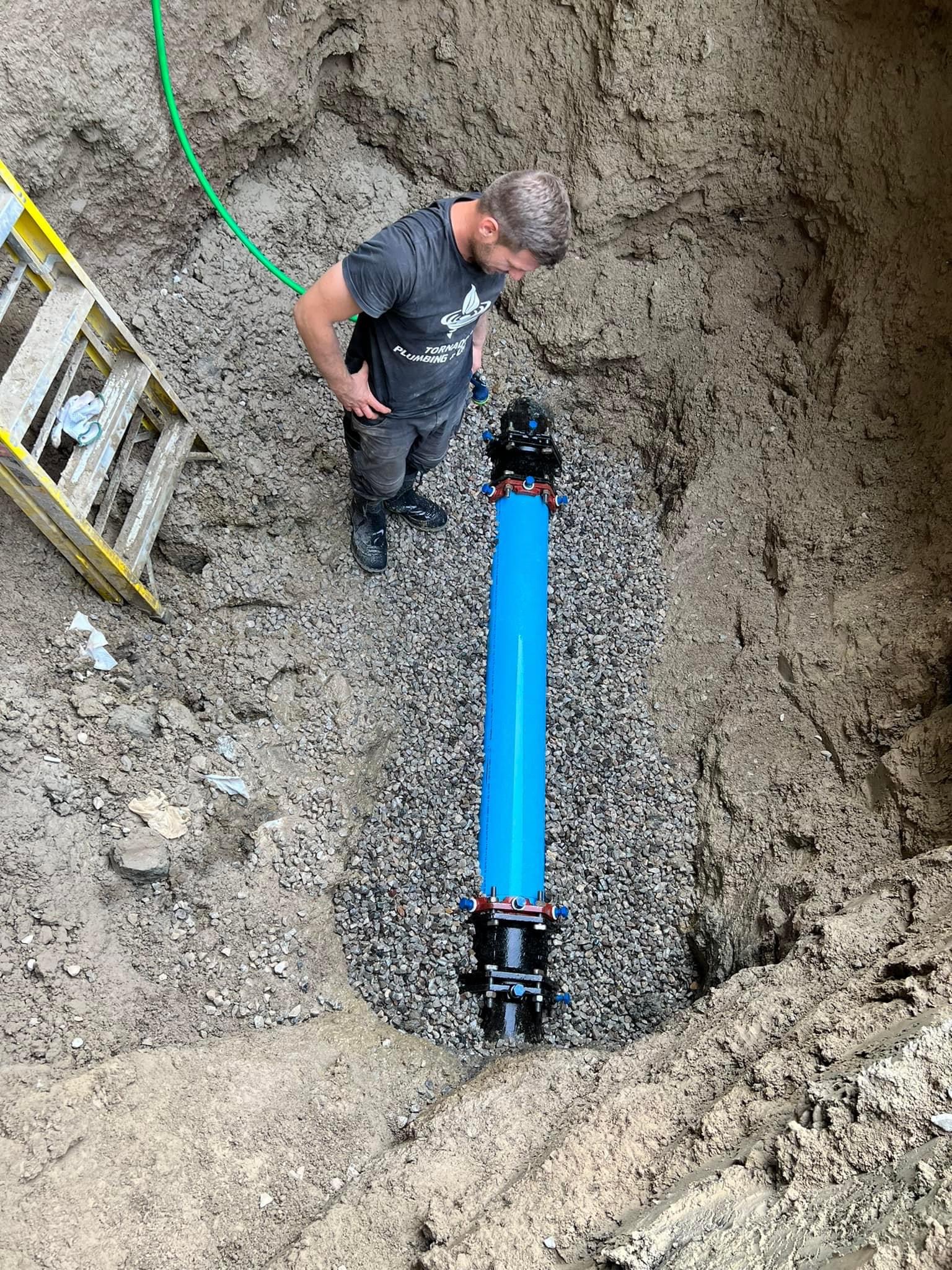
Blue service line installed in an excavation trench
This photo captures the in-ground installation phase after excavation is complete and the new service line is ready to be tied in.
Read next in this topic
These related guides help you compare cost, scope, and next steps without starting over.
Best local service areas for this topic
Use one of these city pages when you want the same problem explained through local housing, flood risk, access, and neighbourhood-specific plumbing context.
Licensed, insured, reviewed Toronto plumbers
Serving Toronto & the GTA since 2016 — over 1,200 completed jobs.
Master plumber T95-4969603 · Plumbing contractor T94-4992639 · Drain contractor T87-4722944 · Building renovator T85-4728632 · Plumbing license FI6216638.
180+ five-star Google reviews. 400+ HomeStars reviews (Best of 2019–2025). BBB-accredited.
Same-day and after-hours dispatch across Toronto, Etobicoke, North York, Scarborough, York, Mississauga, and Burlington.
25-year workmanship warranty
Every job Tornado Plumbing & Drains completes in Toronto and the GTA — repair, install, replacement, drain work, sewer work, fixture work — is backed by a 25-year workmanship warranty. The written terms are provided with every quote. If our work fails within 25 years of the install date, we come back and make it right.
Quick answer
The four warning signs of a failing main water line in Toronto: (1) unexplained pressure drop of 10+ PSI from your previous baseline; (2) rusty or discoloured water at first draw, especially in the morning; (3) wet spots in the lawn, driveway, or front yard above the service-line route, especially during dry weather; (4) a water bill that's doubled or more without explanation. Catching these early often means a $1,800–$4,500 spot repair instead of $4,500–$14,000 for full replacement. If your existing line is lead, the City of Toronto's Lead Service Replacement Program covers the public-side replacement at no cost when you replace the private side.
What the warning signs mean
Pressure drop of 10+ PSI from previous baseline is a leading indicator of a failing service line. Most homes baseline at 50–70 PSI; below 40 PSI is operationally noticeable.
Rusty water on first draw points to galvanized service line corroding internally — common in 1940s–60s Toronto homes. Replacement is the fix; flushing only buys time.
Wet ground above the service line, especially during dry weather, almost always indicates an active leak. Toronto residential service lines run at 6+ ft depth, so visible surface saturation means meaningful underground loss.
Unexplained 2x+ water bill is sometimes the first sign of a slab or service-line leak — the homeowner notices the bill before any visible water.
Toronto residential service lines were typically copper from 1955–80s and HDPE/PEX after; lead service lines exist in many pre-1955 homes.
City of Toronto Lead Service Replacement Program: City pays for the public-side replacement when the homeowner replaces the private side concurrently. Free water-lead testing through Toronto Public Health.
Spot repair: $1,800–$4,500 (single-section dig, replace, restore). Full replacement: $4,500–$14,000 (trenchless or open-cut).
What each warning sign usually means
| What you're seeing | Most likely cause | Right next step |
|---|---|---|
| Pressure drop, all fixtures | Service-line corrosion or partial blockage | Diagnostic + pressure test → spot repair or replacement |
| Rusty water on first draw | Galvanized service line corroding | Replacement (galvanized can't be repaired effectively) |
| Rusty water at all times | Internal corrosion + sediment | Replacement, with water test pre/post |
| Wet spot in lawn during dry weather | Active leak in service line | Locate + repair or replace |
| Wet spot in driveway / hardscape | Service-line leak under paved surface | Camera/sonde locate, then trenchless or open-cut |
| Doubled water bill, no explanation | Hidden leak (service line, slab, or in-wall) | Whole-home leak detection + service-line check |
| Lead service line (pre-1955 home) | Health risk + future replacement liability | City Lead Service Replacement Program |
Repair vs replace decision
Spot repair makes sense when
Single-section failure on an otherwise sound line. Line is recent (post-2000 HDPE/PEX) and the leak is from external damage. Service line has been repaired before and held for years.
Replace the whole line when
Existing line is galvanized (corrodes throughout, multiple repairs won't hold). Existing line is lead (health risk + City program). Line is older than 50 years (copper at end of life). Multiple leaks within the past few years (spot repairs are buying time).
What we recommend on the diagnostic
Visit includes pressure test, locate, water-quality check, and visual confirmation of pipe material at the entry point. We quote both spot repair and full replacement when both are options, with cost-comparison and life-expectancy estimates.
Why Toronto's service-line stock requires extra attention
Toronto's older neighbourhoods (pre-1955, especially central, east, and west) often have lead service lines. Mid-century homes (1955–1980) often have copper or galvanized. Newer suburban GTA is mostly HDPE/PEX. Each material fails differently: lead is a slow health risk, galvanized fails through internal corrosion (rust + pressure drop), copper fails at fittings or after 50+ years from electrolysis or pinhole development. The City of Toronto's Lead Service Replacement Program is well-funded and well-coordinated — homeowners with pre-1955 builds should request the free water-lead test through Toronto Public Health to know whether lead is present. We coordinate the public-side appointment with the City when the line is being replaced.
Where to go next
Service page with diagnostic visit, repair vs replace decision, and pricing.
When full replacement is needed and surfaces above the route should be preserved.
Specific to lead service lines; coordinates with the City's Lead Service Replacement Program.
When the current line is too small for the home's demand and an upsize is the right scope.
Detailed cost breakdown by method.
Sources cited in this guide
Diagnostic before the failure
Catch the failing line early — book diagnostic at Main Water Line Repair & Replacement. For lead-line specific work and City program coordination, Lead Water Service Replacement. Calls go through 647-784-8448.
Common questions about Toronto main water line failure
How do I know if my service line is lead?
Toronto Public Health offers free water-lead testing for any homeowner who suspects lead service line. Pre-1955 builds are highest probability. The City also has a service-line database that tracks known lead lines. If lead is confirmed, the Lead Service Replacement Program covers the City-side replacement.
Is a doubled water bill always a leak?
Not always — but it's the leading indicator. First check: any new heavy water user (pool, sprinkler, leaking toilet). If none, then a hidden leak is the likely cause: service line, slab, or in-wall supply. We diagnose with pressure test, acoustic listening, and meter monitoring.
Can I use a spot repair on a lead service line?
Technically possible but not recommended. The remaining lead pipe continues to leach lead into the water. Health Canada's drinking-water guideline is 0.005 mg/L max — leaving lead in service is a health risk regardless of patch quality. Full replacement under the City program is the right answer.
Explore more